
by Amal Brepotra
If you’re anything of a cult film enthusiast, then Salome is a name you’ve probably heard of. If it isn’t, then it most certainly will be soon enough. From Alla Nazimova’s and Charles Bryant’s 1922 silent reimaging to Oscar Wilde’s once-forbidden play, the biblical figure of Salome has fledged across cinema reimagings for decades. Championing queerness with her unapologetic sexual freedom and erotic rebellion, films around the lonesome princess often present her as an expansion of self-discovery and femininity, becoming a mega-hit within queer cinema communities.
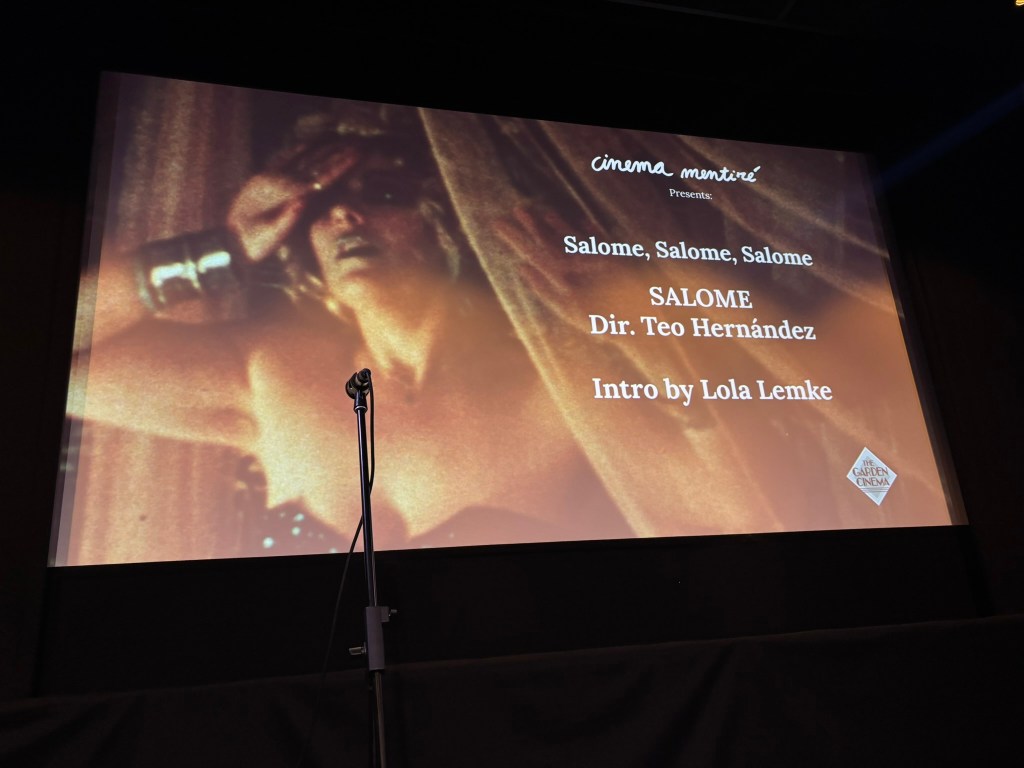
And so, as the London Pride weekend took full swing across the city in early July, it felt only natural to pay homage to every experimental cinema lover’s favourite biblical princess. Salome, Salome, Salome – curated by pop-up film club Cinema Mentiré – featured three acts of extraordinarily dizzying portrayals of the titular character. Each film set in a different era, each director from a different part of the world, Cinema Mentiré conjoined the three choices after conducting research for another programme in 2025 and being introduced to the unashamedly rom-com-melodrama-sci-fi Salome (2024) by Brazilian queer-led collective Surto & Deslumbramento. A film recommendation and a few watch parties later, they finally had their headliners at a time when London appeared to be in its own Salome fever with cinematic renditions of the biblical figure screened across the city (including Films Are Gay’s screening at Finch Community Cinema previously covered here).
So what better time to bring the Latin American Salome’s to UK screens? Yearning to blend queer analogies with Latin filmography, the club’s founders chose two powerful adaptations of the holy figure from Mexico’s Teo Hernández and Brazil’s André Antônio. Needing a bridge between the two, they found Ken Russell’s deliciously spectacular re-enactment of Oscar Wilde’s play. And thus began a weekend full of elated pride, heartfelt celebrations and bodacious performances from the sharp, glitter-tinted lens of three filmmakers who continue to connect with contemporary audiences.
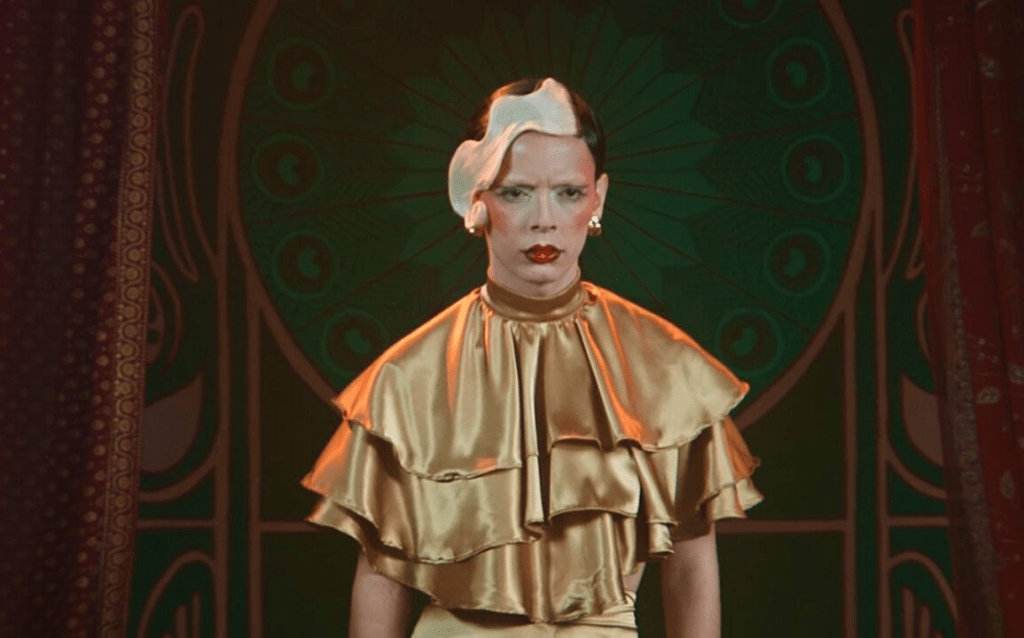
Entering the edge of Covent Garden, guests were welcomed into the cult atmosphere of The Garden Cinema on a sweltering Friday evening for a screening of Salome (2024) by Brazilian filmmaker André Antônio. TGirlsOnFilm associate, Jaye Hudson, introduced the film, outlining that despite the figure’s religious roots, Salome belongs less to scripture than she does to art as this queer-led season will go on to prove.
Relocating the biblical legend to a working-class neighbourhood, the film follows a young successful model Cecília, who returns to her hometown of Recife to spend Christmas with her mother. As she reconnects with her neighbour João, he reveals a bottle containing a mysterious intoxicating substance deemed a brat-green colour. Shortly after, the model begins to fall in love with João and discovers his involvement in a secret cult centered on the bejewelling figure of Salome. Antônio draws together romance, science fiction, melodrama and religious imagery to curate an unapologetically campy narrative, whisking the history of trans and travesti performance into a dreamy space for liberation. Instead of painting queerness through suffering or explanation, his Salomé reinvents desire and myth as purely illuminating and displays a great homage to Brazilian travesti culture – moulding together seamlessly with the next two screenings on offer at Cinema Mentiré.
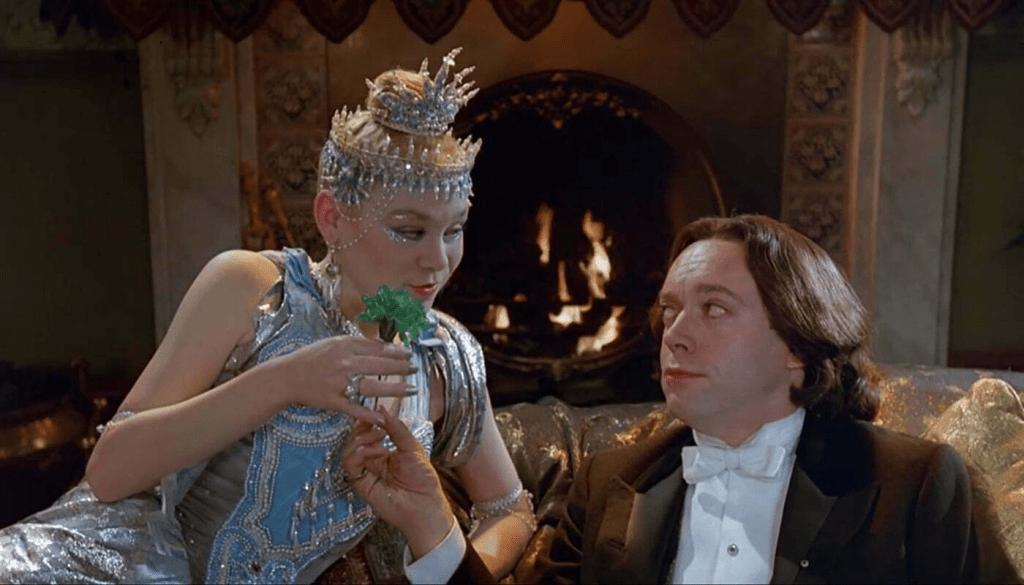
The next day saw a Salome reimagining of equally luminous ferocity, with a 19th-Century English twist. In the Hackney-confines of Rio Cinema, Ken Russel directs an erotic display with Salome’s Last Dance. The film follows a promiscuous Oscar Wilde who, accompanied by his lover Lord Alfred Douglas, attends an illicit performance of his recently banned work of theatre, “Salome”. Drag King, Loose Willis, gave a dazzling introduction to the timeless feature. As if matching the night’s flamboyant screening, our intro speaker was dressed in a striking blue suit and a turquoise feather boa as he described Russell’s avant-garde direction in his filmography as the epitome of drag. For those of us who were getting their first taste of Ken Russell, Salome’s Last Dance was considered a great beginner’s film from the director’s catalogue and would at the very least leave us feeling “creeped out but impressed”, according to Willis.
The play within the film details the story of Herod, his step-daughter and the execution of John The Baptist whilst Wilde, sipping on champagne, wavers towards the sexual advances of a handsome young man. As scenes fluctuated between dark humour and sizzling drama, Wilde’s play combined with Russell’s interpretation paved the way for a queer work of art that celebrates the audacity of uprising against societal norms. Each scene displays an erotic madness of beaming sexuality and charming femininity as Salome herself becomes representative of Wilde’s risky nature, leading to the ill-fate of the Irish writer’s arrest in 1895.
It comes as no surprise though that risk is not unbeknownst to the retellings of the biblical princess as this weekend of film fiascos has unveiled. For Teo Hernández, the gospel story inspired an unusual direction befitted with colourful images and a high camp aesthetic. Seated within a private screening room at The Garden Cinema once more, Lola Lemke introduced Salome (1976) as the closing film of the weekend, bolstering audiences into a cryptic journey where art meets the body. Looking around the room, those in attendance were divided in two. Some had been here all weekend, ruminating in the confines of a biblically-induced experimental season and others had just joined, inquisitive about the pure emanation of Hernández’s Salome.
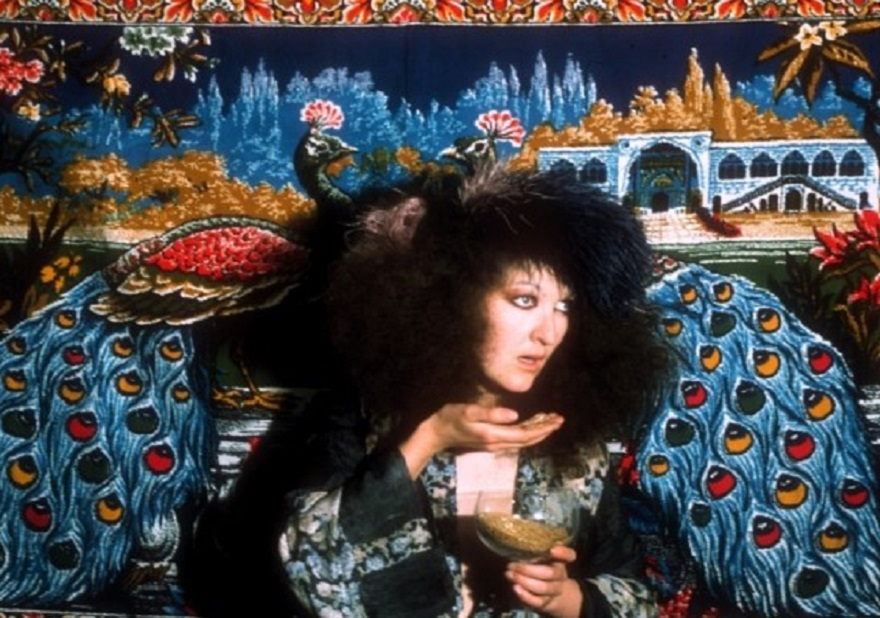
Though this particular reimagining presented a sharp contrast to previous films from Salome, Salome, Salome, its seductive aura revealed itself as the perfect closer. The Mexican director’s outlandish filmmaking is rooted in intimacy as an ecstatic grounding that reaches the body and carries it towards spiritual movement. Salome was largely shot in Hernandez’s apartment, transcending a depthless field where light and colour unite amongst a sensually-charged narrative of bodies. As is the filmmaker’s signature style, the camera becomes an extension of the body – breathing, drifting and pulsing in unison with each character as if Salome herself had possessed the set and those of us in the audience watching.
When credits rolled for each film, I was left with immense gratitude and a bizarre disassociation. There is a beauty that entraps itself within a Salome reimagining by which all three directors manage to encompass so viscerally that once the films are over, reality can’t quite plunge itself back to normal. Experimental filmmaking will polarise itself that way. But for Salome, it will simply recharge whilst symbolising the powerful nature of artistry, performance and desire. Whether it’s through a brat-green envelope of obsession in André Antônio’s modern recreation, the glitter-aided costuming of Salome’s Last Dance, or intimate bodies entrenched in a symphonious dance as was Teo Hernández’s experimental classic. The enchantment of the feminine figure is one plastered in lust, deception and power, as each film’s leads too find themselves wrapped up in, and told boldly in three different eras (or four if we’re counting Ken Russel’s Victorian period setting).
These films navigated a fiery queerness, a tender movement and a magnetic influx of desire from eras that offered a difference of opinion towards each of these themes. From Brazil to the UK to Mexico, infusing the three for this one curated season provokes a touching message in the art of collaboration and cultural immersion. Cinema Mentiré brings not just Latin America to UK audiences, but a myriad of connections between film lovers in age-old establishments that surpass time itself. Speaking to the organisers, I found that they each carry a spark of Salome in themselves as they recall how their summer film curation brought the chance to inspire passion between their own Latin American roots and the Western nation where they breathe these films’ new life. If there’s anything to take away from this experience, perhaps it’s that this is exactly what the movies were made for.
Amal Brepotra (Instagram: @amalbrepotra) is a freelance multimedia journalist based in South London, who blends digital and print storytelling to navigate the rich complexities between culture and media. Her work peruses feminism, film culture and politics, demonstrated in various projects from a self-published zine titled Stigma to a research paper presented at the International Women’s Writing Association Conference on the role of contemporary feminist movements in Me Too Journalism. She can often be found endlessly adding to her Letterboxd watchlist or brainstorming feature ideas in her notes app.


 Culture Film Publication