
by Amal Brepotra
Situated amongst sleek apartment complexes within a subdued business district of Hackney, you’ll find the enlightening Finch Cafe – an easy to spot eatery and event space thanks to its behemoth yellow-birded mascot painted on the blue-soaked sign outside its doors. This is a place far beyond the standard hang-out spot most come to know in Hackney; Finch serves up Middle Eastern delicacies by day and turns into a bespoke hub for inquisitive film screenings by night. Home to its very own Finch Community Cinema, created by film enthusiasts and former cafe employees, Lydia de Matos and Sole Di Capua, the space serves as a dedicated hub for emerging artists and curators in East London to showcase the very best of independent cinema.
Upon entry, visitors are transported into a realm of soft hues and warm lights, unearthing a classic vintage feel that illustrates the owners firm appreciation for the old arts. As I make my way through the entrance, I stop to admire the artisanal setting around me; wooden braised walls lined intrinsically with a selection of old-timey albums and graphic tees for purchase, original paintings of various naturalistic landscapes, an occupied bar covered partially by a queue of people adding to the retro aura of the east side’s buzzing hotspot.
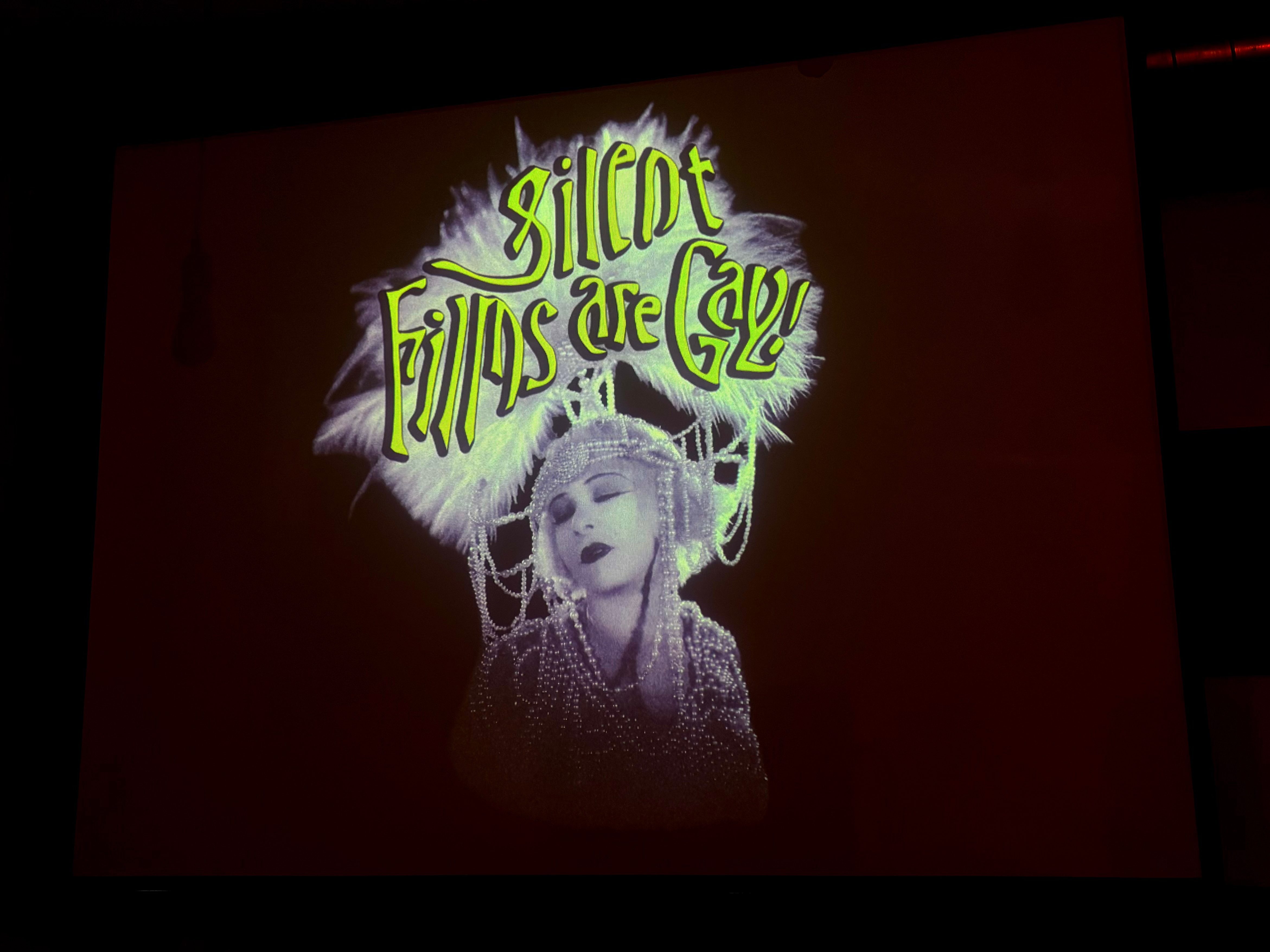
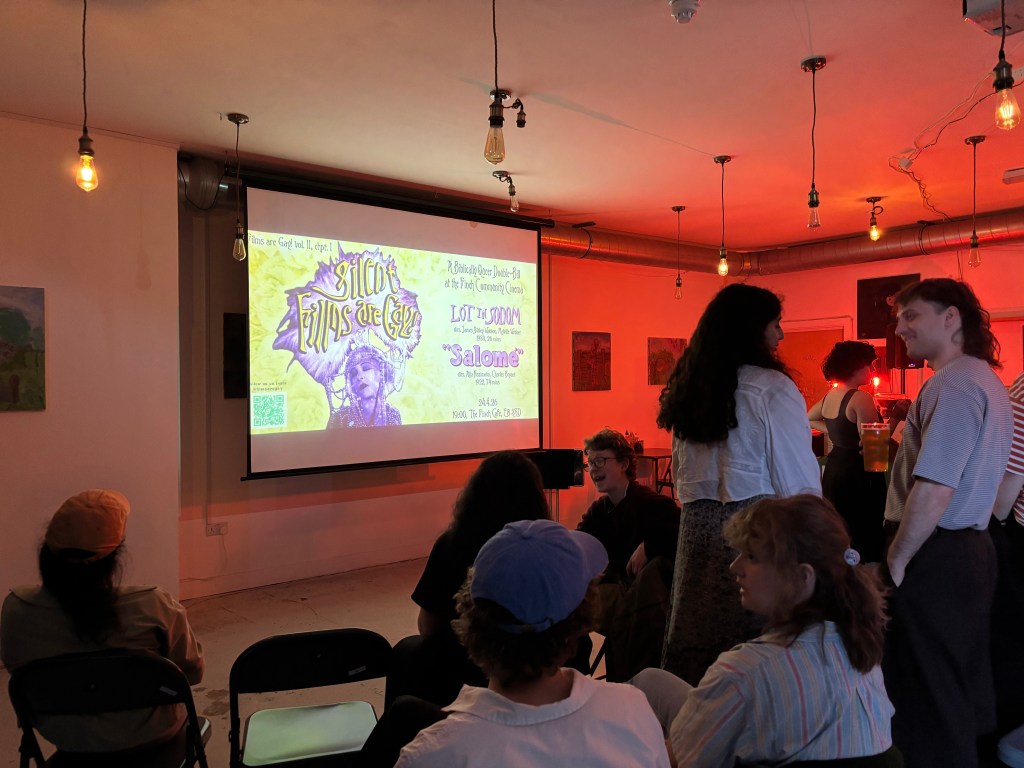
But before I can get wholly distracted by the pristine Arabic-influenced decor of the space, the projector screen located in the back of the room which bellows a loudly artful image of tonight’s event reminds me why I’m here. The place is filled to the brim for Films Are Gay’s double bill screening of the iconic classics Lot in Sodom and Salome. I’m warmly greeted by Erik Anderson Scott who started these screenings whilst attending the National Film and Television School but found he wanted more of an inviting space for queer audiences to celebrate queer filmmaking. Since then, Films Are Gay has covered a different genre of cinema each season and currently they are playing a programme titled ‘Silent Films Are Gay’, showcasing classic queer titles of the bodacious era.
As high-spirited attendees run amok and converse their excitement for tonight’s film curation, the energy of Finch is largely inviting, especially if you’ve never attended one of their screenings before. There’s a certain comfort to be found in this place at a time in people’s lives when comfort and belonging are ever-sacred to which Films Are Gay boast a proud credibility to. Guests don’t just come here to watch movies, they come to build community, share stories and find solace in the sanctuary of queer cinema.
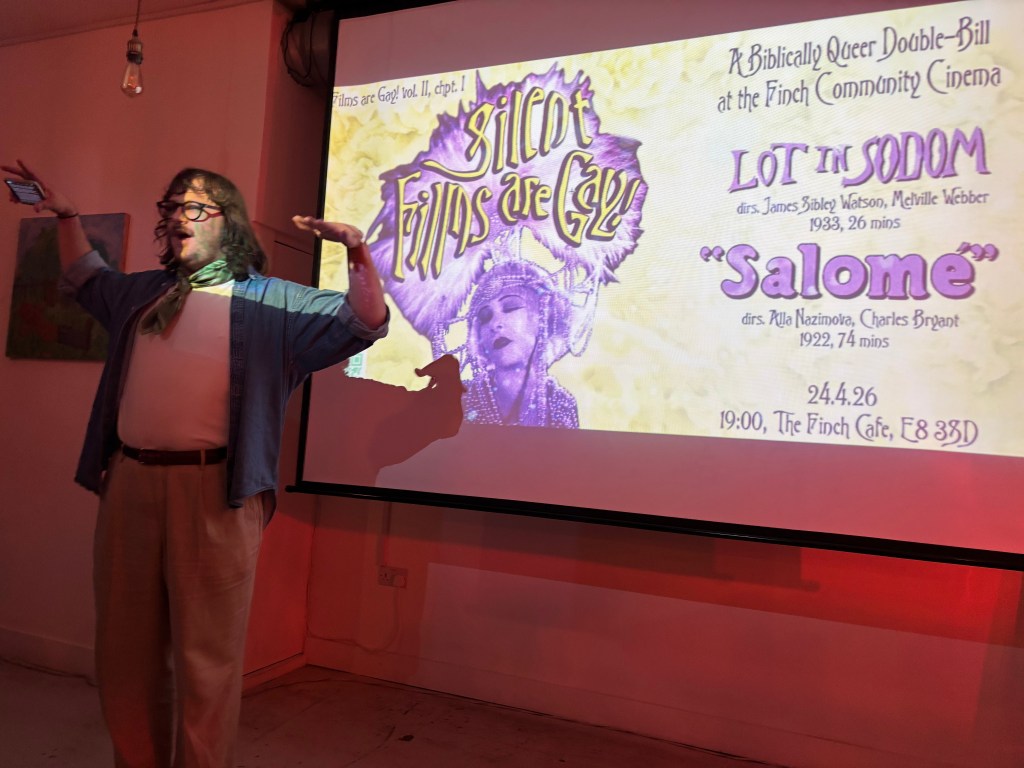
People begin to settle down as our beaming host takes center stage for a short introduction to each film. Lot in Sodom (dir. James Sibley Watson and Melville Webber) is our first of the evening, described as “an avant-garde delight to the eyes” to quote Erik. The short silent film is an experimental, sensual piece retelling the biblical tale of Sodom and Gomorrah that utilises abstract techniques, provocative, oneiric visuals and strong allusions to sexuality which Sam Staggs describes in The Gay & Lesbian Review as “a balletic, cubistic, expressionistic, phallic dream.” An early instance of a split-screen image, the film opens in the clouds above Sodom with that grainy feel-good quality of the silent movie era. The city finds itself overcome by sin where young, half-naked men perform in a steamy, ballet-style orgy. The only innocent is Lot, who shies away from the perpetual lustful acts of his neighbours as an angel appears before him, imploring Lot to escape the city with his wife and daughter before it is inevitably destroyed by flames. Paired with its visceral imagery and eerily transcendental symphony, Lot in Sodom inhabits a gruelling homoerotic decadence that echoes fragments of modern queer liberation. It leaves a flavourful taste to Finch’s audiences, who all sit in tranquil quietness thus respecting the laws of the silent film for our eyes appear only glued to the erogenous movements on screen as we approach the climactic finale where a frenzy of blood and bodies and pure biblical carnage ensue.
When the credits roll and the lights are steadily turned back on, thunderous applause breaks the half-hour silence and Erik has made a frantic return to the front. In that moment, it feels clear to me that this is more than just a passion project for the cult film enthusiast; it’s a boldly sentimental reality that turning a niche interest into a weird and wonderful collective is perhaps what these films were truly made for. As soon as he tells us the time for a quick interval is now, the ecstatic atmosphere returns once more. Conversations find themselves twirled around the captivating effects of Lot in Sodom and I find myself suddenly captured too by the eloquent innovation presented in one of the first of American avant-garde cinema. However, as eccentric as Watson and Webber’s movie is to the queer analyses of the night, eagerness really awaits for the next curation that according to Erik is “the big one.”
Salomé (dir. Charles Bryant and Alla Nazimova) sits as the spectacle to which religion plunges itself into the declaration of queer anthology with leading star Nazimova hailed as the “mother of sapphic Hollywood.” That title is not reserved for just anyone, given that the Russian-born actress and director has brought a myriad of nonconforming elements throughout her career from experimental filmmaking to a lavender marriage with her co-director, Bryant. Not only was Nazimova adapting a controversial play by Oscar Wilde, the one standing rule of making Salomé was that each cast member must be queer. Yet this audacious demand found itself pocketed when Nazimova had trouble finding support for the film before making the ultimate decision to fund it all herself. In spite of the gregarious work she put in, the film suffered poor reception within Hollywood during its 1922 release and the sapphic director found herself at the heart of a smear campaign, leaving her bankrupt and out of the Hollywood picture for good. Though Erik does remind us that whilst the film elaborately alludes to darker tones, it’s important to note that Nazimova’s framing of enslavement in her picture calls for nuanced conversations around her role as a white filmmaker. Still, the piece serves as a fathomable work of queer art, created by a queer woman who put everything she had into it that Erik pays admirable homage to stating, “while most audiences did not appreciate that sacrifice then, we will honour that sacrifice tonight.” And so, we did.
Compared to Lot in Sodom, Salomé enters with charming symphonies and overly-colourful framing to tell the biblical story of King Herod and his execution of John the Baptist at the request of Herod’s stepdaughter, Salomé, whom he lusts for. It breaks my heart a little for Nazimova and queer audiences back then that the film was not appreciated upon its release when its alluring flamboyance journeys across each scene stylishly, matching the effervescence of each character who renders this current audience humoured. Though Nazimova was 40-years-old at the time of filming, the subtle control of lighting in production plus the actress’ boisterous movements and behaviours, remarkably captured the physical essence of a 14-year-old, feeling as close a resemblance to Catherine Earnshaw; a great duality of infantilising femininity and elements of horror. But what Salomé extravagantly portrays is through its queer undertones and seductive choreography that not only sway the attention of Herod but also all of us sitting in Finch, as the film reaches further into its dramatic pinnacle when Salomé performs a deceptive dance for her stepfather. Nazimova graces the wrath, liberation and cruelty of a woman scorned that has those of us watching in a silent hypnosis. As the leading lady’s portrait zooms slowly onto the projector screen to conclude this night of ‘Silent Films Are Gay’, a newfound admiration for the silent movie overcomes me.
Maybe it was the late night exhaustion or the delayed processing of the film’s powerful symbolisms, but the crowd were not feeling particularly fueled by discussion. Not to say Salomé did not move us – it certainly couldn’t help itself but to – there was simply just a wave of tranquil understanding in this elaborate masterpiece amongst those of us in attendance. In a formidable sense, some words are just better left unsaid.
Queer filmmaking has a way of evoking the deepest, most arduous feelings that bring together innovative ideas and timeless bondings which never fail to astound me. What Films Are Gay and Finch Community Cinema have done offers more than just a reflection on the beginnings of queer cinema but rather, allows attendees to find solace in the abnormal. It’s understandable why these two films were chosen given that the filmmakers behind them faced queerhood in a world that celebrated much less to the overall arches of liberated sexuality expanded on within their movies. Perhaps they were not appreciated back then, but they are most certainly now and if there’s anything to take from this evening it’s that the quirkiest art is almost always the most crucial. Both Lot in Sodom and Salomé deliver a fresh perspective on visual storytelling to captivate and entrance, much like what the ambience of a night with Films Are Gay brings to anyone fortunate enough to sit in on one of their specially-crafted screenings.
Amal Brepotra (Instagram: @amalbrepotra) is a freelance multimedia journalist based in South London, who blends digital and print storytelling to navigate the rich complexities between culture and media. Her work peruses feminism, film culture and politics, demonstrated in various projects from a self-published zine titled Stigma to a research paper presented at the International Women’s Writing Association Conference on the role of contemporary feminist movements in Me Too Journalism. She can often be found endlessly adding to her Letterboxd watchlist or brainstorming feature ideas in her notes app.


 Culture Film Publication