by Laura Barnes
Read Part 1 here.
Merkurio
“You have a black heart!”
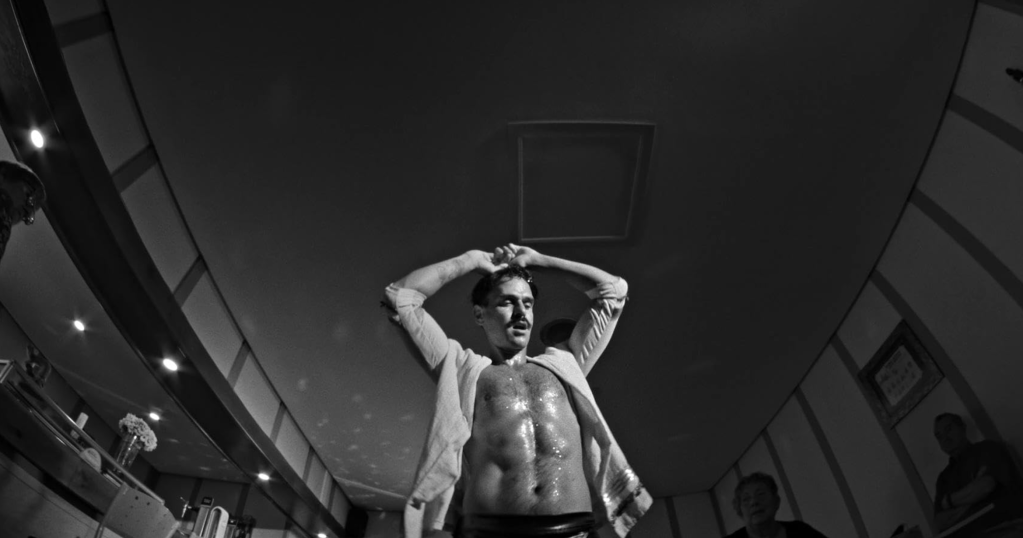
Sébastien Pesle’s Merukurio is a curious little thing. With its minimalistic dialogue and its black and white colouring, it’s almost like a Charlie Chaplin film – that is, if Charlie Chaplin starred in movies about male escorts getting kidnapped and enslaved by witches. Lead actor James Furrux certainly seems to be channeling his inner Charlie Chaplain as he prances, scuttles and wails his way through these twenty-four minutes with the bombast of a Saturday Morning cartoon character. Furrux’s silliness really helps to boost scenes that would have otherwise fallen flat, particularly at the start of the movie (did we really need five minutes of Merkurio seducing old women? I’m not so sure).
Merkurio truly gets interesting (read: profoundly fucked up) when the witch arrives. Olga Martínez is our La Sorcière, and she’s a real, meat-and-potatoes witch. None of this energy and vibes and incense stick nonsense – La Sorcière makes potions out of toad legs and can cast a spell with a single, knarled finger. With a comic book campiness and a soundtrack that could be pulled straight out of a Hammer Horror, Merkurio is a must-see for fans of folk-horror (…and anybody who finds the word ‘Abracaboner!’ funny).
Touch Grass
“Who’s to say I can’t become the monster?”
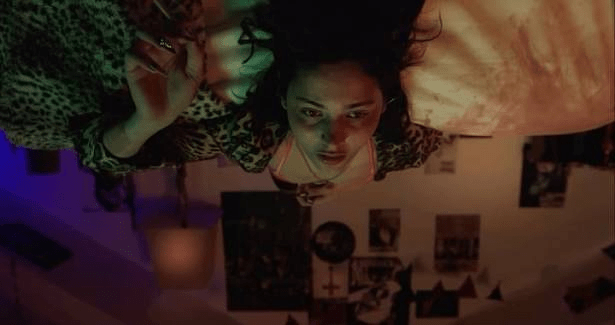
One room, one actor, and a lifetime’s worth of rage. Watching Layla Furlong’s ‘Touch Grass’ is a lot like watching Fringe Theatre. Furlong takes a simple premise and uses it to provoke and unsettle anyone who may be watching. We meet a young woman in her bedroom, smoking a cigarette while the corpse of boyfriend lies on the ground next to her. She is tearful at first, but then the tears give way to a hard defiance. Clad in bloodstained leopard print, Alice Lamanna is a force of nature as she slowly chooses to reject any feelings of guilt. Because it wasn’t a crime; it was an act of self-defence.
The value of rape-revenge movies is something that has been hotly debated by feminist film critics. Films like I Spit On Your Grave and The Girl WithThe Dragon Tattoo are criticised for prioritising shock value over genuine emotional catharsis. Such films often portray rape as an individualised act of violence that occurs in isolation from wider patriarchal structures. There are Good People and then there are Rapists, and it is up to The Protagonist to punish said Rapist. What separates Touch Grass from other rape-revenge movies is the complexity with which it views the topic of sexual violence. You can kill the rapist, Furlong argues, but it is much harder to kill the power structures that create them.
It’s also worth noting that Intereference Fest marks the first ever cinema screening of Touch Grass. The company’s willingness to take a chance on something so new is a good omen of things to come. By opening the door for this film, Interference are taking steps towards becoming kingmakers of indie cinema.
Nothing At All
“What do you think is under there? What do you think is under you?”
A common argument made by fans recently is that movies are dumbing themselves down.
From the most recent remake of Black Christmas to the absolutely diabolical slasher They / Them (naturally pronounced ‘They Slash Them’), a lot of 2020s horror seems to have an underlying fear that audiences won’t ‘get’ it. “Don’t you see?” The films plead with us. “The REAL horror is _____.” You can fill in the gap as appropriate. It could be grief, capitalism, sexism, racism – did we mention grief?
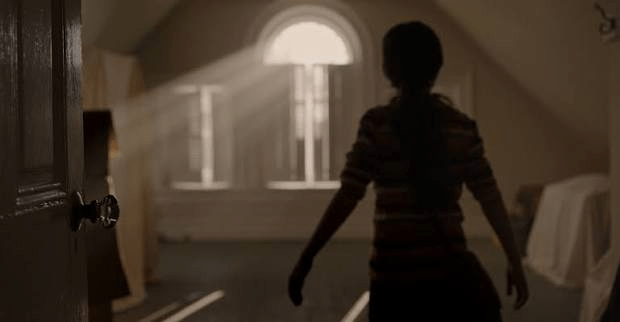
Which is why Nothing At All feels so refreshing. Director Leszek Cygan trusts in the viewer’s intelligence and curiosity enough to turn the next nine minutes into a compelling mystery. We meet our two protagonsts on a busy London street, huddled under an umbrella. The guy tells the girl that he loves her; the girl whispers that she loves him too. But there’s something not quite right about the girl’s confession – in fact, there’s something not quite right about any of this.
Through clever use of special effects, cinematography, and silence, Cygan begins to paint a portrait of The Wrongness that bleeds into every moment of the female protagonist’s life. Tender moments dissolve into static, and cameramen hide in the corner of her bedroom. While the viewer never truly knows what exactly the female protagonist is going through, we do know how she feels: empty. The puzzle of her emptiness is left for the viewer to solve. Is it depression? Dissociation? Or is it simply the feeling of realising that she’s abandoned herself for the sake of this relationship? Whatever it is, it’s enough to make you ponder your own emptiness, enough to make you ask yourself, “When was the last time you did something you REALLY wanted to do?”
Fister
“This is a very bad baby! Very bad!”
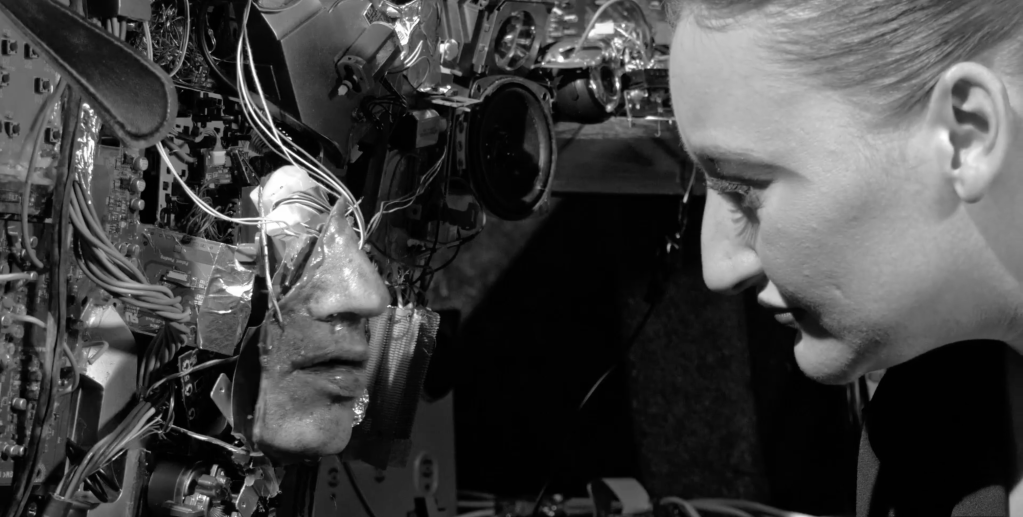
Should I take a shower? Seek psychiatric help? Hand myself in to the nearest police station? These were the questions I was asking myself as I watched Adam (played by Laurence R. Harvey, of Human Centipede fame) thrusting himself in and out of his built-for-sex computer. Of course, it is unlikely that Fister is the only film about Human / Robot Sexual Relations to come out this decade (current debates about AI companions make it ripe territory for filmakers), but I am willing to bet that it is the only movie in which said sexual relations lead to the creation of a 3D printed baby.
What follows is a bewildering assortment of modern day horrors. There’s an AI Pediatician, a streamer that forces people to vomit on camera, and a landscape so grimey it could only possibly be the North of England. Yet despite its depravity, Fister does have a heart. When the 3D printed baby is finally born(?), Adam rebuilds his life with a new sense of purpose. For the first time, we see him develop a bond that isn’t negotiated through a screen.
While I was a little on the fence about it personally – such is my fragile disposition – its edge and cynicism certainly won over the crowd at Interference Fest, and the film took home the Day 2 ‘Best Short’ prize. A big well done to director Anthony Moran, and the rest of the team!
Schramm
“Good morning. Have you ever really thought about God?”
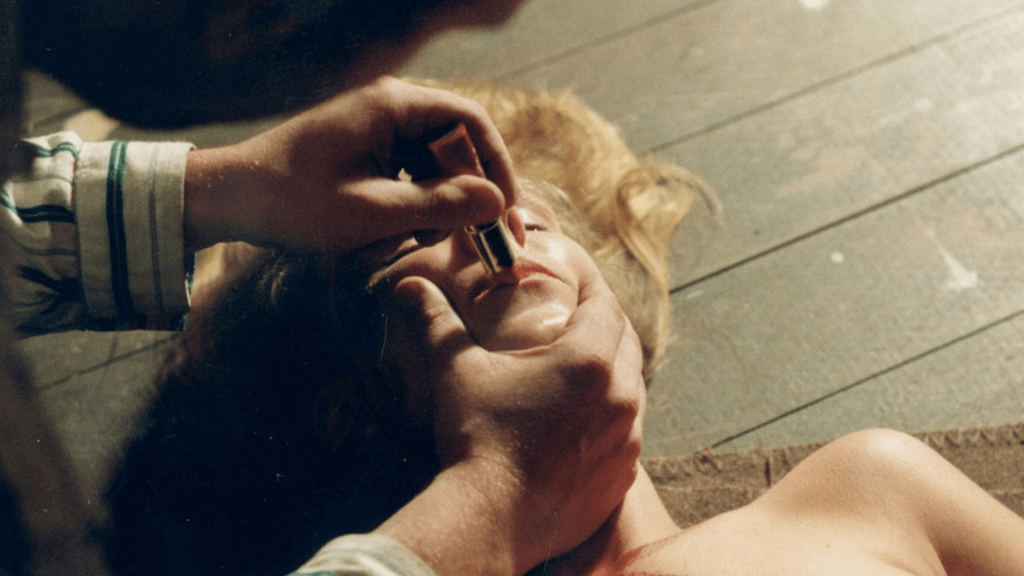
With the short film block all done and dusted, Interference decided to throw us all in at the deep end with Schramm. We’ve seen a lot of depravity over the weekend, but none of it even comes close to German director Jörg Buttgereit’s Schramm. Schramm follows the last few violent days of (fictional) serial killer Lothar Schramm’s life before his startlingly mundane death.
Schramm is an odd choice for a Horror film festival. At some points, it feels like a Psychological Thriller, and at others it feels like some kind of stilted true crime re-enactment. In its vilest moments, it feels like watching somebody through their webcam. We see him make awkward conversation with his neighbour before going hope to violently murder two door-to-door evangelists. We see him let out a long, weary sigh before cleaning up the blood. Later, we see him do something so terrible that it makes the male half of the audience cover their eyes in disgust.
Schramm paints a vivid portrait of Lothar Schramm’s self-hatred, but never musters up a convincing explanation for why it is painting this portrait. Are we supposed to laugh at him? Feel sorry for him? Or are we simply supposed to sit there, mouths agape at the sheer awfulness of him? A part of me has a strong suspicion that it was the latter. At the risk of sounding harsh, shock is the last resort of a writer with nothing to say.
To quote philosopher Simone Weil, “imaginary evil is romantic and varied; real evil is gloomy, monotonous, barren, boring”. As ambassadors of Real Evil, serial killers are deeply boring. They are, for the most part, pathetic and cowardly men. At this, props must be given to Florian Koerner von Gustorf for his magnificently mundane portrayal of the baby-faced Lothar Schramm. He plays the murderous taxi driver with the world weariness of, say, an overworked IT consultant – I can’t think of anything more fitting.
Ticks
“They call me Panic, because I never do.”
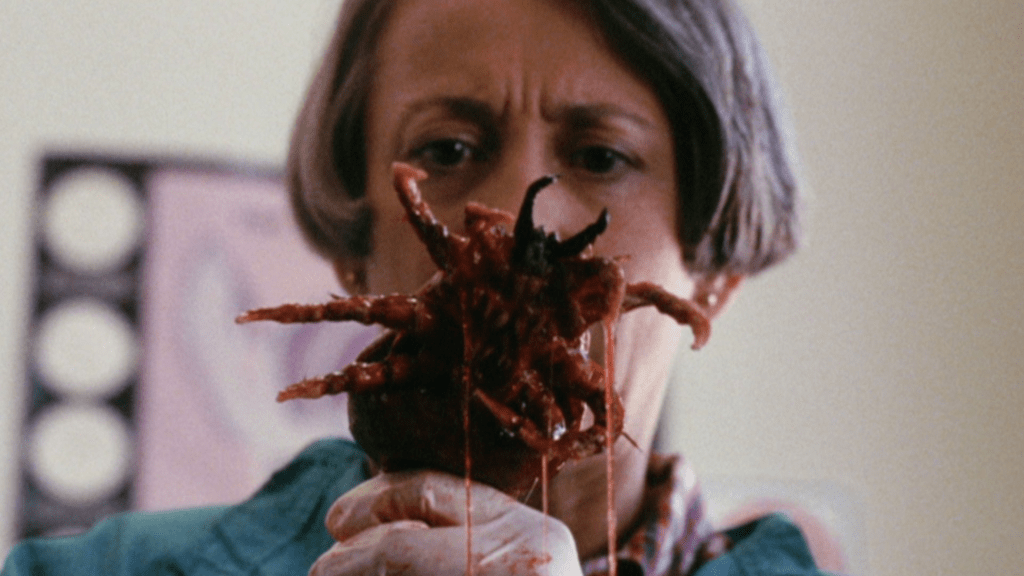
With the bad taste of Schramm still lingering in everyones mouths, we were in dire need of a palette cleanser – and boy, did Ticks provide it! A young Alfonso Ribeiro and baby-faced Seth Green star in this 1990s creature feature about a teen nature retreat gone awry when the group are hunted by a mob of chemically enhanced megaticks. It’s like Buffy the Vampire Slayer meets Alien, and luckily the special effects lie more on the Alien end of the spectrum.
This is the Horror movie fans equivalent of hot chocolate and marshmallows. It’s cheesy, it’s predictable, and it even gets a few laughs (mostly due to the efforts of Ribeiro). Had this movie had a couple more script rewrites and a more generous runtime, it could have easily been a classic up there with other 1990s teen classics such as The Faculty and I Know What You Did Last Summer. But still, one can easily enjoy this film for what it is: a campy romp through tick-infested woods, and a perfect palate cleanser.
Anatomia Extinction
Anatomia Extinction was undoubtedly the highlight of Interference Festival. Yoshihiro Nishimura’s 1995 debut is everything that independent cinema is about: telling stories that nobody else would dare to tell with a limited budget and unlimited imagination.
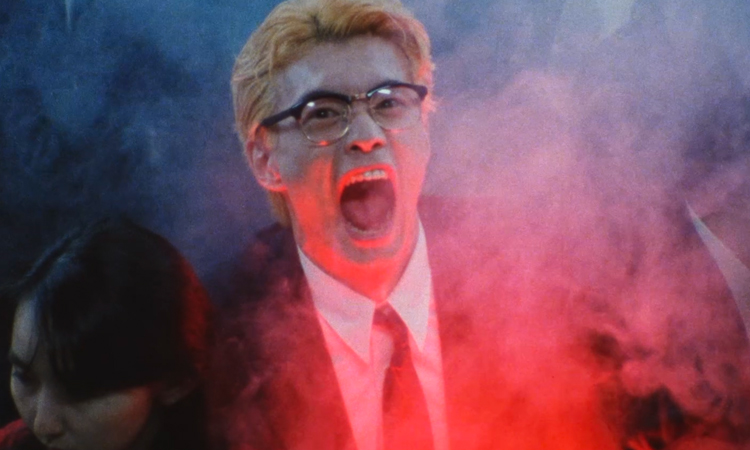
Kisei Ishizuka is the average salaryman. He spends his days doing menial office work, navigating Tokyo’s overcrowded subways, and watching increasingly violent news reports on his television (special shout out to Tomoko Haseyama for her increasingly unhinged performance as the BCG News Anchorwoman). Yet we can tell that Ishizuka’s salaryman secretly yearns for more. We see it in his bleach blonde hair, his desperate attempts to connect through sex, the dismal look on his face as he trundles through Tokyo’s increasingly crammed streets. He is a man who yearns for purpose, and that purpose finds him an empty subway station one late night.
After witnessing a brutal murder, the salaryman is recruited into a sinister group known only as ‘The Engineers’. Tasked with the mission of reducing Japan’s overpopulation, Engineers discarded their humanity in order to become living weapons. Lose a hand? If you’re an Engineer, you’re in luck! You can simply grow a gross, fleshy sword from the stump where your hand used to be. Convenient, huh? This is far from the purpose that Ishizuka’s salaryman had in mind for himself, and we see him try to fight it at every turn. His fate is inevitable, and we can see the end approaching with every seeping wound.
While Tokyo Gore Police is undoubtedly Nishimura’s most famous work, Anatomia Extinction is certainly his most visionary. With its noir sensibilities, grungey set design and gore that errs just on the side of believability, Anatomia Extinction feels like the work of an auteur, free from any and all corporate contraints. It’s a work of antifacist body horror that perfectly encapsulates what it means to lose yourself, to live in a society that slowly strips every choice away from you. Spectacular.
Tokyo Gore Police
“Say NO to Harakiri in the workplace!”
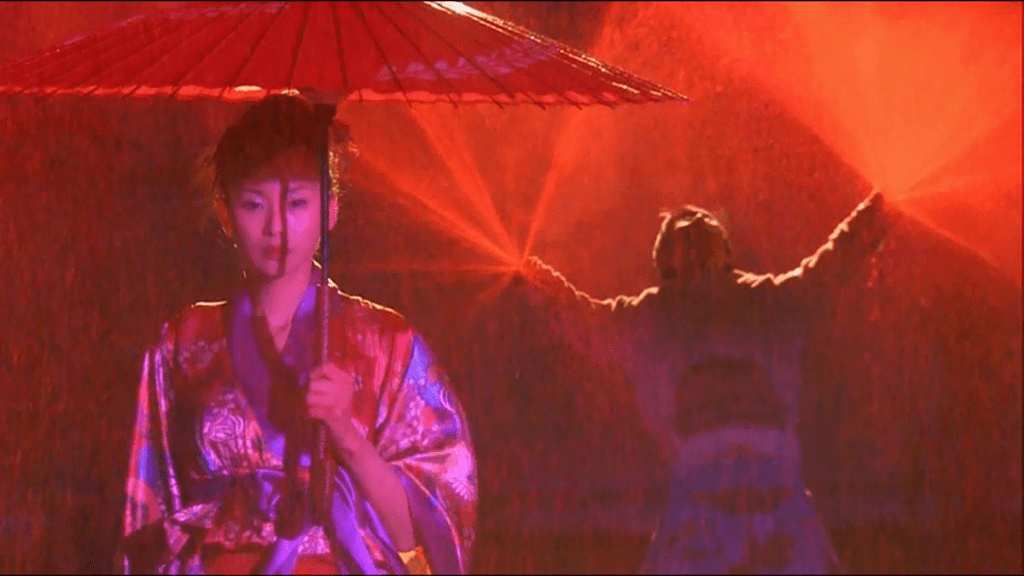
If you looked up the term ‘Cult Classic’ in the dictionary, the words Tokyo Gore Police would appear right next to it. Tokyo Gore Police has long held a sacred spot in the underground Horror hall of fame, and why wouldn’t it? It has samurai swords! It has chainsaw battles! It has a woman with snipers for arms! And the slaughter – oh, the endless, silly, nonsensical slaughter! It’s the product of an imagination injected with nightmares and raised on Starship Troopers, and the result is what is undoubtedly the most bizarre and unserious movie I have ever seen.
Building upon the mythos first established in Anatomia Extinction, Tokyo Gore Police follows Ruka, a proud member of the newly privatised Tokyo Police Force. For Ruka, becoming a police woman serves two purposes. The daily battles with the monstrous engineers acts as a welcome distraction to her self-destructive urges, and her proximity to the senior members of the force brings her closer to finding the officer who ordered her father’s state-sanctioned murder. When an Engineer inserts a key shaped tumor into Ruka’s arm, her mission for revenge is given a time limit – it’s only a matter of time before her body mutates and she becomes one of the Engineers that she’d dedicated so much of her life to chopping up. But it isn’t all doom and gloom! Segways include Wii-Sports style remote executions, surprise birthday parties, mutant strip clubs, and what might be the bloodiest bar fight ever committed to film.
The world of Tokyo Gore Police is nightmarish and absurd. But isn’t the real world also nightmarish and absurd? When we enter Nishimura’s nightmare House of Mirrors, we’re confronted with the worst aspects of our own society – no matter how warped or silly or twisted our reflection may be, it’s still our own eyes staring back at us…
Anyway. That concludes the second and last day of the first ever Interference Festival. I feel renewed. I feel educated. I feel, somehow, as though I have grown as a person. Interference aren’t just hosting screenings, but providing a public service that enlightens the populace. Whatever nonsense Interference decide to screen next, I know I’ll be first in line for a ticket.
Laura Barnes (Instagram: @maamowar / @absolutedestinyapocalypse) is a freelance writer obsessed with the horrors and joys of ordinary life. She has written for publications such as Cafe Lit, Stat Magazine, and Ever Metal, and spends entirely too much time thinking about Vampires.


