by Laura Barnes
Depravity merchants Interference Films are back, and this time they’ve taken over Manchester’s Cultplex Cinema for a whole weekend. The result is a room full of black t-shirts, skull tattooes, and Grindcore bursting from the speakers. We’re lightyears away from Sundance with this one, folks. Interference Fest is about showcasing the best and the worst of Horror throughout the decades, and the result is a weekend jam-packed with gore, splatter and terror.
Note: I was unable to catch the final two movies of Day One – Singapore Sling and Inside – due to some personal commitments (I had to return some video tapes). If you would like to know more about these movies, you’ll just have to head to Afflecks and ask the Interference gang yourselves.
Auntie Lee’s Meat Pies
“Women! Are! Inferior! Men! Are! Superior!”
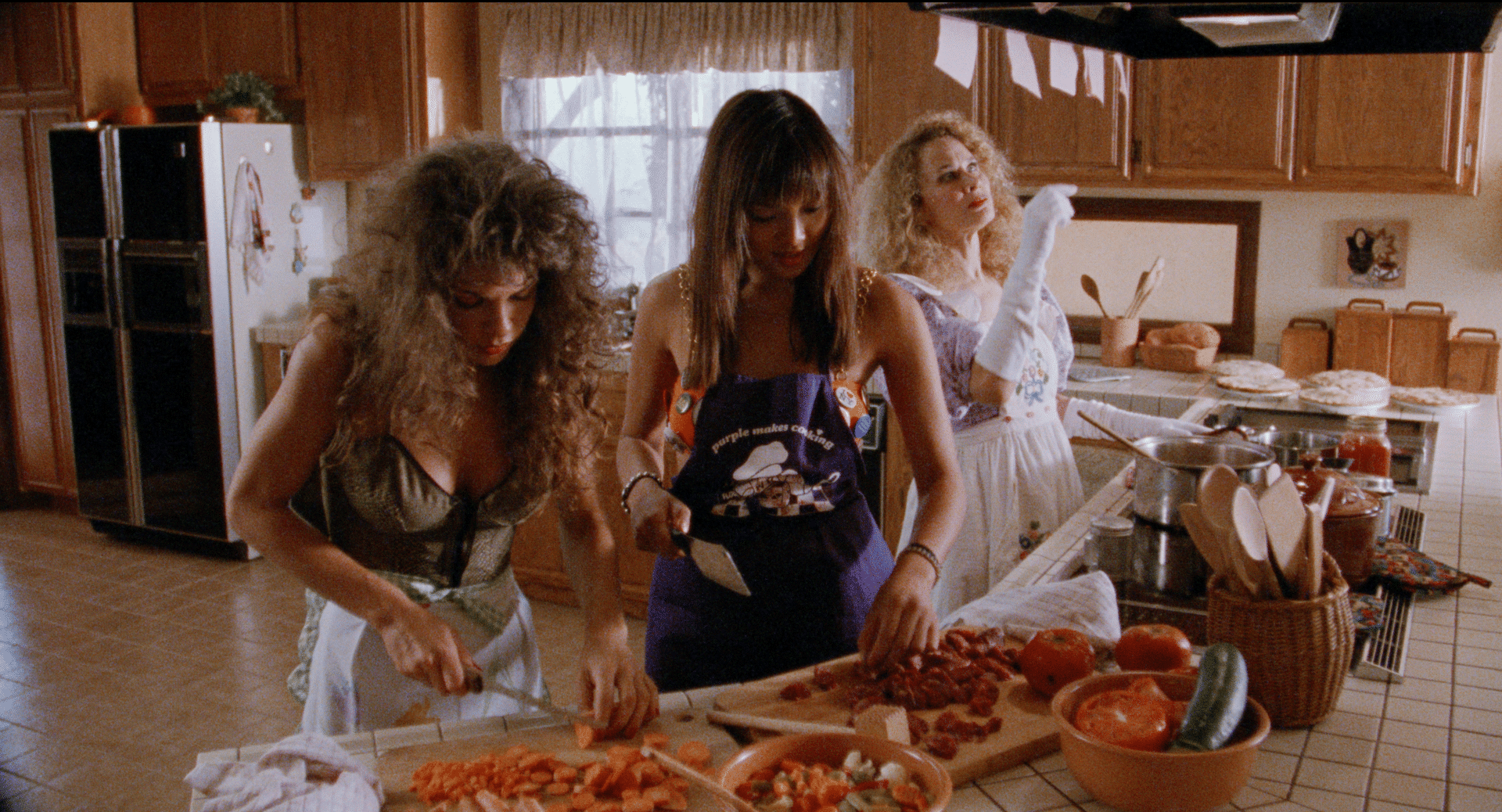
Apply lipstick, drive badly, kill rapists. Auntie Lee’s Meat Pies follows four young women and their Auntie as they stab, shoot, poison and drown any man dumb enough to wander into their patch of Southern farmland. And how do they sustain this lifestyle, you ask? Their homegrown, family-run meat pie business, that’s how! Just, uh, maybe don’t ask what’s in the pies…
There isn’t a whole lot of plot to speak of here. There’s murder, there’s jokes, and there’s ironic 1950s domestic kitsch. Despite the neat hour and a half run-time, the kill scenes are surprisingly drawn out, and the mind can’t help but wander. I find myself thinking about how Auntie Lee’s Meat Pies dramatises the sociopolitical conflicts that divide America both then and today. It’s rural against urban, men against women, and director Joseph F. Robertson against the very concept of taste and decency.
Could it be that Auntie Lee’s Meat Pies predicted – nay, ushered in! – the Girl Power movement of the 1990s? Did this quintet of cannibal nieces inspire the Spice Girls? My mind races, unable to keep track of the infinite ways in which this straight-to-video slasher movie has revolutionised both feminism and the movie industry as a whole… Until one niece opens the pantry to reveal a collection of severed man-hands, and I promptly forget all about pretending to be an intellectually curious person. A smarter cultural critic than I could probably pull some sort of nuance or lesson from Auntie Lee’s Meat Pies, but I’m not sure this movie was made with intellectuals in mind. By the time Glam Metal guitarist Craig gets impaled by a giant snake statue and the credits begin to roll, I am left feeling dazed, bewildered and… Slightly hungry?
Hollywood Chainsaw Hookers
“What’s the matter? Chainsaw got ya tongue?”
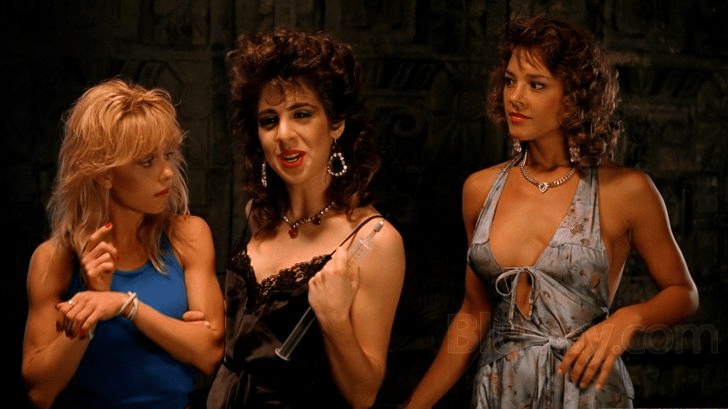
Private Detective Jack Chandler is having a bad day. What started out as a simple missing person’s case devolved into a madcap adventure in which a chainsaw worshipping cult attempts to… Um… Resurrect the Ancient Egyptian Chainsaw God?
I went into this expecting a standard 80s chop-em-up affair – there’d be one or two chuckles, a few eyerolls, a slight questioning of my life choices – but instead I get one of the craziest cinema experiences of my entire life. The movie is propelled forwards by Detective Chandler’s lightning-quick noir-style monologues, complete with all the sleaze and misogyny that no self-respecting Hollywood PI would be without. “You coulda knocked me over with a pubic hair,” he says, when given the sombre news of yet another chainsaw related death. Later, when the Chainsaw High Priest introduces himself, a wounded Jack Chandler simply quips, “So what do you do, pray to Black and Decker?”.
Against all odds, Hollywood Chainsaw Hookers is a successful parody that rips to shreds both the Slasher and Crime Noir genres. Though it pains me to admit it, I would happily watch another twelve Jack Chandler movies.
Short Film Block
Interference Festival isn’t just about screening forgotten classics. As champions of independent cinema, the great folks at Interference are committed to building platforms for the newest names in Indie Horror. As part of this mission, they curated a two-day short film block to showcase the freshest releases in both Local and International scenes. This proved to be the highlight of the entire festival. In the midst of mad-cap gore and 80s schlock, it was consistently the short films that sparked the most discussion, debate and excitement among the attendees. More of this, please!
Donor
“It can’t stay empty. You have to put something there.”
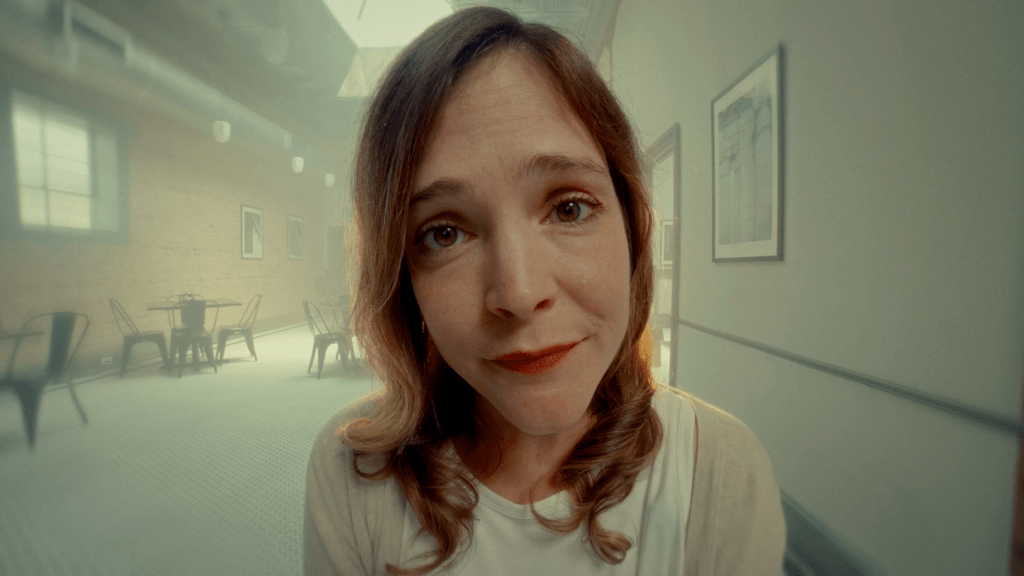
Emptiness is everywhere in Wesley Boone’s Donor. From the cafe to the suburbs, the world Boone’s characters inhabit is dominated by space and silence, by the creeping sense that something important is missing. The most significant void, however, is to be found in the empty crib belonging to our main character, Beth. After tracking down the recipient of her stillborn baby’s heart, Beth becomes convinced that her child never actually died at all. Instead, she starts to believe that her child was stolen.
Donor is crafted with empathy at its centre. Every choice draws us deeper into Beth’s paranoid world, and this is particularly evident in the scenes between Beth and the mother of the donation recipient, Julia. The camera stares uncomfortably into Julia’s face as Lucy Faust delivers a deeply unnerving performance that sends your gut instincts reeling.
Overall, Wesley Boone and lead actress Gordy Cassell do a spectacular job of portraying the specific type of misery that morphs other people’s happiness into a threat.
The Bothy on the Cold Mòr
“Hello? Are you well? I’m really worried.”
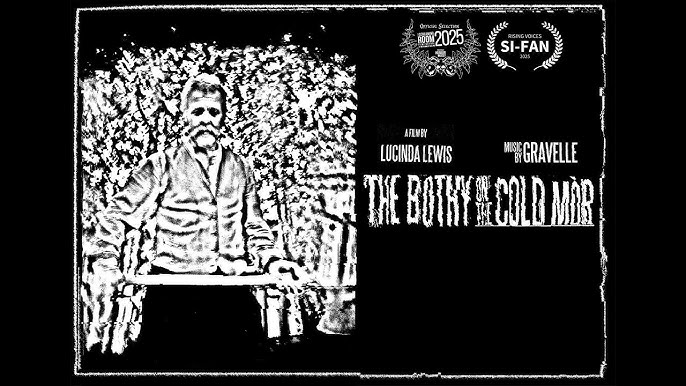
Lucinda Lewis heard the phrase “show don’t tell”, and took it as a challenge. The line above is one of only two portions of dialogue in this film, the other being a TV news report that details the six month disappearance of a twenty-five year old woman. The rest of the tale is told to us through a day in the life of an old man with haunted eyes. He chops firewood, feeds his sheep, and rips and eats a poster of the missing girl. The lack of dialogue is compensated for through the film’s eerie soundtrack, courtesy of ambient music project GRAVELLE.
The Bothy on the Cold Mòr feels more like a poem than a complete story, and would have benefited from being a tiny bit more forthcoming with the mystery at the film’s heart. It does, however, ask some fascinating questions. How does shame feel? What does guilt look like? Where other Horror writers may have chosen to sensationalise it with self-flagellation or random bouts of weeping, Lewis chooses to focus on the mundanity of guilt. Life goes on, whether your soul is stained or not. Perhaps that is the most horrifying prospect of all.
Favela Amarela
“The entire community benefits from the removal of these people.”

Is there anything more terrifying than apathy? This debut movie from Thiago Tuchu and Nícolas Lobato argues that no, there isn’t. Death and tragedy make up the everyday landscape of our protagonist, Damião. By day, Damião works as a cashier in his favela community; by night, he works security for a local drug gang. Both jobs force him to bear witness to the horrors that regularly tear through his community. The police murder his neighbours without consequence, and his grief-striken mothers weep openly in the streets. In the midst of these daily brutalities, Damião begins to notice an even stranger horror lurking beneath the surface. Why has an NGO suddenly become obsessed with Damião’s favela? And what does it have to do with the cloaked figures sneaking through Rio de Janeiro’s back streets?
Favela Amarela’s strength lies in its subtlety. There are no cheap tricks to be found here, no gimmicky soundtracks, and (for the most part) no abstract cinematography. Instead, the camera moves like it is filming a hard-hitting realist drama. Tucho and Lobato aren’t afraid to linger on a face or landscape, resulting in a viewing experience that feels grounded in real time and emotion. With little in the way of special effects, Favela Amerela relies on atmosphere and dialogue to create dread. Tucho and Lobato understand the number one rule of Horror: the scariest monster is the one that you don’t see.
Favela Amarela is a refreshing entry into the Cosmic Horror genre that cleverly weaves together Lovecraftian themes of man’s insignificance and the colossal power structures of colonialism and capitalism. This is a haunting tale that will linger in the mind for some time.
Dead on Distribution
“Do something that will get the Press’ attention. Pick a fight. Fake your suicide.”
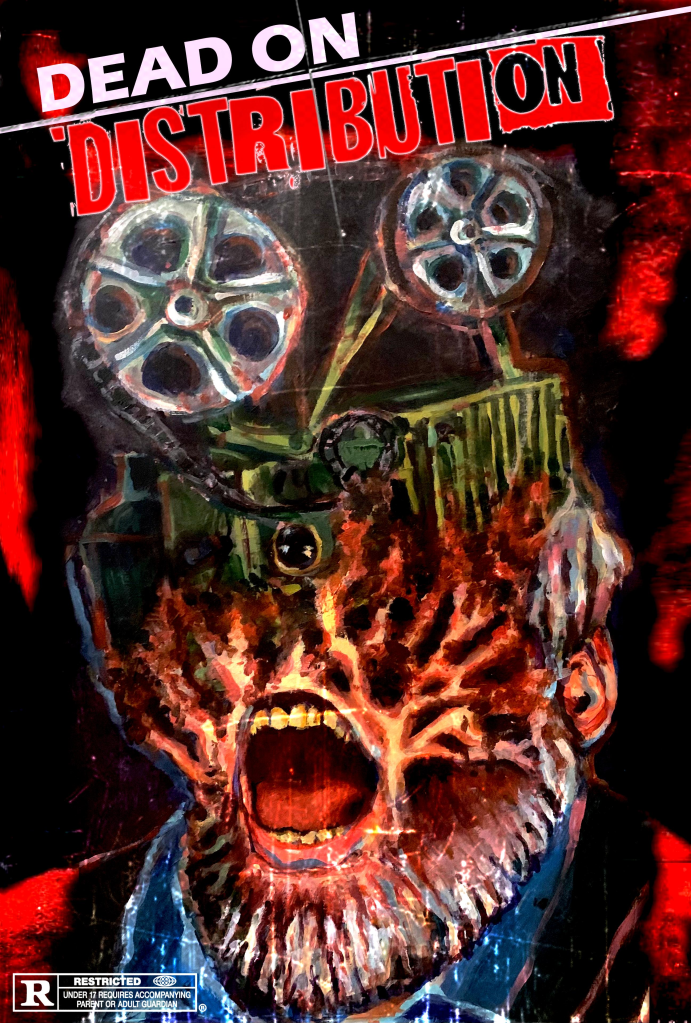
Dead On Distribution and Interference Festival attendees are a match made in heaven. Alasdair Gretton’s second film concerns itself with the concept of the ‘Video Nasty’, the boogeyman that haunted the British zeitgeist from the 1980s to the mid-noughties. When up-and-coming actor Danny Felt realises that his debut movie – the aptly named exploitation movie, Lead Rains Down At Midnight – is doomed to a life collecting dust on video store shelves, he resolves to take matters into his own hands by committing an unspeakable act of violence.
Of course, the gag at the heart of Dead on Distrubution is that Lead Rains Down At Midnight is a naff film, and everyone involved knows it. What drives Danny to commit the climatic act of mass slaughter isn’t the content of the movie, but his life-long desire to be the centre of attention. What really brings this sentiment to life is Jacob Poole’s performance as Danny – there’s a Joker-esque Campness to the way he moves his face throughout this movie, culminating in one unforgettable shot of him clutching the video case with a bloody, shit-eating grin.
If The Bothy on the Cold Mòr was a poem, then Dead on Distribution is a cyberpunk rave. Ear-splittingly loud, jarringly stylised, and violently British, the folks at Interference Fest ate that shit up like popcorn. The film claimed the title of overall winner of the Short Film Block for the weekend – a big well done to Shot by Gretton Productions!
And so concludes my experience of Day One of Interference Fest, with Day Two promising even deeper levels of depravity – there is a double helping of Yoshihiro Nishimura on the horizon…
Laura Barnes (Instagram: @maamowar / @absolutedestinyapocalypse) is a freelance writer obsessed with the horrors and joys of ordinary life. She has written for publications such as Cafe Lit, Stat Magazine, and Ever Metal, and spends entirely too much time thinking about Vampires.


