
by Adam Page
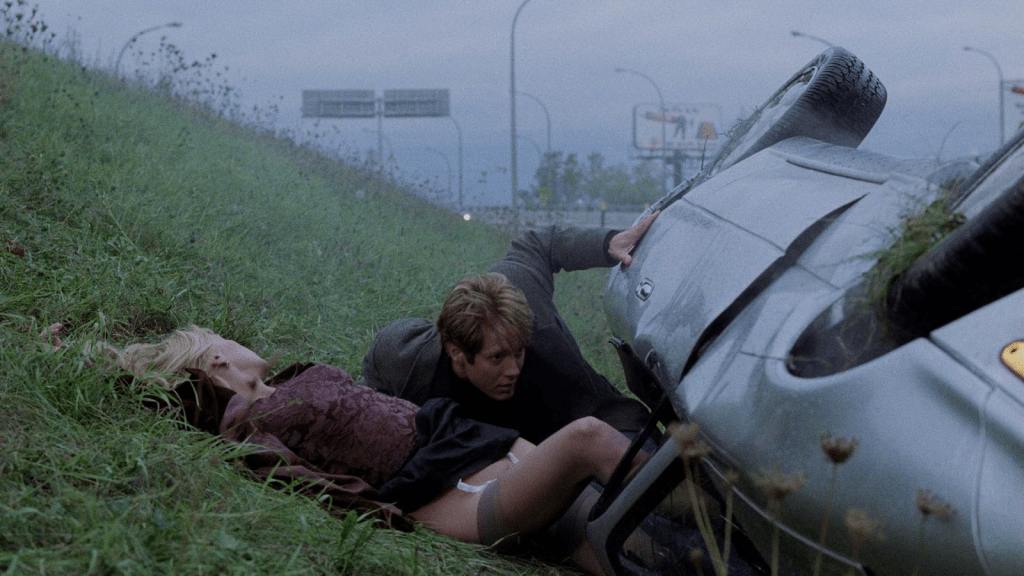
At the end of David Cronenberg’s Crash, James Ballard climbs down into the ditch where his wife Catherine lies bleeding in the wreckage of a car she has just driven off a motorway overpass on purpose. He cradles her, asks if she’s alright. She is. He says: “Maybe the next one, darling.” She agrees, and they hold each other in the dirt. This is not nihilism. So you can get that out of your head right now. Nihilism is basically the belief that nothing matters. What Catherine and Ballard are doing in that ditch is the complete opposite of that. They believe in something which matters so much that they are willing to break their bodies trying to reach it. But they don’t know what it is yet. And that’s the whole point.
Thirty years. This movie is thirty years old and still people describe it as a provocation. They say it’s transgressive and shocking, with Cronenberg being difficult again. They say this because calling something transgressive is a way of not having to think about what it’s really saying. Transgression is a category, and categories can be cages. Crash doesn’t fit in the cage. J.G. Ballard published his novel in 1973. He had lived through a Japanese internment camp, watched his wife die young. He lived in the same semi-detached house in Shepperton, England for decades and watched the motorway civilisation rise up around him. The flyovers, ring roads and service stations were spreading like scar tissue across the rural English countryside. He understood something about the modern body that most of us were still trying to deny. And that is the modern body is not natural. It hasn’t been natural for a long time. It sits, barely moving, in climate controlled rooms. It is transported around in metal shells, moving at speeds no organic system was designed to process. It is surveilled, medicated, and optimised. Our modern body is already half-machine. The machine half is expanding and we aren’t talking about it, because we have decided to call this progress and move on.
Ballard looked at the new motorways and saw a new kind of eroticism beginning. Not the eroticism of flesh against flesh in a pre-industrial Eden, but the eroticism of the interface. That place where body meets machine. Where organic tissue presses against steel, glass, and fibreglass at high velocity and something gets released. Something which wasn’t there before, and has no name yet because the thing it’s describing has never existed before. Cronenberg understood this. Other directors may have softened it, or allegory-fied it and made it a metaphor about something else: capitalism, addiction, maybe male violence, but Cronenberg took it literally. He created the movie Ballard wrote. And that is to say, he made a movie about exactly what it claims to be about. The sexual psychology of the car crash, and the eroticisation of the wound. The body beginning to discover new desires it doesn’t have the vocabulary for.
The French call the orgasm le petit mort. The little death. The idea is simple: in the moment of climax, the self briefly dissolves. The ego, the chattering, cage-building thing, goes offline briefly. And what remains for that fraction of a second is just the body, just the sensation. Existence without the commentary track running over the top of it. Then you come back. The self begins to reassemble, and you are you again. But just for a moment, you have touched the dissolving of you.
Death, then, is la grande mort. The big dissolution, and the one you don’t come back from. The psychoanalytic logic goes like this: the drive towards orgasm and the drive towards death are not opposites. They are expressing the same underlying desire. The desire to stop being a self, and stop maintaining the huge, effortful fiction of coherent selfhood. The desire to release.
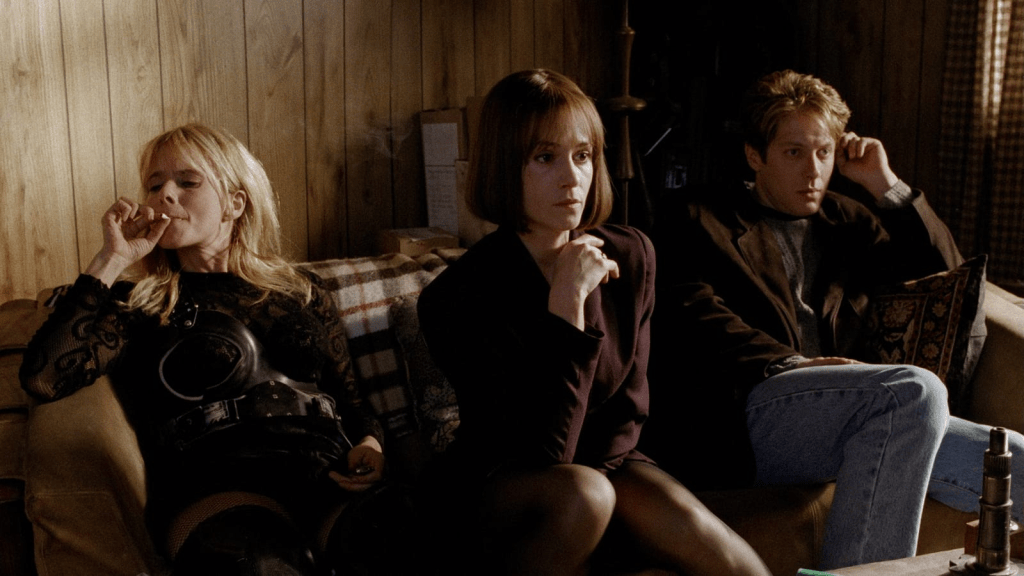
Vaughan, played by Elias Koteas with the serene focus of a man deep in his religion, understands this in his cells. He wants to get close enough to death to see what’s on the other side of himself. He stages re-enactments of famous crashes. He photographs accident victims. He collects wounds like other people collect experiences. Every impact is a rehearsal, and every scar is a notation in a score he is composing towards a finale he can’t yet name.
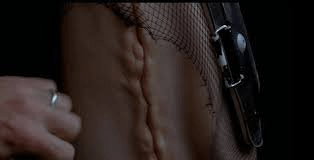
The movie is full of scars. Gabrielle, Rosanna Arquette’s character, wears them openly, on her thighs, where the metal penetrated her. Her leg brace works as a kind of exoskeleton, a new limb and record of the event which remade her. James Ballard runs his hands along her scars, and it isn’t fetishism in the clinical sense. It is archaeology. He’s reading the crash in the same way you would read a text. And he is learning a new language written in flesh.
There is a lot people get wrong about this movie. They think it’s about death wishes. They watch Vaughan driving into traffic or barriers, into other cars and diagnose suicidal ideation. The death drive. Thanatos runs wild. And yeah, Freud is in there. Ballard deliberately puts him in there, then he puts him in a car and drives him into a motorway pylon at 90mph to see what would come out the other side.
What comes out isn’t death. What comes out is transformation.
Consider the mythology of thresholds. The threshold is not the room, and it is not the outside. It’s the charged space between states where the passage itself does something to you. Rituals happen at thresholds, and initiations happen at thresholds. The person finally crossing is not the same as the person who entered the in-between space. In Vaughan’s theology, the crash is a threshold event. It’s not an ending but a crossing. The body enters it one thing and comes out, if it does come out, changed.
Changed into what? Ballard doesn’t tell us. And this is the movies true philosophical courage. Most transgressive art has a thesis. It will tell us, here is the transgression and here is what it means. Here is what it reveals about masculinity, or capitalism or bourgeois repression. Crash simply refuses to tell us what the new thing is. It only points at the direction of travel. The species it imagines, the Ballard-species or the Vaughan-species, doesn’t yet exist. It is in process, and becoming. The movie is a document of becoming, not arrival.
In 1996, the Evening Standard and Daily Mail orchestrated a campaign to keep Crash out of British cinemas, stating that it was “morally repugnant.” It was banned by Westminster City Council, and other councils in the UK followed suit. The ban was eventually lifted, and the movie was passed uncut with an 18 rating. It played to audiences who mostly left shaken or confused. Or generally both. But the damage to the movie’s reputation was done. It was the movie they banned. The weird one about sex in car crashes. That movie you watched if you wanted to be disturbed.
This is a tragedy of reception, as the movie isn’t trying to disturb you in the way a horror movie disturbs you, it isn’t trying to make you recoil. It’s trying to do something much stranger. It’s trying to make you recognise something you didn’t know you contained.
In interview after interview, Cronenberg was careful and exact about this. He said the movie was not about sick people. Instead, it was about people at the edge of human experience, and they were probing what lay beyond that edge. He has said Catherine and Ballard and Vaughan were not cautionary tales, they were explorers. In their own way, they were heroic. This was the claim that just couldn’t be absorbed by the culture. The culture can absorb transgression, and it can absorb shock. It even has its own categories for these things: not for everyone, approach with caution, adult content. But what it can’t absorb is the suggestion that the transgressive figure might just be ahead of the rest of us. That what it considers monstrous may be evolutionary. And maybe the people breaking taboos might be breaking them because the taboos are the cage. And that cage is getting too small.
Evolution isn’t about survival. This is just a myth we tell children; survival of the fittest, with the fittest being the one who lives longest, passes on the better genes and maintains the status quo of the organism. But evolution is really about pressure and variation. About the radical accident of mutation and the thing which happens at the threshold of catastrophe, with the organism entering the extinction event as one thing and exiting, if it exits, as something new. The dinosaurs didn’t survive, they were replaced by stranger, smaller, warm-blooded and feathered creatures incomprehensible to the Cretaceous world that came before.
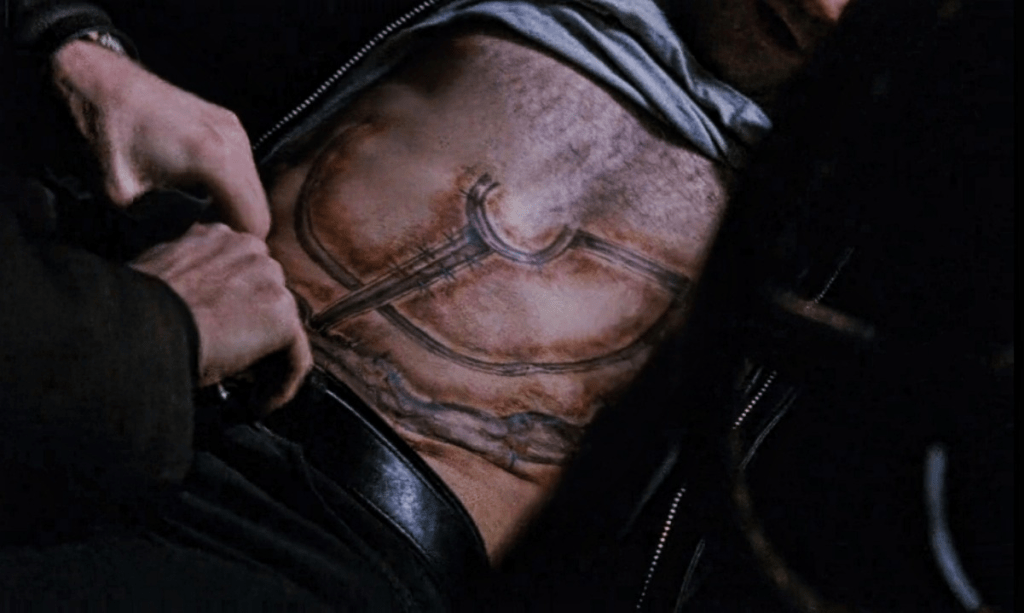
Vaughan is searching for the crash that will do to the human body what the asteroid did to the Cretaceous. He knows he most likely won’t survive it, and has accepted that. It isn’t a death wish, exactly, it’s a species wish. He is putting himself out there as volunteer, as raw material for whatever comes next.
Let’s get back to that ditch. Back to James and Catherine, holding each other in the wreckage and beginning to have sex. Back to the line that has been misread for thirty years.
“Maybe the next one, darling.”
It isn’t: maybe the next crash kills us and then we can stop. It isn’t: we are shattered people seeking obliteration and haven’t found it yet. It isn’t nihilism, or despair.
Listen to it again. Listen to what it is really saying.
It’s a declaration of love. It is maybe the most intimate thing two people can say to each other after they’ve discovered what they’re looking for together. They are saying: I know what we are chasing, I know we haven’t yet reached it, I know you’re with me, let’s keep going. That’s every artist who looked at the work they just made, feeling it was close but just not quite there yet, and turned to the person beside them and said: maybe the next one. Or every scientist running the experiment and seeing the anomaly in the data and thought: there. There is the thing we haven’t named yet. The next experiment will show us more.
Catherine says: “Yes. Yes.” She isn’t broken, she’s committed.
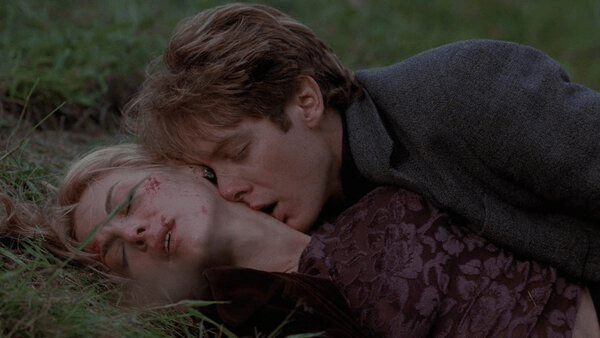
This is what Cronenberg gave us thirty years ago, what we weren’t ready for and what we are, maybe, thirty years on beginning to be able to see. A movie about two people who have discovered that the human body has an appetite which civilisation has not found a form for. They are following that appetite wherever it leads, whatever the cost because the alternative, with a managed and safety-regulated life and a body never exceeding its design parameters and a self never touching its own dissolution, is a type of death that they find less bearable than the literal one.
Are they right? The movie doesn’t say. It isn’t a moral instruction. It’s a philosophical proposition offered to us in the form of sound and image and those specific textures of Cronenberg’s cold, grey-silver Toronto as a stand-in for a universal nowhere-modern-everywhere.
The proposition is this: the body wants something it can’t name. It has found in the crash, temporarily, the closest approximation to that thing. The wound is a door, with the scar a record of the passage. Vaughan is dead, but something of what he was reaching for lives on in Ballard, in Catherine, and in the unnamable evolutionary pressure that sent them to that motorway in the first place.
The species changes at the threshold. The threshold is the crash. But the crash is not an ending.
Maybe the next one, darling.
Yes. Yes.
Adam Page is a freelance writer focusing mainly on film and literature with a special interest in all things horror related. He is in his final year studying for a BA in English Literature and Language and is somewhat obsessed with Bruce Springsteen. He plays terrible guitar and is definitely a cat person. His favourite film changes depending on what his mood is.


