
By Joseph Ratchford
On Saturday the 17th of October, Cultplex presented an all day event of body horror classics. Joseph Ratchford attended, both as a volunteer for the first two films of the event, and to report on it.
The first thing I noticed was the champagne bucket. Sat on stage, overlooking the aisle, it glistens under the looping slides of upcoming screenings and red lighting. It was as if the screen, flanked by polyester felt curtains (also red), was calling to me. Guided by natural curiosity and journalistic integrity, I responded. I wandered down the chipped-concrete floor, and glanced down at the bucket. It was a third full of plastic eyeballs.
For those reading unfamiliar with Cultplex, this is evocative of its charm. It’s not a grindhouse, but it’s not not a grindhouse. A truly independent cinema operating out of a small building in Red Bank, it sits just about where the city centre ends and Cheetham Hill begins. Compared to Manchester’s primary arthouse, HOME, a four stories high, National Lottery and Government funded new build in the heart of Deansgate, it’s night and day. I love HOME, I really do, but it feels less of Manchester, as it does an attempt to build the BFI Southbank, North Edition. Cultplex, however, with its handpainted walls, second-hand seats, bucket full of eyeballs, and scrappy charm, feels as Manchester as a cinema can get.
The eyes, we discovered, were for the raffle. And it wouldn’t end with them. I watched as Rob, Cultplex’s cinema manager, and Beth Moore, a local comedian, entered the screen with a Tesco bag. I did not see them, but I have it on good authority that they added vegetable soup to the bucket. When they exited, we were told the doors were open, it was time to let everyone in. So, me and my co-volunteer, Harry, manned the barrel by the screen entrance as we began to usher in visitors. Unfortunately, we did not get to see the raffle, but I was told winners had to (if they wanted) duck their hands into the soup to get their prize which was written out on an eyeball. If anything is more body horror than reaching through eyeball soup to get prizes, I don’t know it.
Film One: The Fly (Cronenberg, 1986)
When volunteering at Cultplex, I like to ask visitors if they’ve seen the film before, the nos are usually dripping with curiosity; a watchlist staple they’re excited to finally cross off, and the yeahs are usually delighted. Every movie is someone’s favourite, and when you get to hear someone exclaim that the day’s showing their, or at least, one of (the great pain of most respectable cinephiles is that you just can’t pick one.) their favourite movies, there is no better feeling. To me, it’s no longer just sat in a screen with strangers, I’m with someone who is having one of the best moviegoing experiences of their lives. Even if I do not share their faith, I can respect the religious experience. Find something there.
Some movies get mostly curious ‘nos’, The Fly was not one of those movies. Every audience member I asked whilst taking tickets had not only seen the film before, they were ecstatic to be seeing it on the big screen for the first time, entering in a sense of almost religious fervour. Everyone, except one member of the audience.
Myself.
When I first got into Cronenberg, I did so with a simple goal; avoid The Fly. It was ‘too mainstream’, I thought, being 17 years old, deep in the throes of my Zappa phase, and failing to grow a beard. I instead started with Videodrome, and whilst I’ve seen a good portion of his filmography (Naked Lunch is probably my favourite, but I have a deep fondness for Crash) and got over myself, The Fly continued to elude me.
So, I sat down for the screening, hoping to be blown away, and welcomed into the congregation. It took its time, but it connected. I just had to get over myself first.
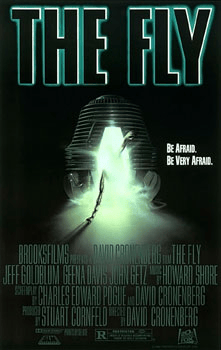
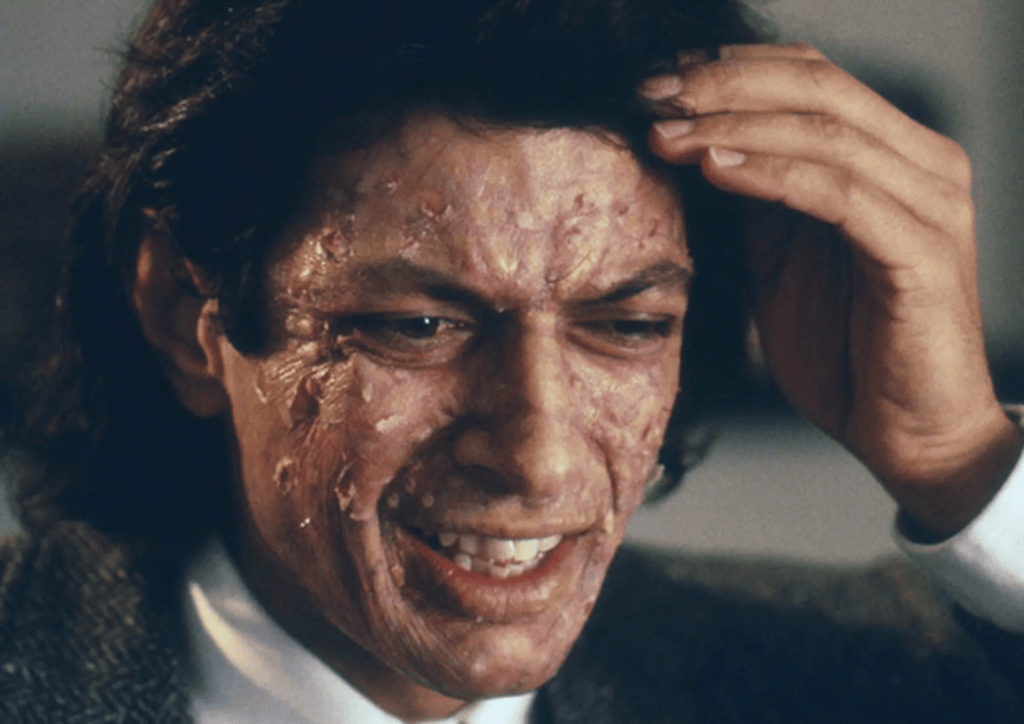
The Fly is a fascinating piece of Cronenberg’s filmography in how removed from his usual coldness it is. The film, a love story, focuses on Seth Brundle (Jeff Goldblum), a scientist who, testing his teleportation device, begins to transform into a giant fly. This causes somewhat of a rift in his relationship with his girlfriend, Veronica (Geena Davis). For as flippant as a descriptor as that is, the emotions are completely sincere. There is a genuine romanticism to Brunle and Veronica’s relationship. They share easy chemistry, and Brundle’s mental and physical deterioration is played straight as something that viscerally upsets both her and himself. Brundle’s ultimate villainous turn, kidnapping Veronica to merge their DNA and cure himself, is played as the loss of a loved one’s mind, akin to losing a partner to addiction or dementia. As someone whose prior exposures to Cronenberg have been so cold regarding romance (and in the case of The Brood, actively opposed to the concept) and sentimentality of any kind, The Fly left me uncomfortable for reasons beyond its body horror. When was the shoe going to drop? When would something so sincere reveal itself to have the same dead, cold, undertone that has defined this man’s work for me? When does Veronica fade away, revealing herself to be a construction of Brundle’s own need for sexual stimulation, a-la Videodrome?
The magic is that it never does. When Brundle is ultimately killed, it is seen as a tragic thing, a removal of his humanity and his life. Veronica cries over his corpse, now devoid of any recognisable traces of Jeff Goldblum, yet we know that this monster was once a man, taken away by his own hubris. I cried too.
Whilst I ultimately loved The Fly, I think my neurosis got in the way. In this attempt to auteurise, to present something in a box, I lost what made the movie special in the desire to find what I had ascribed as Cronenbergian, rather than what the movie is, which is a deeply romantic tragedy. Besides, if we were to look at The Fly as an auteurist piece, it is still deeply of his obsessions. Brundle’s reaction to the early stages of his transformation is glee that he has ‘transcended flesh’, that he is reinvigorated, and safe from eventual decay. Fear of decay and death, that our bodies are slowly deconstructing themselves, have been a defining trait of Cronenberg’s filmography since The Brood, and spreads all the way to The Shrouds, his most recent work. Brundle’s belief he has transcended aging is somewhat ironic in how much his portrayal is rabid in the deconstruction of all that is beautiful about him: Goldblum spends much of the film’s second half shirtless, a decision that gets less and less appealing as his stomach begins to bloat and caprese, shelled in latex and covered in goo. The themes are all Cronenberg, the only difference is presentation.
Film Two: Society (Yunza, 1989)
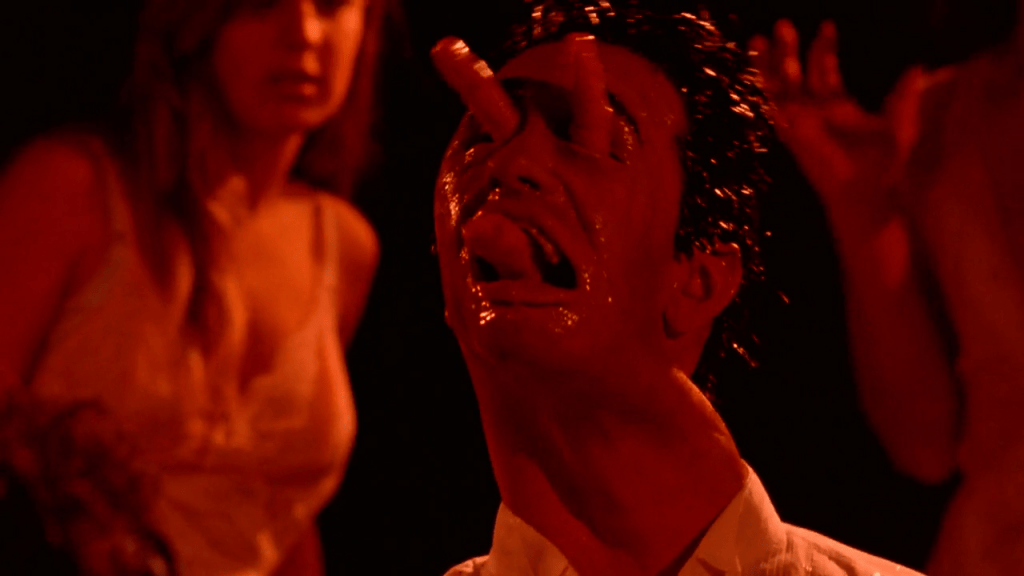
The next film of the day came. This time, the crowd was split down the middle: half were nervous, shaking and laughing, gleefully uncertain. They know enough to know something is coming, but no idea what. The other half are practically exploding with anticipation. They know all too well what’s coming, and they can’t wait to share in it.
I’m exactly the same. Out of all the films of the day, Society has to be the one I’m most excited to see with a crowd. It’s a film I associate deeply with my university days; having first seen it at a friend’s dorm, with no prior warning or knowledge about where it was going outside ‘body horror’. Whilst Society is still magnificent with or without prior knowledge of what form that body horror ultimately takes, there’s a purity to the unspoiled experience, and the visceral reactions it gets out of you (or at least, it got out of me), and to feel it secondhand, that mixture of delight and shock, is not only a source of personal nostalgia, but collective joy. Just as every movie is someone’s favourite, every screening is someone’s first.
Whilst everyone, even those going in as blind as possible, knows whereabouts the film will go, (the theme of the event is body horror, after all) the film disarms the viewer by holding it away from them for as much as possible. At first glance, and for sixty of its hundred minute runtime, Society is an LA conspiracy thriller. 16 year old Bill Whitney (Baywatch star Billy Warlock) has it all; he is captain of his high school’s basketball team, his family are wealthy beyond compare, but there is something wrong. They hold events without him, he does not act, nor look, like them. His therapist does not trust him, he is theoretically popular, but his classmates are disconnected, and not quite right. His world is too archetypal, too shallow. Warlock’s casting is no coincidence, the Beverly Hills of the film is deeply evocative of the constructed, day-glo Los Angeles from the show where Warlock made his name. If you were to watch Society without knowing where it eventually goes, you’d think it was purely a paranoid thriller wrapped in sunshine and teen movie aesthetics.
On rewatch, this part of the film felt more reminiscent of a b-movie Under The Silver Lake. Brian Yunza (producer of Re-Animator and From Beyond, and ergo an essential figure in developing my love of goopy movies) might not have the same mastery of the camera and commitment to obliqueness that animates David Robert Mitchell – so much so that Under The Silver Lake’s most ardent fans are desperately trying to solve the ‘hidden mystery’ in the film’s messaging, but what he is aiming for is different. No one’s trying to ‘solve’ Society, its third act wraps things up far too neatly for any form of ambiguity regarding what is going on, and why. The conspiracy exists as a vehicle for Yunza, and special effects icon Screaming Mad George, to shock and satirise in the most unambiguous manner possible. The LA aesthetic needs to be the most cartoonish version of itself, the body horror, when it comes, has to be the most disgusting version of itself possible. If not, I feel the darkness of its implications would be suffocating.
The Fly is body horror without winking irony, it has shades of dark humour, but ultimately it is sincere in the matters of love and flesh. It ends in tears, and Society ends in laughter, the ultra-rich have gotten away with it, even if the truth gets out, there’ll be no consequences. The rich being able to do what they want without consequence is not some new, radical, idea that has grown in prominence over the past decade of cinema. It has always been there, and there is nothing to be done. You’ve got to laugh to stop yourself from screaming.
INTERVAL:
My shift finished, I changed out of my volunteer uniform, and joined the congregation for a short interval. The atmosphere remains ecstatic, and the crowd has grown, both in age and excitement. Whilst The Fly is the most famous of the films screened today, I think I can pin American Werewolf in London as the most accessible. At the barrel, an American woman amicably chatted to the current set of volunteers about how the film captured how she felt when she first came to the UK. Those who signed up for the whole day settled down with their hotdogs and chit-chatted about what they had just seen. Outside, through the fenced windows of Cultplex’s upstairs bar (the cinema being split into two bars across its two floors), dusk has begun to creep in. Candles light the two rows of tables across the floor, and the lights are dimmed. There’s a bad moon on the rise, but inside, the atmosphere is anything but.
With my front of house work finished for the day, I go to take advantage of one of the staples of Cultplex’s special events: their themed drinks. Viscerama is no exception, offering, not one, but two themed drinks. The first I tried was the Alien Brain Hemorrhage. Two shots of syrup and baileys on top, creating a trickle down the syrup that certainly resembled a haemorrhage. I usually struggle with shots, but the sweetness of the syrup and the creaminess of the Baileys meant it went down smoothly, even if it was a bit sugary for my personal taste.
I have a certain, slightly reluctant, admiration for campy halloween nonsense: sure the music snob in me rolls my eyes the second I hear the Monster Mash, but I can’t help but find some level of whimsy in it. Sure, I know pumpkin carving is a waste of a perfectly delicious squash, but I’d be lying if I didn’t smile a little each time I saw one. If I was to express the appeal I get from the halloween season, it’d be to compare it to Elvira. It’s the macabre, but removed of anything genuinely disturbing; it is all knowing camp, and winks to the audience. Plastic skeletons and elaborate dress up. I love it.
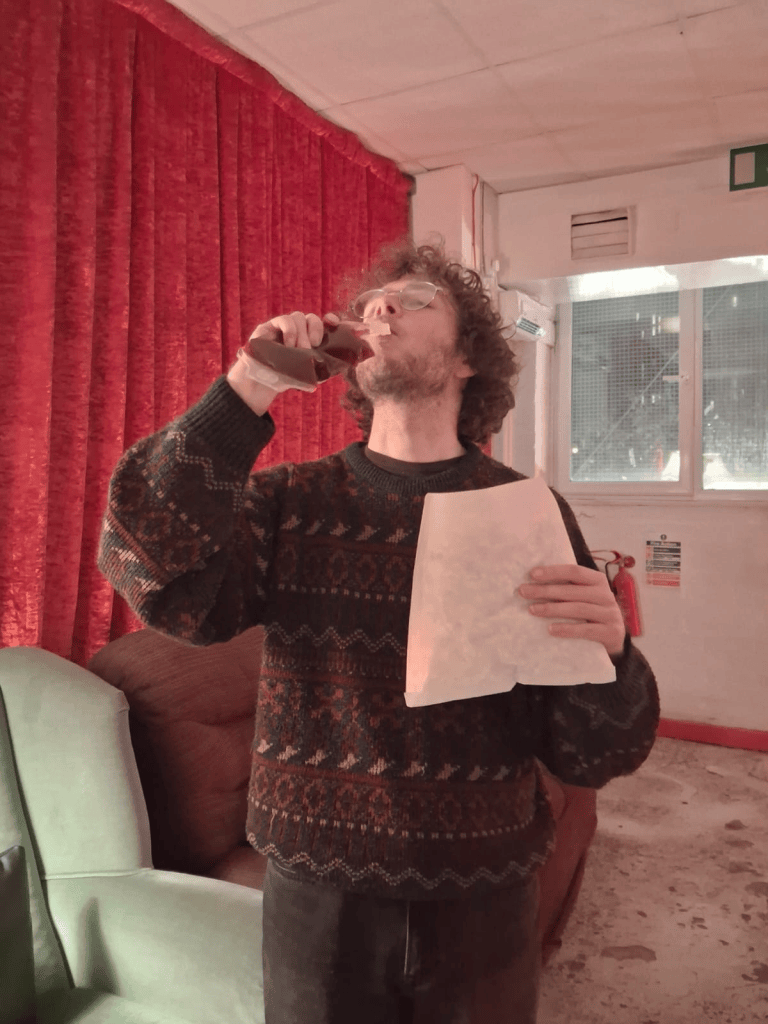
This is to say that the second of the themed drinks: sangria in a blood bag, was practically made for me. There’s something macabre about the presentation, it’s a blood bag, after all. However, the tang of the sangria, the warmth of it passing through my stomach; the writing at the back of the bag which expresses that, yes, this is safe for vampires, it expresses that strange morbid camp that gives the season life. So, giddy with seasonal joy and sangria, I grabbed my blood bag, a large bag of popcorn, and took my place with the nattering crowd.
Film Three: An American Werewolf in London (Landis, 1981)
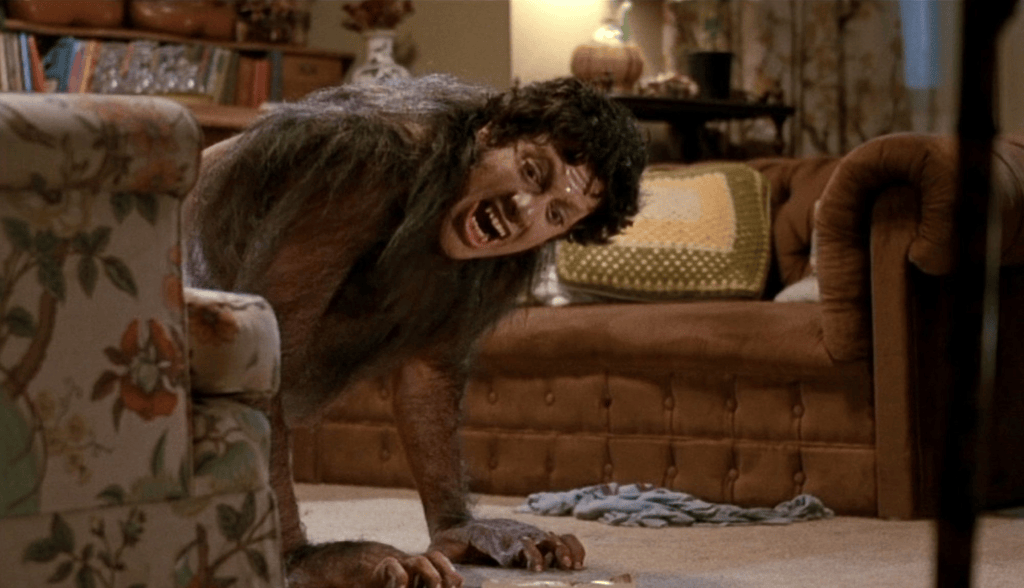
It was a cold October night in Manchester. The dusk had faded into dark, the screening room was packed and bursting with excitement. I took a sip out of the blood bag, and the film was about to begin. It is already one of the most perfect moviegoing experiences of my life before the introduction. Beth Moore, ‘Comedian, presenter, and horror movie encyclopaedia’, to quote Rob, who has stuck around for the day, takes the stage for a brief, spirited, introduction. The lights dimmed. I settled down, took a sip of my sangria. Bobby Vinton’s sultry take on ‘Blue Moon’ kicks in, the film pans across the Yorkshire Moors, and I felt good to be alive.
It was then that, out of the mouth of an aging Yorkshireman and two young Americans, came perfect German diction.
Rob was quick to fix the issue, pausing the film and turning the screen off as he apologised. We sat in silence for a second. ‘Blue Moon’ kicked in once more…and the film was, once again, in German. It’s a silly flub, and everyone laughed. Rob played into it.
‘I’ve turned on the subtitles!’ he expressed as the screen flickered back to life, and there came ‘Blue Moon’. For a second I considered the novelty: if the film was, once again, in German, it’d be, at the very least, something I haven’t seen before. However, I needn’t have worried, the film was in English, and everything continued as normal.
American Werewolf In London is neither a body horror satire a la Society or an ultra-sincere body horror romance, a la The Fly, it exists in its own separate mode between the two. Focused on David Kessler (minor scream king David Naughton) and Jack Goodman (After Hours’ Griffin Dunne), two American backpackers who get attacked by a strange creature out on the North York moors. Jack dies there and then, and David wakes up in a hospital in London three weeks later. Slight problem. Jack’s zombified corpse is telling him to kill himself, on account of David now being a werewolf.
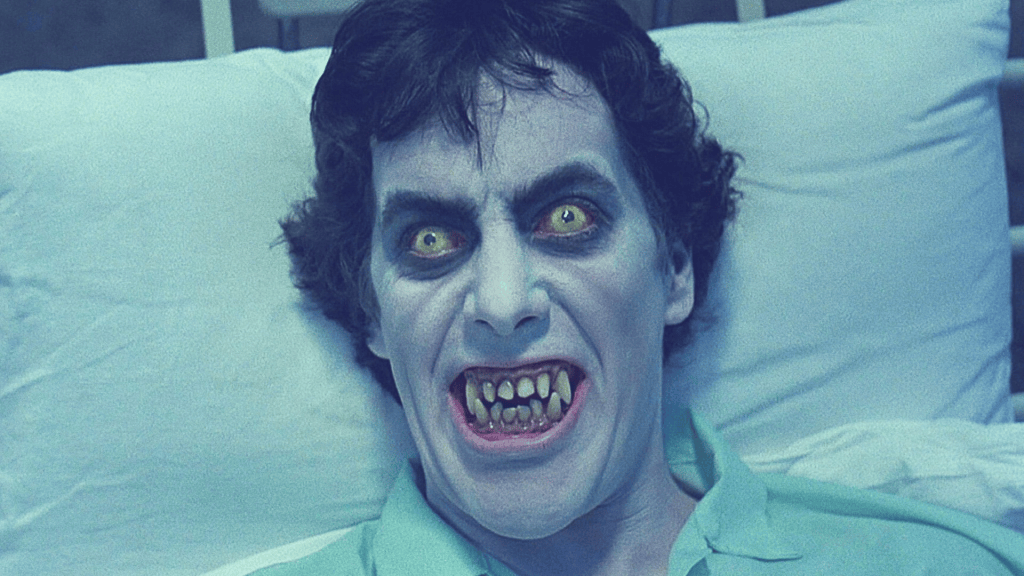
The film runs off an interesting disconnect between its glib, morbid, sense of humour, (Every sequence with Jack runs off a wonderful dissonance between the character’s mild annoyance at his situation, and the gradual decomposition of his body.), and taking the horror and pain of David’s transformation completely seriously. This is best exemplified by the film’s transformation sequence; still one of the most impressive practical effects creations in cinema history, it is slow, painful, and Naughton’s screams are horribly realistic. We wholly believe that, not only that what’s happening hurts, but that his humanity is taken away from him.
In balancing this tone, however, I can never escape the feeling that American Werewolf forgets to have an ending. It cannot stay on his love interest, Alice’s (Jenny Agutter) tears upon his death, it cannot pan over to a joke. The film is unable to decide whether its final notes are silly or serious, so, sticks on nothing.
This is to say that, despite being a film I’ve long admired, this is the first time I’ve watched American Werewolf where I can say I enjoyed it. My issue has always been that the pairing of David Naughton and Griffin Dunne leaves the film somewhat lopsided. Not because the two lack chemistry, far from it, it’s simply that Griffin Dunne is incredibly charismatic, and David Naughton, in my opinion, is not. It’s a clearly motivated choice. Naughton is charming enough for the horror to feel scary, for his transformation to work as well as it does, to be a character you don’t want to turn into a werewolf but not so charming that you actively feel bad for him. It could be argued this is key to the film’s tone, and if the two switched roles, it would not work the same way. To that I would argue that Dunne’s performance in Martin Scorsese’s After Hours. That film runs off a similar logic of its lead having to be likeable enough to garner the audience’s sympathies, but not so likeable that it is not funny when bad things happen to him, counters that point. Whilst I don’t think Naughton is devoid of talent, I can’t deny having a little voice at the back of my head whenever Jack was not on screen asking, ‘where’s Jack?’
Despite my lack of engagement with its lead performance, watching American Werewolf in these circumstances, at this time of night, surrounded by ardent fans, laughing at every joke, I found myself delighted, enraptured in the experience, and the giddy delight of everyone leaving the screen afterwards. Whilst I may not be fully in its cult, I can at least say I loved attending the church.
Film Four: Tetsuo: The Iron Man (Tsukomoto, 1989)
It was the final film of the day, and the crowd shrank down once again. The American Werewolf fans, beaming smiles on their faces (if no Chinese menus in their hands), wandered down the stairs, and away from the cinema. They’d had their fill, and, clearly, the time of their lives.
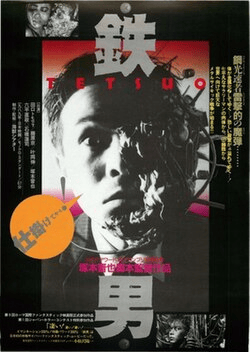
Leaving the final, and by a significant margin, the least accessible film of the day: Shinya Tsukomoto’s 1989 masterpiece, Tetsuo: The Iron Man. I convened with my friend Cara, both of us positively buzzed in excitement: the film is a shared favourite, and we were fascinated to see what the audience would think of it.
Tetsuo was something of an odd duck in terms of programming. The prior three films, whilst all great, are perfectly accessible pieces of body horror. They are strange, of course, disgusting, without a doubt, but they are all, on some level, mainstream, commercially-minded films. Both The Fly and American Werewolf were distributed by major Hollywood studios, and were majorly successful at the box office. Whilst Society is more niche, it was still produced by Yunza as part of a two picture deal with Wild Street Pictures, with the guarantee he would deliver them a Re-Animator sequel. Tetsuo, was self-financed by Tsukomoto as an extension of his ‘Kaiju Shiata’ experimental theatre troupe, a fact that maintains in the film, which lacks a narrative in a conventional sense, and serves as an experimental work first and foremost.
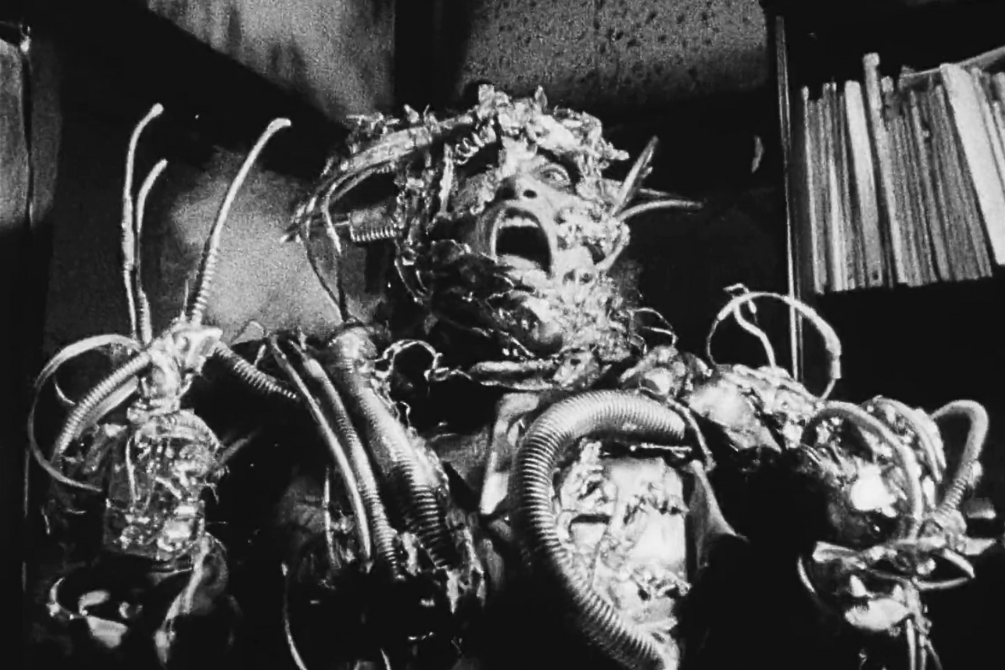
What plot Tetsuo has is relatively simple: a Japanese Salaryman (Tomorowo Taguchi) is cursed by a vengeful Metal Fetishist (Tsukomoto) to turn into metal. Things go very wrong for him. However, to describe the plot of Tetsuo is like describing an aluminium can: sure, it’s there, it’s nice it’s there, but what matters is what is inside.
The film reminds me most of the famous Videodrome quote: ‘all hail the new flesh.’ Cronenberg’s warning, that our hunt for stimulation, hunt for a technology that overtakes our humanity, will both destroy and consume us. The difference between the world is that whilst Cronenberg will tell us this, he only shows us glimpses of this ‘new flesh’. Tsukomoto has no interest in telling us this. Every piece of metal grafted onto Taguchi feels like an invasion, overtaking his physical form, taking it, and its autonomy, piece by piece (most infamously when the Salaryman’s penis transforms into a drill), until his humanity is replaced by a fuel for rust.
The hunt for stimulation is addressed purely audiovisually. Tsukomoto’s film is chopped into pieces. Shots are erratic, continuity is a thing of the past. Everything is designed for maximum stimulation and impact. The film’s special effects are done through a kind of live action stop motion, where Taguchi and Tsukomoto rush through Tokyo’s outskirts, frames removed from their motions. It’s a choice evocative of the production’s roots in abstract theatre: the actors are manipulating their bodies to evoke robotic movement in a matter beyond SFX. Every choice seems so overwhelming, every frame so busy, the soundtrack always cavalcades with aggressive industrial sound. Tetsuo feels beyond humanity, beyond cinema. It is sensory overload. It is a power drill, with the only intent of boring into your skull.
This isn’t to say it is all empty flash, far from it, but for as much as I adore the film, I’ve always struggled to put the thematic depth I find in it into words. I suppose I see it as a rejection of transhumanism, the belief that we should shed our fleshy coils and embrace ourselves as a wholly technological species. The transformation not only hurts the Salaryman so far beyond repair that he intentionally rusts himself, in order to destroy his consciousness, it drives him to such a state of madness that his body and mind merge with the Metal Fetishist. Whilst there are certainly romantic interpretations of Tetsuo (the final lines of the film being ‘our love could destroy the whole fucking world’), what narrative threads we do have (mostly regarding the childhood of the Metal Fetishist), and the sheer relentlessness of the aesethic counteracts anything tender or human. To transcend flesh is to feel pain beyond your imagination. To close the gap between man and machine is to allow yourself to be consumed by the latter. That, I suppose, is the nature of the genre. We like to believe we exist beyond the constraints of flesh, beyond the constraints of mortality, that we can free ourselves of our shackles and maintain what we feel is our humanity. But we cannot. The brain is a muscle, and all we have is flesh.
The audience poured out in a stunned silence. Some queued for posters. But, compared to the joyful murmurings that followed every other film of the night, the response was a muted, overwhelmed, silence. Regardless, as we poured out into the chilly October air, we knew something had changed. That the final sermon of the night had shaken us to our cores.
Joseph Ratchford is a freelance writer based in Manchester, and a recent graduate from Lancaster University. Whilst he has a particular interest in genre cinema, he strongly believes that all films are worthy of analysis, appreciation and interpretation.


