
by Sean Wilson
Now celebrating its 25th anniversary with a 4K re-release, Donnie Darko continues to endure as a haunting expression of the teenage experience.
If cult classic Donnie Darko is all about losing a sense of time, then the experience of watching the film on its 25th anniversary is strangely analogous with those themes. After all, it hardly feels like yesterday since writer-director Richard Kelly’s breakout debut stormed teenage psyches, and just think how much the world has changed in that time.
That’s not to say the film’s journey to defining cinematic status was straightforward. It was shot on a minuscule budget and, despite favourable reviews, tanked on its debut in America in 2001, understandably lost in the proximity to the 9/11 attacks on the World Trade Centre. Donnie Darko was more warmly received on its somewhat limited theatrical platform in the UK in 2002, ultimately grossing £1 million, although it was only when the movie was released on home entertainment in 2003 that it properly staked its claim as striking piece of work. The UK chart-topping cover of Tears For Fears’ ‘Mad World’, covered by Gary Jules and the film’s composer Michael Andrews, laid a lot of the groundwork there.
Backed by Drew Barrymore’s Flower Films label (she also appears in the movie as disenfranchised high school teacher Karen Pomeroy), Donnie Darko emerged as David Lynch for the millennial generation: tortured, undefinable and defiantly non-linear. Those of us in the throes of adolescence at the time of the film’s DVD release had hardly seen anything like it, and time hasn’t dimmed the film’s impact. (That said, Kelly did his bit with his foolish and much-derided Director’s Cut in 2004 that ironed out the timeline while junking most of the songs that had helped make the original so memorable.)
It’s also fascinating to witness a big movie star in their embryonic stage, in the movie that helped define them. Jake Gyllenhaal had already appeared as a kid in City Slickers and as a young teen in Joe Johnston’s wholesome, somewhat underrated, October Sky. But the edge that Gyllenhaal displayed as the titular character in Donnie Darko was instantly arresting, paving the way for his celebrated roles in the likes of Brokeback Mountain, Nightcrawler and others.
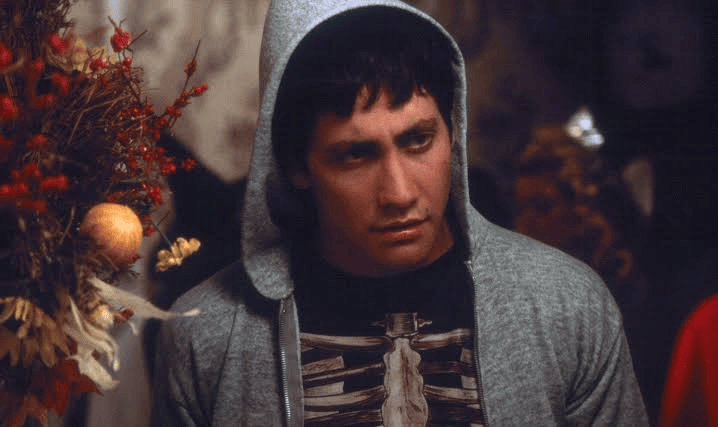
Donnie Darko is unexpectedly akin to Brokeback Mountain’s Jack Twist, a character not entirely comfortable in his own skin, with the potential to transfigure his emotional surroundings as he sees fit. Of course, in Donnie Darko, there’s more than just personal ego on the line, but the fate of the whole world. The beauty resides in how the film dovetails typical adolescent angst with the slow-burning and alarming apocalyptic menace, but it’s also a fine allegory for the teenage experience. Who doesn’t remember carrying the weight of the world on their shoulders at that age?
Of course, when we were told that by our so-called superiors, it was always figurative and often dismissive – who would believe a teenager has any important weight to bear? Donnie, of course, does, and the film literalises, physicalises, his metaphorical struggles, in the process allowing him to emerge as an unexpected and unlikely hero.
Not that Gyllenhaal’s superbly angular performance makes Donnie a superhero like Iron Man or Captain America (something he wryly questions in the film). Donnie is angry, confused, undergoing therapy and utterly lost. His parents, played by Mary McDonnell and Holmes Osborne, are somewhat detached, his older sister Elizabeth (played by Maggie Gyllenhaal) is a spiky presence, and his younger sister Samantha (the late Daveigh Chase, star of eventual sequel S. Darko) is still clinging onto her childhood innocence. Donnie is a palpable surrogate for the young adult viewing audience, and whose reluctance to take medication for his sleep-walking sits alongside manifestations of a demonic humanoid rabbit named Frank. There’s also the small case of a jet engine falling onto the family home seemingly from out of nowhere.
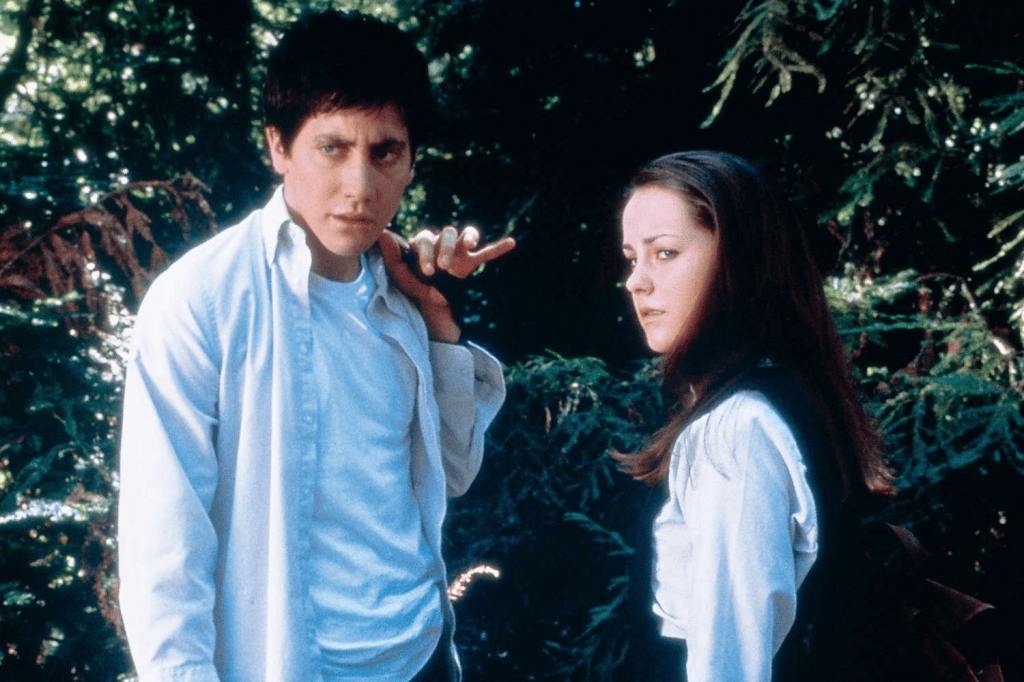
Is Donnie in the throes of paranoid schizophrenia or are these things actually happening? Spoilers for a 25-year-old movie but it turns out to be the latter. Frank exists and, along with the aircraft engine, is a portent, a dark visitation encouraging the central character’s ultimate redemption, namely the prevention of soon-to-be-girlfriend Gretchen’s (Jena Malone) demise. Via a time loop paradox, Donnie must go backwards and sacrifice himself, undoing all manner of imminent pain, something that’s foreshadowed prior to his death in a conversation with his teacher, Professor Monnitoff (a pre-The Pitt and mid-E.R. Noah Wyle). In the scene, the professor hands Donnie a book called The Philosophy of Time Travel, written by ex-teacher Roberta Sparrow whose musings prove crucial for Donnie in unlocking his ultimate destiny.
One can analyse the labyrinthine byways of the film’s plot until the cows, or rabbits, come home. However, Donnie Darko (at least in its theatrical cut) is best appreciated as an intravenous injection of pure mood and atmosphere with any number of striking set-pieces that a director would be proud to call their own. The adolescent mind rarely proceeds in a mechanical A-B-C pattern and nor does the movie. Instead, it uses an elliptical structure to authentically mirror growing pains in a way that makes most coming of age movies feel utterly contrived and fake.
For 1990s and 2000s kids, it also acted as a gateway into classic 1980s music. After all, the film is set in 1988 and this allowed Kelly to curate a superb mixture of familiar and slightly left-field alt-pop needle drops. Some of the most famous examples include Echo and the Bunnymen’s ‘The Killing Moon’ in the opening sequence, and Tears for Fears’ ‘Head Over Heels’ during the introductory school montage (cued by a superb vertical-into-horizontal shot from the back of the school bus).
There’s also, as mentioned, the climactic, melancholic twist on the latter’s ‘Mad World’, reconfigured as a lament for life and death, and a superb usage of The Church’s ‘Under the Milky Way’ for a pivotal Halloween party sequence. The music isn’t used as a gimmick but as inner dialogue for the characters, a reflection of time and place but also inner joy and pain, and the semi-tonal notes in between. The less said about Kelly’s musical substitutions in his ill-advised director’s cut, the better.
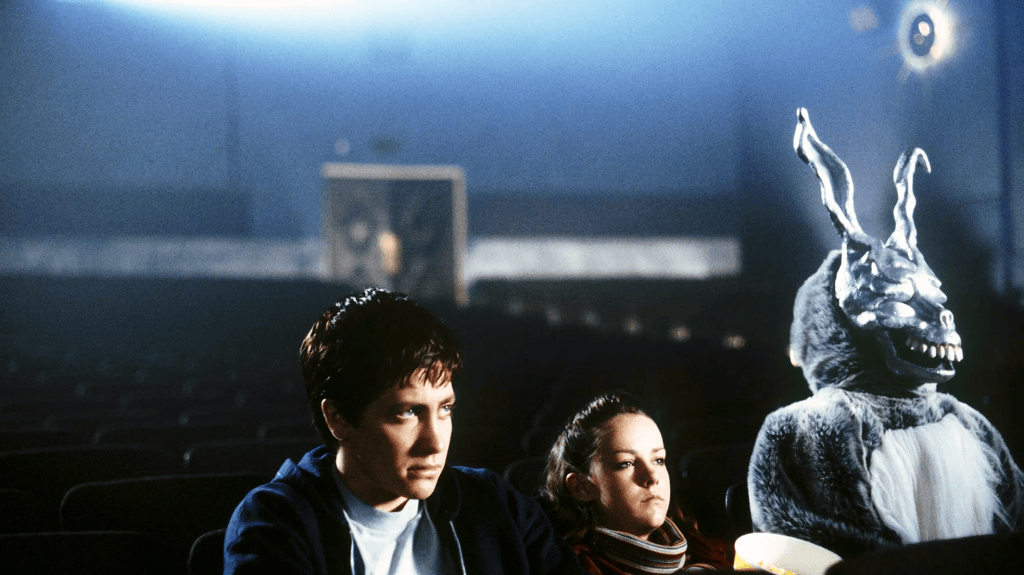
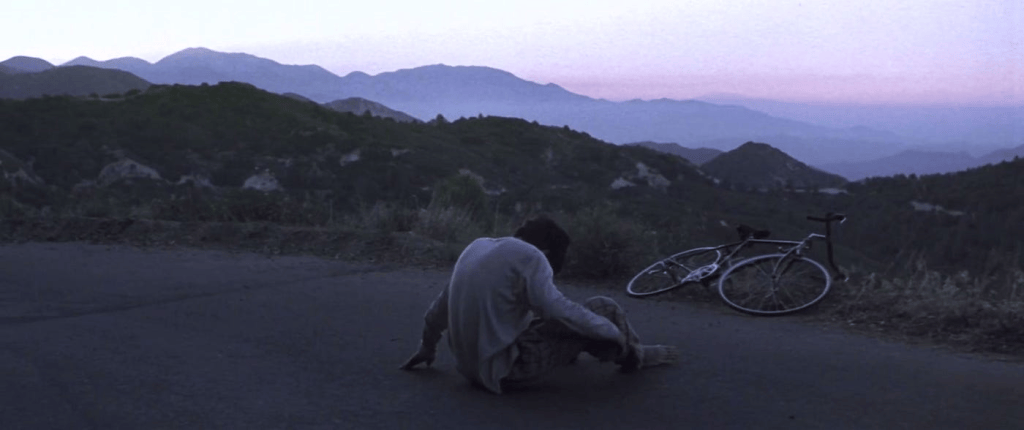
The film ably mixes humour and poignancy, sometimes in the register of the same scene. Donnie’s disorientated opening appearance on the golf course, and subsequent ‘Killing Moon’-scored bike ride, strikes a brilliantly surreal note. A therapy session involving Katherine Ross’s sympathetic shrink Lillian probes Donnie’s mind under hypnosis before it involuntarily turned into attempted masturbation. Meanwhile, an Abyss-style liquid portal snakes its way through rooms, halls and bodies, and a nighttime cinema visit takes a turn for the liminal. The last of those is a touchstone scene in the movie, yielding the classic exchange between Donnie and Frank: “Why do you wear that stupid bunny suit?”/“Why do you wear that stupid man suit?”
The movie sits at a fascinating juncture, riffing on 1980s pop culture (“I’m voting for Dukakis”), and yet poised to speak directly to early-2000s audiences via the presence of Drew Barrymore and its moody, head-scrambling aesthetic. Speaking of the 1980s, the movie pulls a real coup by inverting the star iconography of Dirty Dancing icon Patrick Swayze, here playing a sleazy self-help guru who is exposed by Donnie (prompted by Frank) as a pederast. The joy of the movie resides in how the familiar becomes unfamiliar, whether it relates to actors, themes or music. Moments of compassion (Donnie’s sympathy for bullied school student Cherita, played by Jolene Purdy) sit alongside Philip K. Dick-style surrealism (Donnie using a knife to probe the liquid boundary between one world and the next).
Donnie Darko’s cult reputation has, in part, been extended by its iconography, actors and its existence as the main curio in the stalled career of its director. Gyllenhaal wrote a forward to Kelly’s 2003 tome The Donnie Darko Book, which contained extracts from the film’s fictional The Philosophy of Time Travel. Frank’s monstrous mask has become a Halloween staple, and quotes have passed into movie lore (“Sometimes I doubt your commitment to Sparkle Motion”).
For a movie about pre-destination and determinism, it also showcased cultural premonitions of its own: a pre-fame Seth Rogen even appears as a sadistic high school bully, who is directly implicated in Donnie’s desire to wind back the clock. Like Donnie himself, the film exists out of time, and that is surely why it continues to endure 25 years on: it’s very hard for a movie to date when it doesn’t seem to obey the rules of cultural physics.
Donnie Darko is re-released in the UK in 4K via Arrow Films on 30th October
Sean Wilson is a Bristol-based journalist, writer, author and podcaster with a specialism in cinema and soundtracks. He has more than 15 years of experience in print and digital media, including the likes of Bristol’s Watershed cinema, Curzon, Cineworld, Picturehouse Cinemas and the BBC. He is also the author of The Sound of Cinema, an academic analysis of the history of soundtrack music from the silent era to the modern day, which encompasses interviews with leading soundtrack figures including Michael Giacchino, Terence Blanchard and Alexandre Desplat.


