
By Adam Page
I’m going to tell you about a movie that you once couldn’t watch.
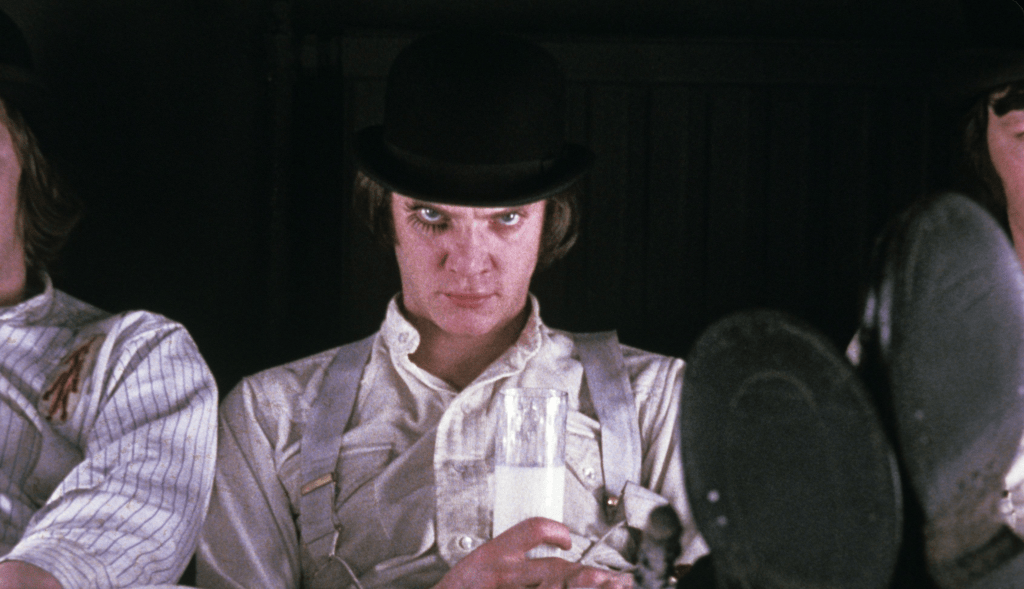
Not because a censor or any court said no, but because one man, in one house in Hertfordshire, decided that his own movie was too dangerous to leave in the room with you.
Say it slow: self-imposed. Keep saying it until it stops meaning anything, they way words do if you repeat them often enough. Self. Imposed. A man banned his own movie from his own adopted country, and he did it so quietly that half the country thought the government had done it for him.
They hadn’t; nobody had. And it’s that part which should scare you a little.
What you should know about the milk bar and the droogs and the ultra-violence, and I’ll give it to you fast as Kubrick would have wanted it, is:
A Clockwork Orange opened in British cinemas on the 13th January, 1972. Malcolm McDowell’s eyes, the cane and bowler hat. Beethoven’s Ninth Symphony turned into a weapon. The movie had already been passed by the British Board of Film Censors with an X certificate, adults only, thank you very much. John Trevelyan’s board had rejected an earlier attempt at a script back in 1967 with the Rolling Stones playing the gang. But this version, Kubrick’s, went through clean.
Clean is a word that’s about to stop meaning anything, too.
Within months there are headlines. Not just one, but a pattern. A seventeen-year-old Dutch girl is attacked in Lancashire by a gang singing “Singin’ in the Rain.” The same tune and choreography of Alex’s home-invasion sequence, transplanted from the screen and into a field. A sixteen-year-old boy beats a homeless man to death and basically tells the police that he had heard about a scene like it. In 1973 a homeless firewood seller is murdered and the tabloids go looking for something they can call, with a straight face and in print, the Clockwork Orange Gang.
You want a body count and the tabloids give you one. Whether the movie caused any of it is a different question, and it’s a question nobody in 1973 was interested in answering, because a real answer takes longer to print than a headline does.
Now, repeat after me: correlation is not causation. Say it in the voice of someone defending a thesis. And then forget it, because nobody in Fleet Street was defending a thesis. They were selling newspapers, and a teenager in a bowler hat looks better on the front page than a teenager in a school blazer.
Of course, the press didn’t invent moral panic; they just perfected the delivery system. Stanley Cohen was a sociologist instead of a moviemaker, although the two professions very doing very similar work that year, and he was already building a vocabulary for it: folk devils, groups changed into a stand-in for whatever the public was really afraid of, and in Britain in the early 70’s it was a lot of things which had nothing to do with cinema. There was mass unemployment, strikes, a country that had stopped feeling like it knew what it was. Give people a villain with a face, Alex’s face with false eyelashes and grinning at the camera, and they’ll take that over an economic forecast every time. It’s a lot easier to hate a movie than a decade.
There’s a technique to this, and it never changes: find an incident. Then find the flimsiest possible thread connecting the incident to the movie. Print that connection as though it were rope. Repeat until the connection becomes true simply from the repeating, as nobody fact-checks a folk devil.
Kubrick didn’t defend the movie in public, and this matters. This is the part people get wrong when they tell this story at dinner parties, where they imagine him giving interviews, standing his ground, the director-as-gladiator image that would look great in a documentary and isn’t what happened.
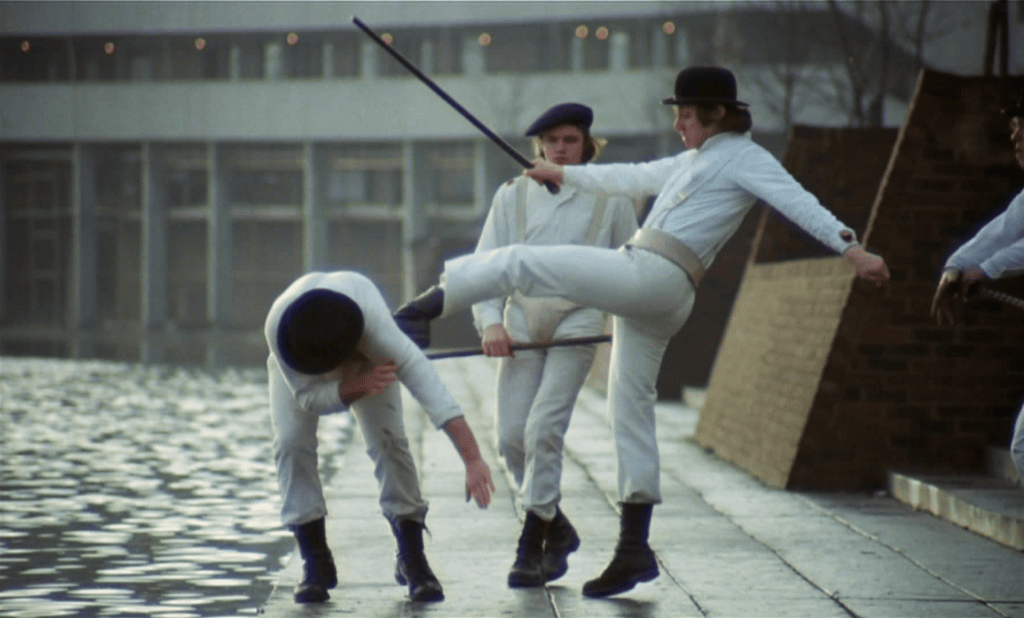
What did happen was quieter and worse. What happened was a man in a farmhouse outside St. Albans, someone who had moved his family to England because he found it calmer and more private, easier to disappear into, started getting phone calls. Started getting letters. Started getting told, by people who had never met him, exactly what would happen to his wife and daughters if he didn’t do something about that movie with his name on it.
He never gave the full content of those threats to the press; he didn’t need the world to know the specifics. He just needed the world to stop, and there was only one lever he could pull to make that happen. So, in 1973, a year after the British release with the box office still strong and the movie still making money, he pulled it. He asked Warner Bros. to withdraw A Clockwork Orange from UK distribution. Not edited or resubmitted for a different certificate. Gone, off every print and out of every cinema. Effective immediately and indefinitely.
Note that word indefinitely. He didn’t say ten years, or fifteen, or even the twenty-seven it took. Nobody said anything, it just stayed gone.
Just a quick aside about power, a very specific and unglamorous kind.
A director in 1973 doesn’t usually get final say over distribution in a foreign territory. That isn’t how the contracts work, or even how studios work, generally. Warner Bros. had a hit movie generating revenue and a director told them to stop generating it, and they said yes because it was Stanley Kubrick, and Kubrick’s contracts were famously his own, and any man who could make a studio wait years for a single movie could also make a studio pull one off the shelf.
That’s the least reproducible thing about this whole story. No other director gets this; not before and not really since. It’s not a lesson about censorship so much as it is about leverage, and what happens when an artist accumulates enough control over his machine that he can, on his private decision, make an entire country’s relationship to a piece of culture simply stop. For twenty-seven years. Longer than some of the people reading this have been alive.
You can call that vanity or integrity. Both those readings survive contact with the facts. Kubrick himself gave almost nothing to feed either interpretation, with just a handful of guarded comments over the decades. There was never a real explanation, no apology and no defence. Silence held for that length of time is its own kind of statement, and it’s one that refuses to be paraphrased.
There are the myths and the corrections, and notice just how little distance there is between them.
Myth: the BBFC banned Clockwork Orange. Correction: the BBFC never rejected it. It carried a valid X certificate the whole time it was unavailable. There was never any legal reason it couldn’t be shown, there was only Kubrick.
Myth: it was banned because it was too violent for British audiences. Correction: British audiences had been watching it in cinemas for a full year before the withdrawal. The violence wasn’t new information in 1973. But the death threats were.
That gap between the myth and correction is where every good moral panic lives. Nobody wants the correction, as it’s bureaucratic and quiet, involves the words self-imposed, and the myth is a story about a nation so shocked by depravity that as one it rose up and banished that depravity from its shores. One version makes Britain the hero. The other? It makes Britain the audience for a man protecting his family from a mob the country’s own press had created.
Guess which version got repeated for three decades.
You want to know the strange part? While Britain was living without the movie, the movie kept living everywhere else.
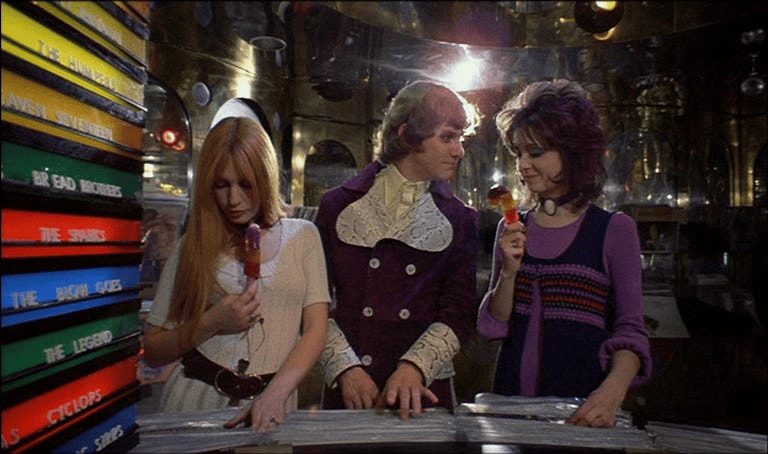
France and West Germany had it. Even in the United States, where it had drawn similar accusations and similar invoking of Alex DeLarge, it was never withdrawn. Only Britain went dark. So for twenty-seven years there existed a version of world cinema in which A Clockwork Orange was both an available object of study on one side of the Channel, and a rumour or bootleg VHS passed hand to hand at university film societies, on the other.
Bootlegs. Just think about that for a second. A movie’s illegal, degraded, fourth-generation copy became more culturally present in a country than the actual legal, and still-certified original as that original had been removed by the one man who still had the right to remove it. People were watching it on tapes recorded off continental television broadcasts. People watched it at private screenings organised like seances, word passed quietly and address given at the door. We all know that the forbidden version of a thing is always sharper in the mind than the actual thing. If you ban an object, you don’t destroy its meaning, you concentrate on it.
Now let’s put this next to the video nasties. The comparison writes itself and I’d be lying if I told you it didn’t. Ten years after Kubrick’s withdrawal, Britain had a new moral panic, one with a body of law behind it: the Video Recordings Act 1984, built to deal with a wave of low budget horror titles; Cannibal Holocaust, Driller Killer, Evil Dead, seventy-two titles, most cheaply made and some of them truly brutal and all imported on the new home-video format faster than anyone in government really understood how to regulate them. The Director of Public Prosecutions eventually came up with that list of seventy-two titles, all prosecuted or threatened with prosecution under obscenity law. Mary Whitehouse’s name is all over this, campaigning and quoting the worst possible frame of the worst possible movie and building a case for a country that needed protecting from its own video store.
The difference though, and it’s the whole difference, is the video nasties were banned by the state, through real statutes and prosecutions, through a board given real legal teeth to seize real tapes. Clockwork Orange was never touched by any of that machinery, not once. It sat totally outside the nasties list because it was never a video nasty in the legal sense. It had a certificate, a studio, respectability and a director with an Academy Award nomination on the mantlepiece. It didn’t need to be banned by the state as it banned itself first.
The same fear. The same tabloids, and usually the same specific tabloids, running the same shape of headline ten years apart. The same appeal to a public that violence on screen was a direct pipeline to violence in the street. A different mechanism completely. One is a government deciding what its citizens are allowed to own. The other is an artist deciding what he’s willing to survive.
If you want to understand British moral panic as a genre, put both those stories on the same shelf. Read A Clockwork Orange’s withdrawal as the elegant version and the video nasty list as the ugly and bureaucratic version. You’ll see they’re both the same organism wearing two different suits, and that organism doesn’t care which suit it’s wearing as long as it keeps being afraid of something.
Kubrick doesn’t relent. He doesn’t let a distributor quietly put a print into a festival, or do the thing directors do now with the anniversary re-release, the twenty-fifth-anniversary cut and interview circuit where he explains what it all meant. He just leaves it closed, the same way you leave a door closed on a room you don’t want to think about, and he carries on making movies. Barry Lyndon, The Shining, Full Metal Jacket, Eyes Wide Shut, all arriving in British cinemas without incident or threat, without a single headline connecting a real crime to a Kubrick frame, and A Clockwork Orange just sits there behind him the whole time, an old would he built his entire later career around not touching.
He dies in March 1999, six days after showing the final cut of Eyes Wide Shut to his family and the stars. That’s a story of its own, where a man finishes his final movie and doesn’t live to see it released.
But within months, Warner Bros. have cleared A Clockwork Orange for UK re-release. No new laws have been passed, and the BBFC haven’t changed their mind, because their mind had never been the problem. The single obstacle standing between Britain and that movie for nearly three decades had been one mortal, threatened man, and now that the man was gone, so was the reason.
Just think about what that means. The ban wasn’t really a ban on a movie. It was a ban shaped exactly like a man’s life and running exactly as long as he did. And it ended the instant he stopped being a target anyone could threaten.
The last thing, and the thing that should sit with you after everything else in this essay has stopped mattering.
The moral panic never needed the crimes to be real; it only needed them to be printable. It needed a swinging cane and a bowler hat and a nation’s appetite for a villain it could point at instead of a decade it couldn’t fix. It got twenty-seven years out of a single run of headlines and one frightened family, and it would have kept going if the man at the centre of it hadn’t simply died first.
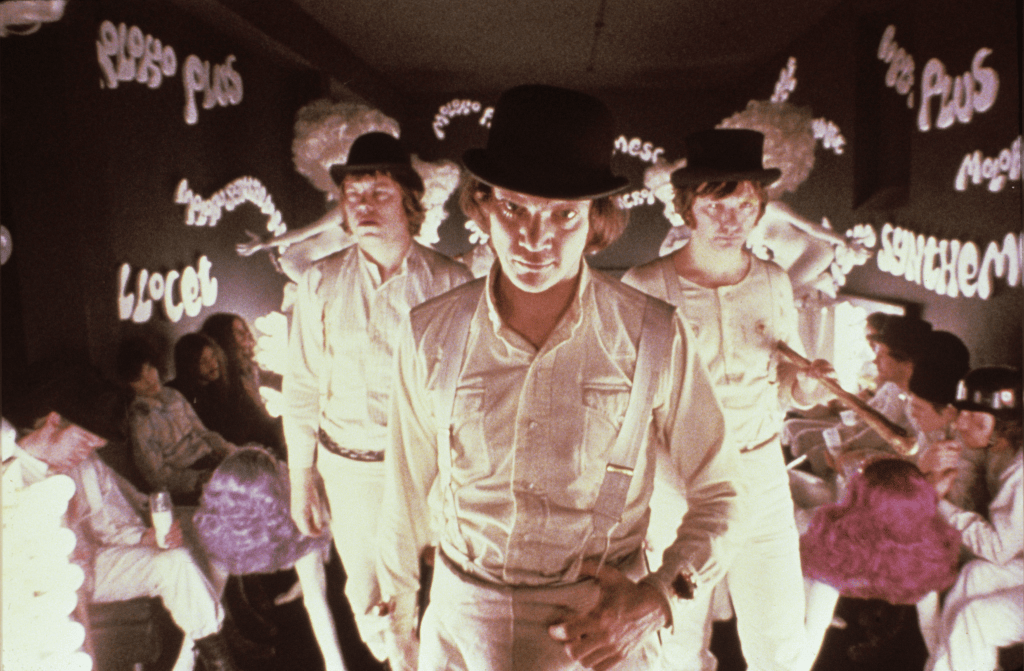
This isn’t a story about censorship. Censorship is a decision from the government, something you can file an appeal against, or a law that can be repealed. This was smaller and colder than that. This is a story about what a mob can make an artist do to his work, with no trial or verdict. Just phone calls and letters through the post and a silence that runs twenty-seven years deep and only breaks when the man holding it stops breathing.
Say it again, one more time: self-imposed. Now tell me that’s not the most honest phrase in the story.
Adam Page is a freelance writer focusing mainly on film and literature with a special interest in all things horror related. He is in his final year studying for a BA in English Literature and Language and is somewhat obsessed with Bruce Springsteen. He plays terrible guitar and is definitely a cat person. His favourite film changes depending on what his mood is.


