
By Christopher Stewardson
Ultraman (1966-67) turned 60 this past July. Naturally, Tsuburaya Productions has capitalised on the anniversary with an array of merchandising, special events, its newest Ultraman series (Ultraman Teo), and a far-reaching documentary (The Origin of Ultraman) which traces the global resonance, cultural position, and personal meaning of the Ultraman character.
When Ultraman was first broadcast in July 1966, it built from and continued the success of Tsuburaya Productions’ Ultra Q (1966), which thrilled audiences with half-hour, black-and-white stories featuring a parade of bizarre creatures, alien visitors, and strange happenings. Broadcast in January that year, Ultra Q entered (and ultimately bolstered) a media landscape primed for its monstrous offerings. Indeed, by 1965, Toho’s consistent output of special effects epics had flooded cinemas with everything from Godzilla (1954) and Mothra (1961) to The Human Vapor (1960) and Gorath (1962), making stars of the studio’s kaiju stable in the process. These films regularly attracted high audience attendance, going out on double bills with films from Toho’s other flagship series like the Young Guy films or the Crazy Cats comedies – a testament to their broad appeal in the first half of the decade. Also in 1965, rival studio Daiei chased Toho’s kaiju successes via Gamera, the Giant Monster, and Toei weren’t far behind.
So, when Ultra Q appeared, it properly consolidated a veritable “monster boom” that exploded as the year went on. Indeed, at the cinema, Toho continued with both The War of the Gargantuas (1966) in July, and then another Godzilla entry via Ebirah, Horror of the Deep (1966) in December. Daiei followed up its debut Gamera film with Gamera vs. Barugon (1966), as well as their excellent Daimajin trilogy. Meanwhile, Toei offered thrilling special effects titles via Watari, the Ninja Boy (1966), The Golden Bat (1966), and Magic Serpent (1966). And on television, where the “monster boom” was arguably most pronounced, Toei delivered the creepy Akuma-kun (1966-67), P-Production produced Japan’s first colour special effects TV show via Ambassador Magma (1966-67), and following on from Ultra Q, Tsuburaya Productions’ Ultraman made its debut in July. Monsters were everywhere.
Concerning the “face” of this monster boom, it’s Tsuburaya Productions’ connection to Toho that’s most significant. Eiji Tsuburaya, Japan’s special effects titan, established the company that would eventually be called Tsuburaya Productions in 1963, allowing for freelance work with a variety of film studios. Toho quickly invested in the company in 1964 and appointed staff to executive positions. Many of Toho’s creative personnel would also carry over to Tsuburaya Productions’ output, with sound design, models, and monster costumes from Toho’s films reused for Ultra Q and Ultraman. In turn, it is a visual testament to these intertwined company histories that the very first monster which appears in Ultra Q (the ancient kaiju Gomess) was constructed from the 1964 Godzilla costume. Indeed, Gomess proceeds to battle a fantastic bird named Litra, which itself was a redressed Rodan puppet. Later in the series, Manda (from 1963’s Atragon) appears in the sixth episode as a dragon, whilst Baragon (from 1965’s Frankenstein vs. Baragon) was redressed as Pagos for the show’s eighteenth story. Baragon would then be redressed several times more for Ultraman, serving as Neronga, Magular, and Gabora, the first of which also faced off against repurposed A-Cycle Ray vehicles first seen in Invasion of Astro-Monster (1965). Similarly, the V-TOL jet design from Gorath would also be used in Ultraman for the main aircraft of the Scientific Special Search Party (SSSP), the high-tech investigation agency at the heart of the series. These are just a handful of examples.
Of course, all the programmes and films of the mid-’60s kaiju boom were deeply interconnected (for example, Tomio Sagisu, who founded P-Production, had worked under Eiji Tsuburaya and was briefly associated with Tsuburaya Productions’ staff; P-Productions even contributed some animation for 1962’s King Kong vs. Godzilla), but the Toho-Tsuburaya connection is paramount when considering this media landscape.
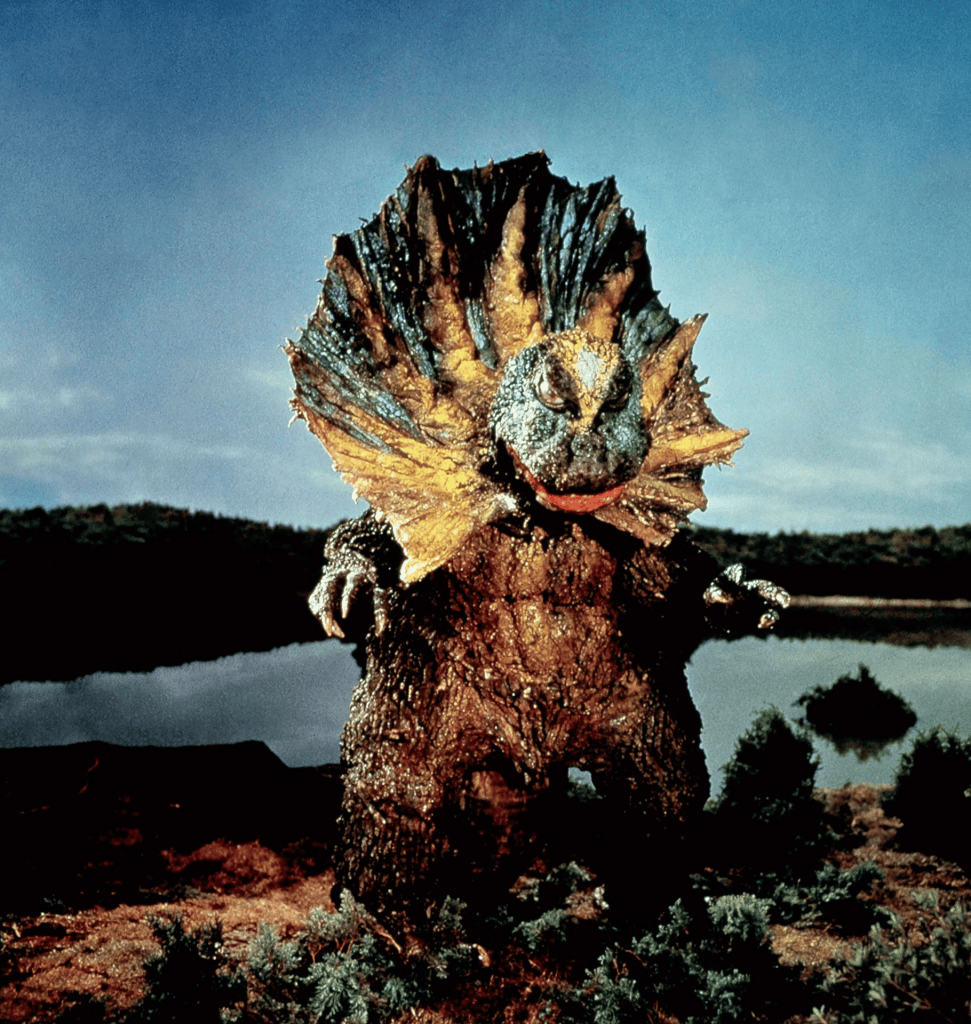
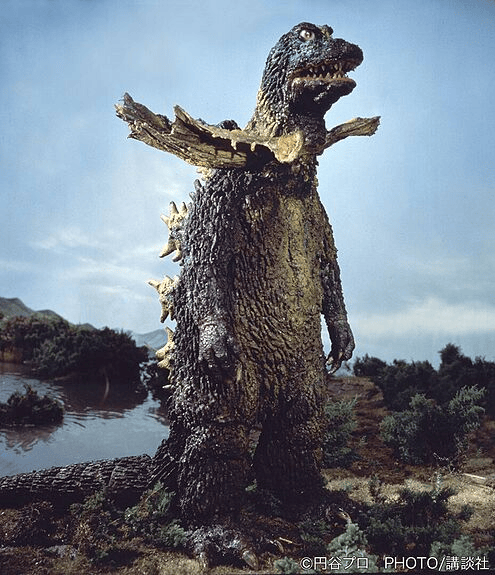
When Ultraman’s tenth episode was broadcast in September 1966, Godzilla was once again redressed as a new kaiju. And I would argue that this monster, Jirahs, is the face of the mid-’60s kaiju boom. In the episode, the SSSP investigates Lake Kitayama due to a mysterious increase in its fish population. The cause is revealed to be a gigantic dinosaur-like creature, named “Jirahs” by the maniacal scientist who raised it. When the monster runs wild, the SSSP’s Hayata (Susume Kurobe) transforms into Ultraman to do battle.
Jirahs was constructed using two Godzilla costumes: the body of the 1964 Godzilla suit and the head of the 1965 costume. Around Jirahs’ neck was a large frill, and the creature’s body was given hues of yellow, green, and blue. Kaiju designer Tohl Narita, who designed most of the series’ monsters and whose creative philosophies would indelibly influence conceptions of kaiju going forward, even described Jirahs simply as Godzilla with a scarf. Fittingly, inside the Jirahs suit was Haruo Nakajima, Godzilla’s predominant performer between 1954 and 1972.
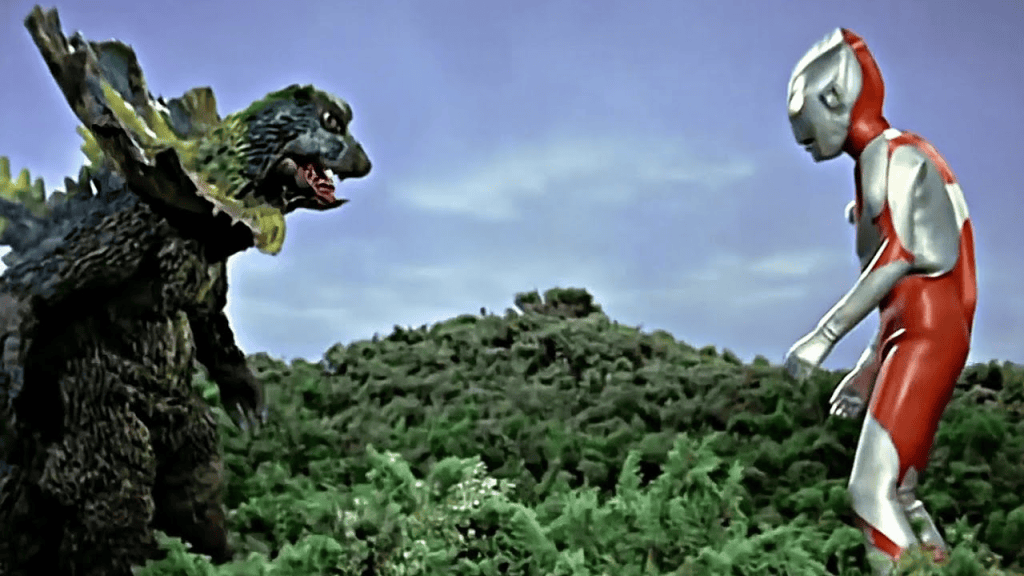
When Ultraman finally appears, it isn’t long before the silver giant rips away Jirahs’ frill. If a child had walked into their living room at this juncture, they’d be met with the image of Godzilla versus Ultraman. And this is the significant point. Whilst technically not Godzilla, the images present exactly that: Godzilla and Ultraman together in full colour. Two of Eiji Tsuburaya’s most influential creations squaring off in a programme broadcast at the height of a media explosion directly caused by the films and images he’d helped to produce. Ultraman ultimately defeats Jirahs, who collapses with a thud as a sombre melody from series composer Kunio Miyauchi (recycling a track from his brilliant score for The Human Vapor, other pieces of which had already been used in Ultra Q) conveys the tragedy of this poor monster. We could look at this as Godzilla passing the torch.
Indeed, the next few Godzilla films in the second half of the decade began playing to narrower, younger audiences. The kaiju boom on television directly competed with monster films at the cinema, as part of television’s wider impact on cinema-going audiences. Indeed, the Japanese film industry itself was slowly sinking into a depression that would eventually affect Toho’s special effects films more overtly. Godzilla’s character had also been shifting to a friendlier, more anthropomorphised position at this point, demonstrating the series’ ability to evolve (appealing to children in the process) but much to the dismay of creative staff and older fans at the time. But whichever factor you look at, audience attendance for Godzilla films was in steady decline. Ultraman would be followed by Ultra Seven (1967-68), which was arguably even more popular than its successful predecessors, firmly consolidating the hold that Tsuburaya Productions’ early Ultra programmes had on contemporary popular culture in Japan. Godzilla certainly wasn’t gone completely, but it isn’t hard to view Jirahs collapsing before Ultraman as a visual metaphor that we can understand in retrospect. It is to this end that Jirahs exemplifies the kaiju boom, from its roots with Godzilla to its future with Ultraman, and with Eiji Tsuburaya’s guiding hand serving as their connective tissue.
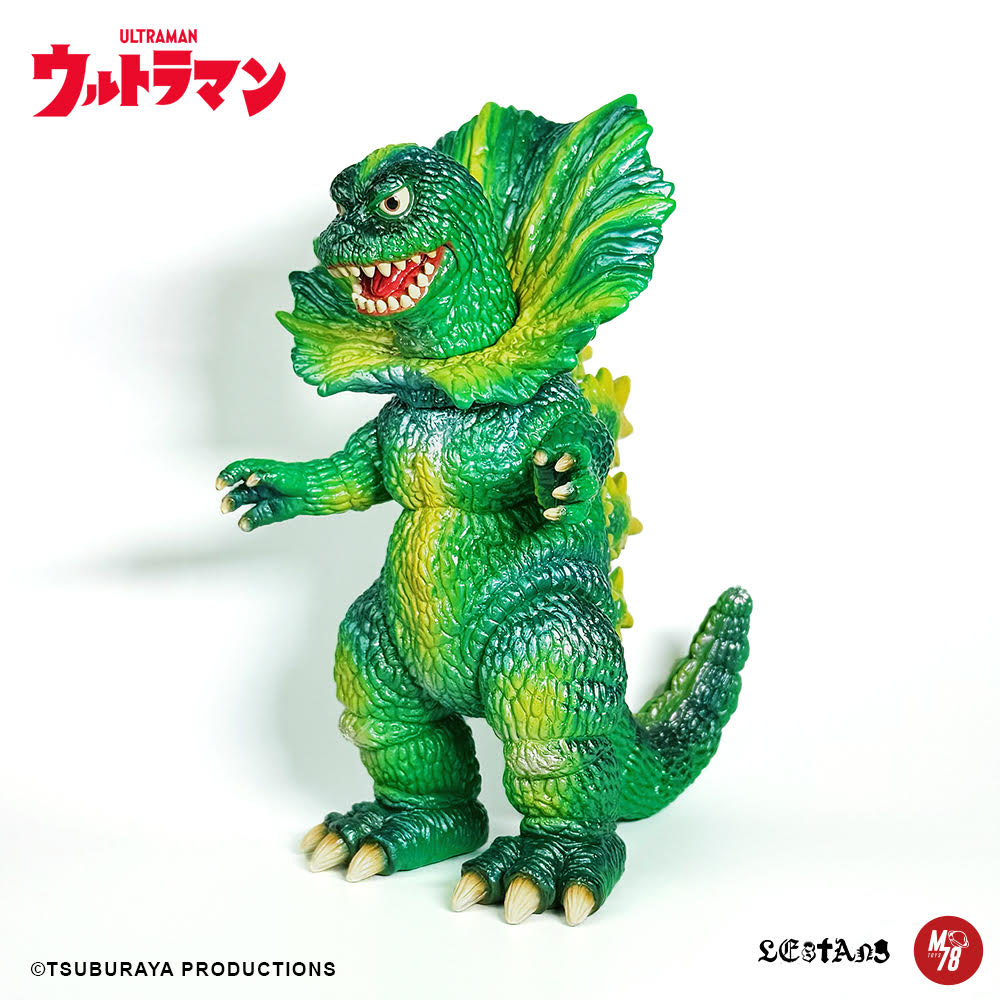
In terms of Jirahs today, kaiju fans online have observed several Jirahs-related items in recent merchandising efforts, with twitter user @TAKUM78 noting a distinct influx over the last year. Another fan, twitter user @cosoOmo, wondered whether this increase in Jirahs’ presence has been a means to lure Godzilla fans to Ultraman; though, as they note, fans of the former are likely already enthusiasts of the latter. Then again, in America, where some Godzilla fans still seem strangely reluctant to dive into Ultraman, Tsuburaya Productions’ participation at G-Fest in 2025 (complete with Jirahs making an in-person appearance) may work to such an effect. In any case, @cosoOmo’s hypothesis reiterates the intersection the two characters share. The monster remains a mascot for the interconnection between Tsuburaya Productions and Toho, and, appearing as it did in 1966, the face of the kaiju boom itself. As we celebrate Ultraman’s 60th anniversary, let us also consider this tragic, frilled kaiju and all it has come to symbolise.
Christopher Stewardson (IG: chris_stewardson) Christopher Stewardson researches and writes about mid-20th century genre cinema, predominantly from Japan and America. He is the author of a critical companion to GHIDORAH, THE THREE-HEADED MONSTER (1964), published with Liverpool University Press. His other writing can be found in Fangoria, Little White Lies, the Film Masters blog, and in blu-ray liner notes for Eureka Entertainment.


