By Joseph Ratchford
‘Is he man? Or monster? Or is he both?’ was one of the three taglines that brandished the first issue of The Incredible Hulk. The others were ‘Fantasy as you like it!’ and ‘The Strangest Man of All Time!!’. They didn’t stick the same way.Created by Jack Kirby and Stan Lee in the early years of their collaboration, The Incredible Hulk was, similar to the duo’s Fantastic Four, and its successor, Stan Lee and Steve Ditko’s Spider-Man, a different kind of comic hidden within the branding of super-heroics. Fantastic Four, whilst on the surface a family of ‘superheroes’, had more in common with pre-superhero pulp novels than the vigilante adventures of Batman and Superman, and Spider-Man more with the company’s pre-superhero romance melodramas such as Minnie the Model. The Incredible Hulk was no different. Except The Hulk was no fantasy adventure, and it certainly was no romance comic.
The Hulk was horror.
Jekyll and Hyde in the spectre of the Cold War. A pulp reckoning with nuclear power. The effect of an atomic bomb test gone wrong, meek, ‘cultured’, atomic scientist Dr Bruce Banner was cursed to, at night, transform into the inhuman, uncontrollable, Hulk. The comics’ dialogue frequently comparing the character to a gorilla in both size and strength, those early issues, intentionally or not suggested that there was a primal, animalistic, urge that motivated the bomb, and it was a shadow that cast over its creation.
Whilst nuclear anxiety no longer hangs over the character, at least, not in the same way, one element from that short run (the title being a rare unsuccessful one for this era of Marvel, only lasting six issues) caught on, and remains consistent to this day: the divide between Banner and the thing that lives inside him. To Banner, the Hulk is a primal, inhuman creature of pure aggression. To the Hulk, Banner is nothing but weakness. One side is all he represses, the other is a shell without it. Jekyll is Hyde, after all.
Ang Lee’s oeuvre is one defined by its relationship to repression. In any genre he touches, be it the romantic comedy (The Wedding Banquet), the spy thriller (Lust, Caution), the western (Brokeback Mountain) and the wuxia (Crouching Tiger, Hidden Dragon), his work will always find the desires, find the selves. His characters have hidden themselves through their place, within their status in society, and what self could be more hidden than one that is bright green and nine-foot tall?
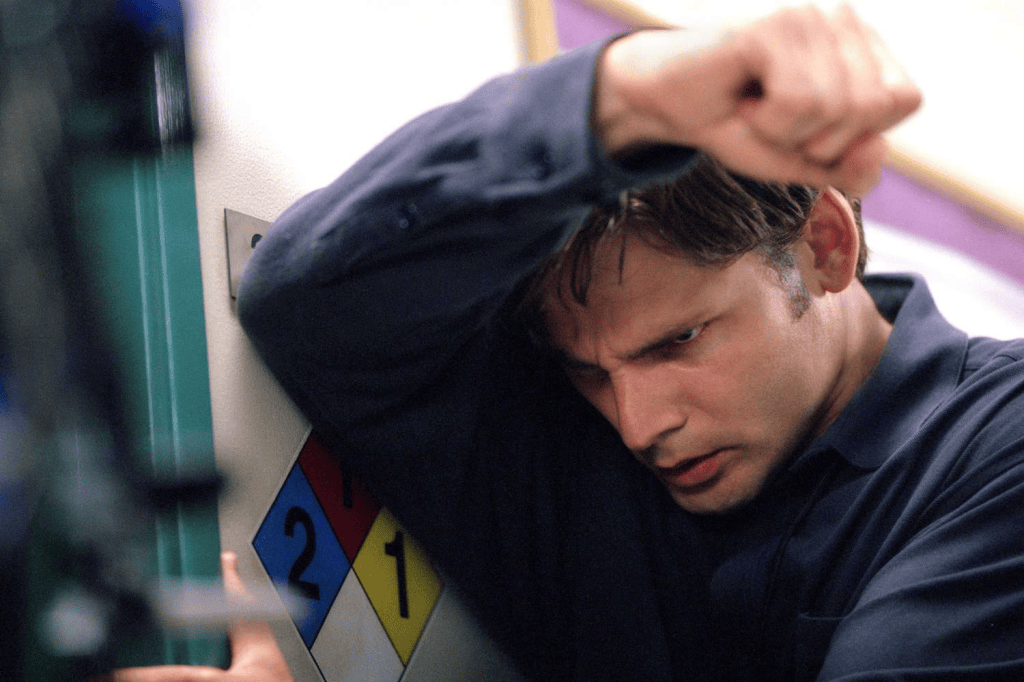
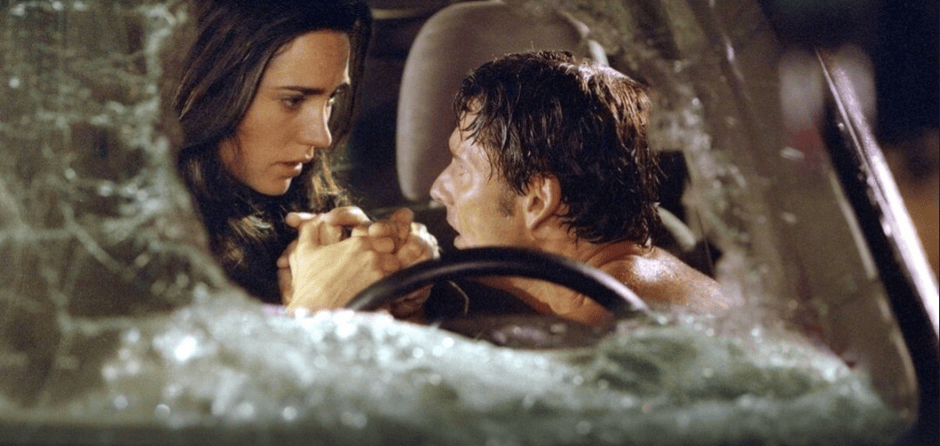
Hulk reframes the character as, not a pulp reckoning with the Cold War, but as a pulp reckoning with parental trauma. The film’s lead is Dr. Bruce Banner (Eric Bana), a genetic scientist, adopted after the death of his parents when he was four years old. Banner is a passive protagonist, friendly with his colleague and ex-girlfriend, Betty Ross (Jennifer Connelly), but reserved. When a test on a genetic experiment goes wrong, Banner finds himself faced with a man who claims to be his deceased father. That same night, Bruce has a blackout, and he transforms into a nine-foot, bright green creature, controlled only by a childlike rage. The next morning, he has forgotten the night before, only feeling a simmering rage and flashes of memories unfamiliar to him; memories of a woman, a house, a green explosion in the desert and a knife. He is contacted and imprisoned by Betty’s father, General ‘Thunderbolt’ Ross (Sam Elliott), due to both his drastic transformation and the similarity of his work to that of his disgraced father, David Banner (Nick Nolte). A father the general claims murdered Bruce’s mother. A murder Thunderbolt claims Bruce was witness to. A murder he does not remember.
Whilst received tepidly by critics and immediately dismissed by audiences, the film understands the nature of the character, and the genre in which he plays like no other adaptation. Hulk is not an uplifting piece of good vs. evil. It is not thematically simple and concise; it does not primarily aim to move nor entertain you. It may aspire to do those things, but the primary aim of the film is to provoke audiences. Not with its content, not with its scares, not with its protagonist, but with its themes and psychological complexity.
I do not want to write off the superhero subgenre entirely, especially as a similar emotional complexity and pulpy visual sensibility can be found in Sam Raimi’s Spider-Man trilogy. However, as Witney Crother Dilley states in her book The Cinema Of Ang Lee: The Other Side of The Screen, the first two instalments of Raimi’s trilogy follows a more conventional ‘good vs. evil’ dynamic between the titular character and his villains, the complexity being built on the scaffolding of a conventional narrative and a likeable, relatable lead. Tobey Maguire’s Peter Parker is a put-upon everyman, a wide-eyed romantic, and a man who can control his fantastic abilities. His origin is tragic, but it is a lesson that sets him on a path towards undeniable super-heroism.
Hulk is similar to Raimi’s films, but it is no superhero movie. Rather, it is a monster movie.
The monster movie, whilst often crossing over with horror, is its own distinct entity. While horror is defined by its intent to scare and disturb the viewer through both its aesthetic and thematic choices, the intent of the monster movie is to utilise the idea of the monster to explore specific sociopolitical themes. Whilst the monster can be used primarily to thrill audiences, with their thematic purposes present, but backgrounded (Alien, Aliens, Pacific Rim, Tremors, many of the Heisei-era Godzilla movies), the monster as thematic exploration is usually foregrounded in not just the most beloved of these films (the original Godzilla and King Kong films respectively, The Host, The Shape of Water), but also the most embryonic of them: the Universal Monster movies.
When we think of the Universal Monsters, the first things that come to mind are probably not the films themselves, but their impact on pop culture. The bright green Frankenstein’s monster of decades of Halloween costumes, a Dracula that resembles Bela Lugosi doing the Monster Mash, the archetypical toilet-paper-bandage mummy, Young Frankenstein. These films maintain an identity as family-friendly Halloween iconography, which, whilst enjoyable, hides the great thematic depth they contained. It may not be as heady as Mary Shelley’s novel, but James Whale’s Frankenstein duology is still a story of a man disgusted by his own hubris. His own, ‘savage’, heartbroken, creation, (Boris Karloff) looking back at him, and unable to understand how his creator could hate him. Whale’s follow-up to his first Frankenstein film, The Invisible Man, whilst wildly entertaining, is a film about a man who is given unapologetic freedom to do as he likes when made invisible, and slowly goes mad. Given that Whale was gay, the character might speak to the entitlement closeted existence brought queer people in the 1930s, at the expense of their own stability and sanity. The Wolf Man is an exploration of wrestling against one’s repressed sexual desires. Whilst heavily abridged from the original novel, Dracula as portrayed by Bela Lugosi oozes the predatory sense of sexuality common to the character. These films deal with characters who have to either repress or answer to a reflection of themselves. They are not scary. Instead, they are gleefully unsubtle, almost theatrical in the scope and shadows of their imagery and size of their acting, even if the emotions covered are heavily internalised. They are didactic and clear with their themes. These are the foundations of the monster movie and Hulk’s sensibility fits wonderfully alongside them.*
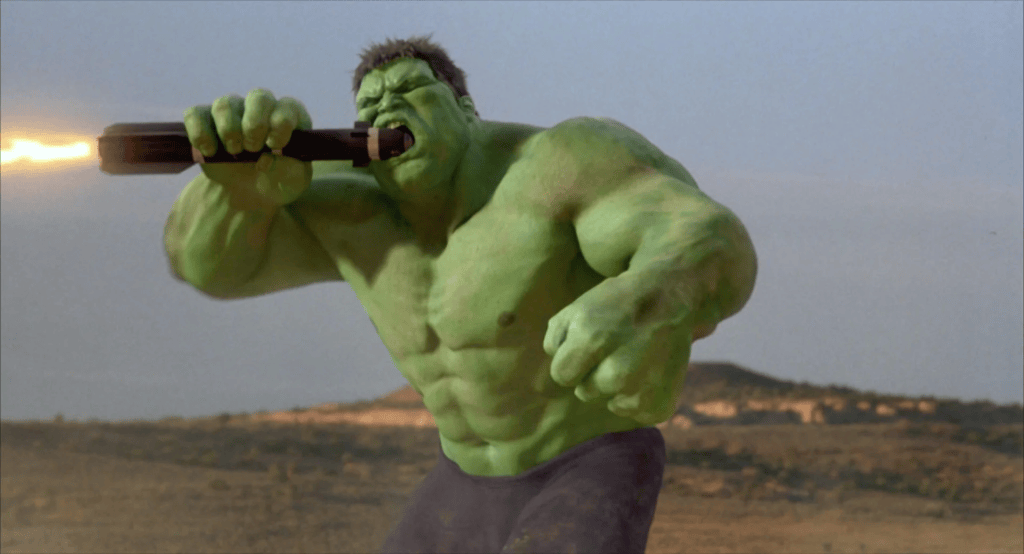
The creature itself is, similar to the Universal Monsters, not obscured in shadow, instead being shown in its entirety. Whilst the character’s design is still mocked for its excessive greenness compared to the greyer, more realistically-toned Hulks of Mark Ruffalo and Edward Norton’s takes on the character, it fits the heightened visual tone of the film excellently; the Hulk operates more as a metaphor, and what he represents is foregrounded by the film, and the action is backgrounded. The first look we have of the monster is it standing in the doorway of Bruce’s childhood home; the doorway through which he saw his father kill his mother. It is the only time we cannot see its face. When Bruce transforms, the film pays close attention to how his body contorts, it ties itself in knots, it expands and grows in ways that, whilst never quite body horror in execution, is so in intent. Much like Frankenstein’s Monster, this is a broken thing that shouldn’t exist.
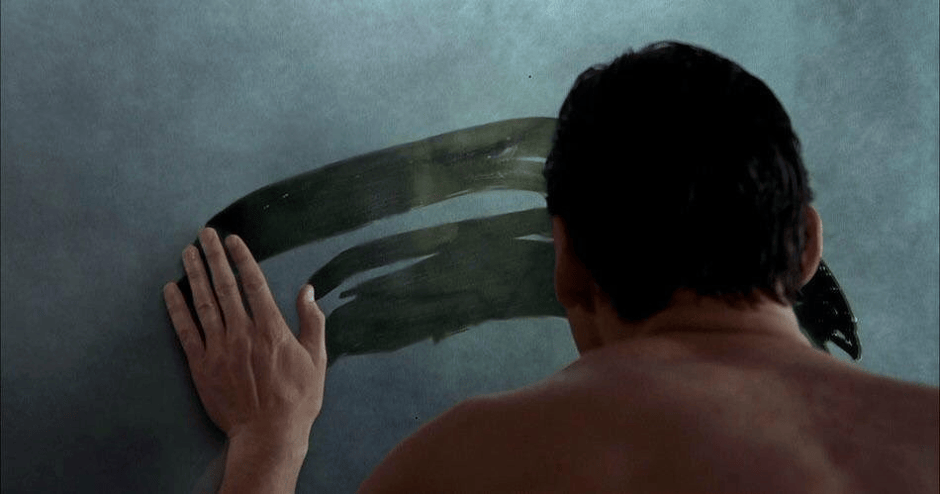
The influence of James Whale and Boris Karloff’s take on Frankenstein’s Creature lingers over the Hulk, both in personality and presentation. Of course, said depiction’s influence; the bright green skin, the broken English and childlike personality, have all been elements of the Hulk since the early 70s, but it is Lee’s film that takes influence from said presentation’s humanity alongside its aesthetics. The monster’s face is always clear, always framed in such a way we can see its changes and complexities. The Hulk (Ang Lee himself supplying the character’s voice and facial capture) can look at Betty Ross with a love and affection it cannot state, but can express better than Banner possibly could. It initially gazes into David Banner’s eyes with the love a child has for its parent. It always looks confused, lost, and heartbroken. Just like Frankenstein’s Creature, the Hulk cannot fathom the hatred and anger of the world he faces. It cannot understand how its creator, the man that has kept it subconscious, hides it away. In one spectacular sequence, we see what Bruce perceives when he has transformed. The Hulk stares at him from the other side of a fogged-up mirror, watching until he grabs him through the other side. The Hulk is antagonistic, calling Bruce ‘puny human’. The Hulk is terrifying. An inhuman thing that takes Bruce’s autonomy away from him. A parasite that expresses nothing but disdain for its host. But when the camera lingers on the monster’s mournful face; we understand that this is just Banner’s perception. The Hulk is creature of pure id, Bruce Banner and the Hulk are Jekyll and Hyde, sure, but this Hyde is not the evil found within Jekyll, but the terrified child within.
Whilst the character makes for an engaging counter to Whale’s Frankenstein, what really makes the film a monster movie in the Universal tradition is its staging. Whilst Hulk eschews the large stagey backdrops and German Expressionist shadows of its forebearers, it still presents itself visually with an acceptance of and eye for its unreality. The film liberally uses the bright colours and visual conventions of a comic-book. scenes are often split into panels. Lee usually using the technique to bring attention to multiple close-ups to allow the viewer to engage with several characters emotionally at once, or juxtapose the film’s action sequences, with the reactions of those around the Hulk, underlining that, to these characters, what they are witnessing is nothing short of horrific. The film’s non-naturalistic style enhances the emotions of scenes and characters in a way that brings attention to their size, even if the performances are in the more naturalist style that Lee specialises in as a director. Theatre is not an invisible influence, either. The emotional finale of Hulk is a conversation between Bruce and his abusive father, David. The scene is framed with both participants lit across an empty background; more akin to black box theatre than a superhero movie. Not only is this scene, a moment of sincere, theatrical, performance above special effects indicative of what makes Hulk a Universal Monster film specifically, it speaks to the humanity that animates it, and the humanity with which Hulk treats its subject.
The film is, at its core, about the scars of an abusive childhood, and the emotions in which they trap you. It is not just that Bruce is emotionally withdrawn, so much so that his relationship with Betty is almost defined by Bana and Connelly’s non-chemistry, and awkwardness, but that he exists in the absence of them. Bruce is a man who goes through the motions. He has no idiosyncrasies. He has no sense of joy, of sadness, of anger. His existence exists in absence of anything that can be noticed, and therefore exploited. The only intimacy, physical or emotional, he truly shares with Betty is post-transformation, and it is always with the intent to either hide or suppress the Hulk. To hide and suppress his memories. To hide and suppress his emotions. To hide and suppress himself.
In the film’s prologue, displaying Bruce’s childhood, which runs counter to his father’s scientific experiments on both the boy and himself, his mother states that Bruce ‘is just so bottled up’, his only form of emotional expression being when he makes his toys fight. The film does not show us any other games. The film makes it clear that The Hulk was not born in his lab accident. The Hulk was not born when his mother died; the Hulk has always been there.
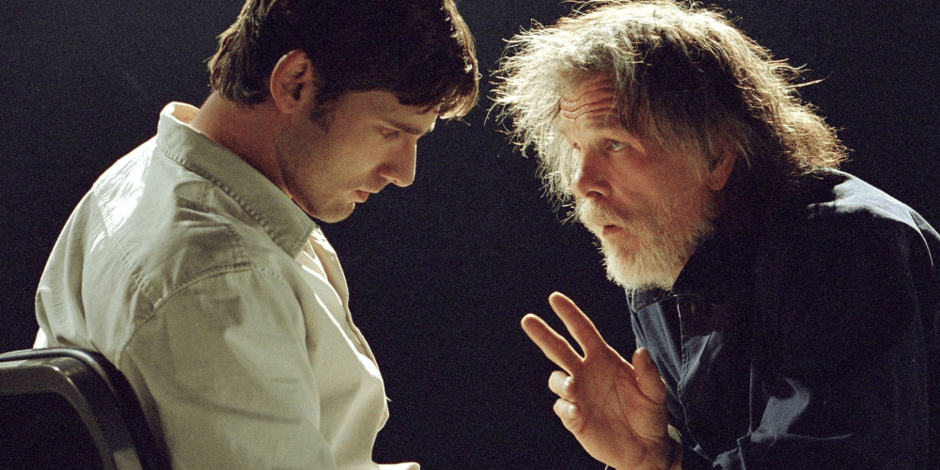
The film literalises much of this subtext, the experiments David Banner does on his son are the results of those he has done to his own body. The idea is positively Freudian, the monster that the father has passed onto the non-consenting son. When we see David play with Bruce as a child, he encourages him to ‘have a fight’ with his toys, encouraging the same violence that defines David as a husband, and foreshadows the tendencies that the Hulk will later unlock in Bruce. This is further literalised by David’s reasons for re-entering Bruce’s life once he starts to transform; he wants to absorb the Hulk, and by extension Bruce, into himself. His interest in his son is only in how he can gain his own power, and, when using a shred of Bruce’s DNA gives him the ability to absorb anything he touches, to stabilise it. As he puts in the scene discussed above: ‘I gave you life, now you must give it back to me.’ It’s pure narcissism, and speaks to the cyclical nature of toxic masculinity: all the father has taught his son is violence, all he has passed on is a destructive, repressed rage that he can never escape. Even in the film’s final action sequence, an impressionist scene where Bruce is briefly able to make peace with the Hulk, overwhelming David’s attempts to absorb him with the sheer depth of his emotions, screaming at him to ‘take it all!’, it does not last. Even with his father gone, even with a brief moment of peace, the trauma David has left him is forever part of him. The Hulk will never truly leave him, and he will never truly control it.
In contrast with David and Bruce’s dysfunction is that between Thunderbolt and Betty Ross. From the beginning of the film, the relationship between the two is a strained one. Lee blocks Connelly and Elliott within distance in wide shots, and, to take full advantage of the comic book form as a manipulation of space, in separate panels within the same shot. When the two meet for dinner early in the film, Betty realises that, whilst her father might claim to love and care for her, his ulterior motive (to subcontract her and Bruce’s work in healing radiation to the military), will always be his work. Whilst Thunderbolt Ross is not extracting his child’s blood, not trying to take her life away from her in the same way David Banner is to his son, the selfishness remains. Both fathers, as depicted in a childhood flashback that doubles as a dream sequence where Thunderbolt abandons two-year Betty at a diner for work, are men who have put their passions and their callings before their children. A neglect that has, adding to the Freudian reading the film has on the character, left Betty with ‘a fixation on emotionally unavailable men’, which she is, the film implies, aware of the roots of, but does not want to acknowledge. Whilst Betty does not contain anything as disruptive as a Hulk, her psychological scars are still there, and still destructive. Later in the dream sequence she imagines Bruce strangling her child self. This could double as the effect Bruce’s stifling of his inner child has on her emotions or the overall fear of male violence that hangs over her, a violence Bruce does not understand, but the Hulk, in some way, represents. Regardless, the film is quiet about her pain, compared to the expressionist, superpowered trauma of Bruce, but always empathetic.
It is in that choice that Lee’s film widens its scope from just the monster inside Banner, but the universality of parental trauma; that it maintains as a destructive force in all our lives, that everyone’s parents will fail them at some point. Maybe we won’t turn into literal monsters, but we are still the products of our parents, and their failures will leave us scarred. There is always a Hulk behind the doors we wish we didn’t open. To quote Crother Dilley: ‘The film was a plaintive cry for audiences to show compassion for this terrible, doomed, hero. But were the hearts of the audience soft enough to love this character?’ Perhaps it is not the softness of the audience that led them to reject Hulk, but the uncomfortable knowledge that the film spoke to the scared child inside them, waiting to be released.
Are we men? Are we monsters? Or are we both?
* Down to the film’s primary legacy being the tie-in ‘Hulk Hands’ toys and Halloween costumes.
Joseph Ratchford is a freelance writer based in Manchester, and a recent graduate from Lancaster University. Whilst he has a particular interest in genre cinema, he strongly believes that all films are worthy of analysis, appreciation and interpretation.


 Culture Film Publication