
By Adam Page
Are we sitting comfortably? Then I’ll begin. I want to tell a story about a woman. A woman who eats dog shit on camera and means it as a thesis statement.
Not as a joke, or a gross-out gag for the midnight crowd, although it certainly is that, too. As a thesis, filmed in one long, unbroken take so you don’t have the comfort of telling yourself it’s just a trick. We sit there in the dark and watch Divine’s mouth close around it and we understand, on a pre-verbal, lizard-brain level, that we just witnessed one of the most honest moments in gay cinema.
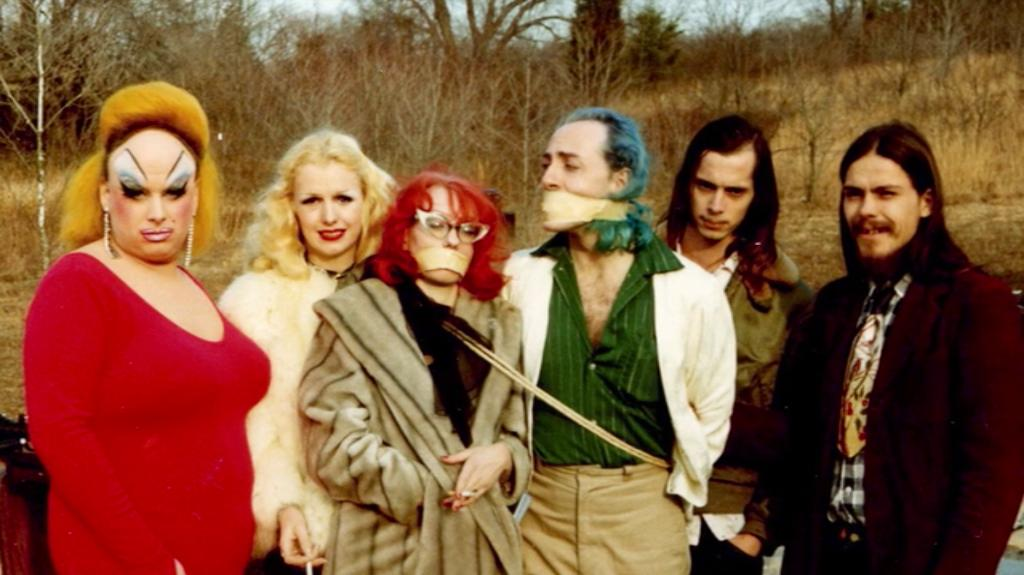
There is something that we first need to unlearn: that trash is the opposite of meaning, and that filth is just filth. If I had a hundred pages, I couldn’t unteach that quick enough, so instead, I’ll just show you a woman in a slinky red dress eating actual faeces and ask you to sit with the fact that in 1972, this was one of the only images of queer life that absolutely refused to apologise for itself.
Everything else was apologising.
Everything else was Sal Mineo dying pretty in Griffith Observatory, or the sad-eyed sissy who killed himself in the third act so the straight audience can go home feeling educated and not implicated. It was respectability politics wearing a movie reel like a hospital gown, ass hanging out while still bowing.
John Waters took a long look at that whole tradition; homophile respectability, a well-lit apology, a gay character created as tragic proof of good taste and citizenship, and did something far more radical than simply protest. He didn’t argue with it, as arguing means you accept the terms.
He made the terms eat shit.
You want to know what abjection is? Forget Julia Kristeva and her Powers of Horror essay for a second, forget the seminar room, I’ll get to that. But abjection is simpler than that. Abjection is what your body does the instant before your mind can stop it. It’s the gag reflex; the thing you can’t look at then can’t look away from, the wound or the roadkill, the mothers corpse you suddenly can’t call her anymore, just it. Kriseva’s entire argument is that the abject is what is expelled in order to make the self possible. Corpses, shit, blood and vomit: we cast them all out so that we can say I am not that thing. Civilisation has a long history of throwing waste products over the wall and calling the wall a soul.
Waters’ genius, and I’m using that word on purpose, knowing what it costs me to use it about a movie with a scene called ‘The Singing Asshole and Surfin’ Bird’ Waters’ genius was to understand that gay men, drag queens, or anyone else living outside the frame of mainstream respectability had already been thrown over that wall. Already abjected, and already the thing civilisation defines itself against.
So, he stopped trying to climb back over.
Instead, he built a whole cinema on the other side of it.
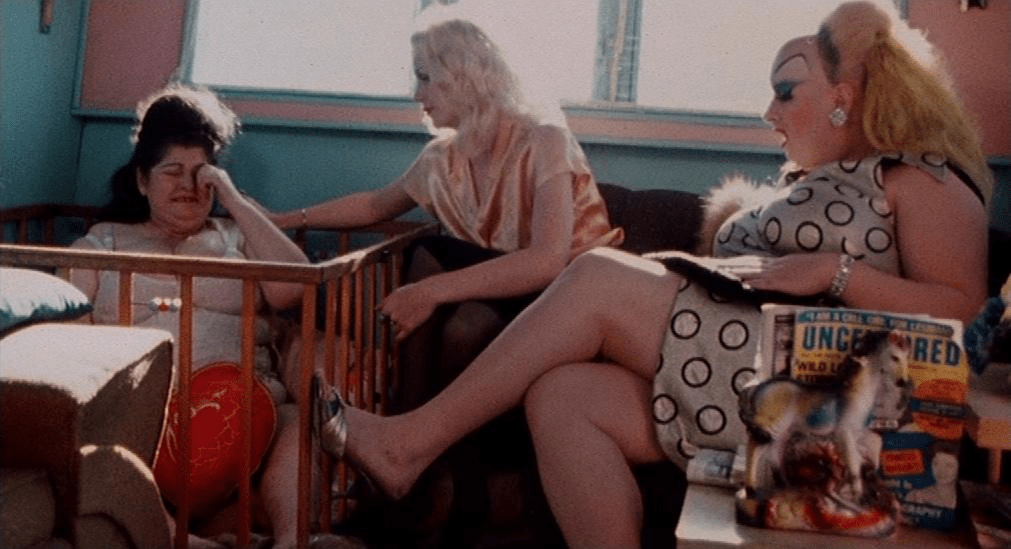
Every image in Pink Flamingos is built like a small and deliberate act of expulsion turned inside out. Divine does more than simply tolerate filth, she also curates it. She weaponises it. There is a moment where cleanliness itself becomes the joke, where those nice, tidy suburban rivals, the Marbles, those who kidnap young women and sell their babies to lesbian couples for a profit all the while maintaining a spotless home, are revealed as the real monsters, and Divine, filthy, screaming, and magnificent, is revealed as the only person in the movie who never lied about what she was.
And that’s pretty much the whole movie in one sentence; the clean people are the criminals, and the filthy woman is the only honest one left.
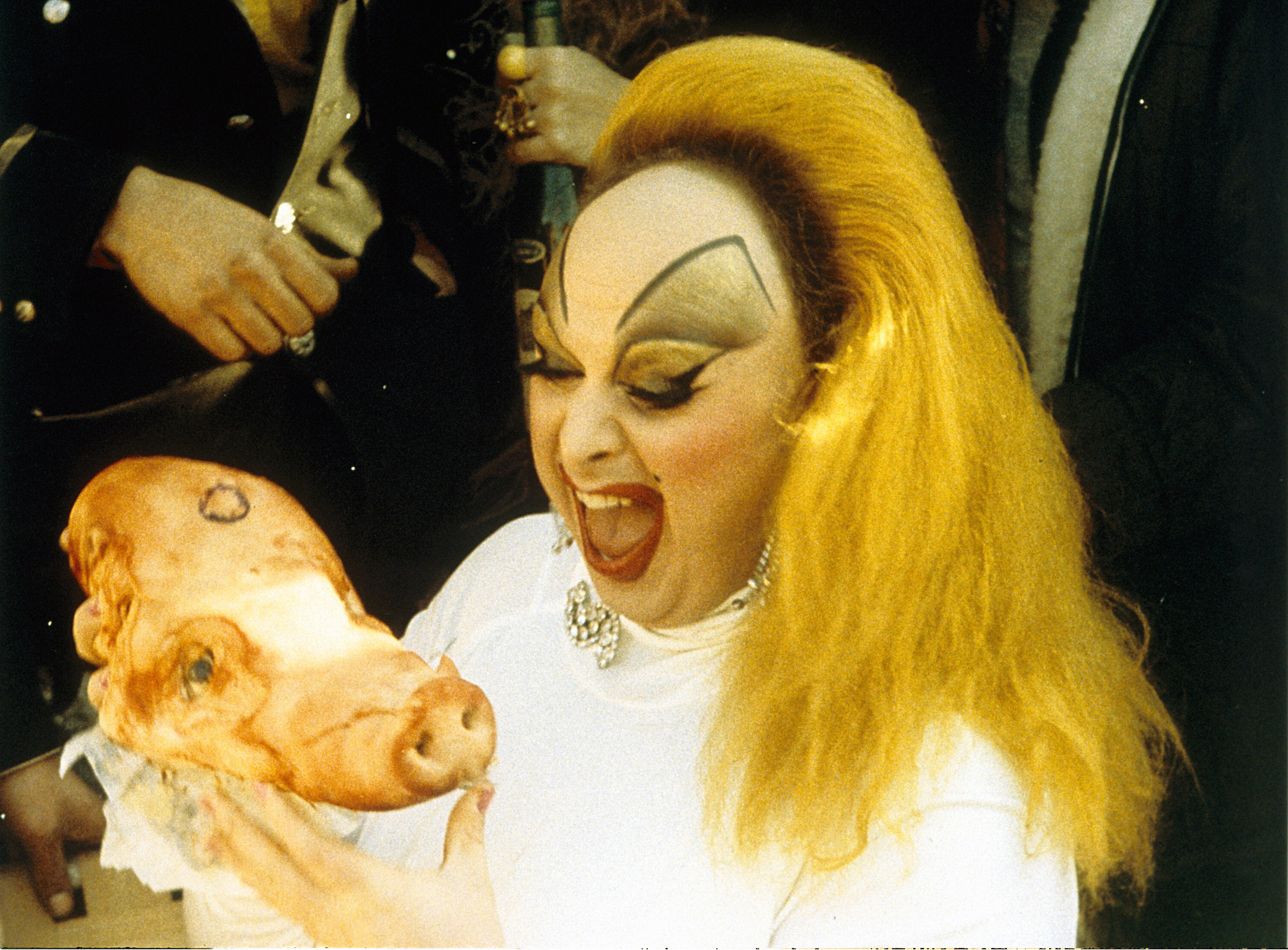
Susan Sontag wrote “Notes on ‘Camp’” in 1964 and tried to keep it apolitical, and filed under aesthetics, under “failed seriousness,” and under the double vision of loving something because it’s ridiculous. She wasn’t wrong in what she wrote, but I think she just wasn’t finished.
Waters picked up camp eight years later, doing the thing Sontag flinched from: he made it a weapon.
In Sontag’s telling, camp is a private language, a wink between insiders, a way of loving Joan Crawford’s shoulder pads without saying aloud what that love costs you. It survives by staying decorative, and by never demanding anything of the mainstream except to be left alone in its corner, irony intact.
Pink Flamingos takes that sensibility; the theatrical excess, the love of the fake and the overdone, the drag, and totally refuses the corner, and refuses to stay decorative. This isn’t camp as a little private joke you tell at a party where the straight people don’t get the reference. No, this is camp dragged out into burning daylight, into a trailer in Phoenix, Maryland, and exploded in front of anyone who wanted to watch, deliberately, so that those who found it disgusting would have to publicly say so out loud, and reveal just what they meant by “disgusting.”
Of course camp without the wink is still camp. It’s just camp that stopped asking for permission.
And I think that’s the difference between Sontag’s camp and Water’s camp. Sontag’s is a code, and Waters’ is a bomb made out of the same material.
There’s something we should understand about the gay cinema Waters was working against; not just the homophile movies with their doomed pretty boys, but the whole rising tide of what eventually would get marketed as positive representation. The polished movies, those that would say: look, we’re just like you, we suffer too, we love the same, so put down your torches.
I’ve always considered positive representation as a hostage negotiation. You get to exist in the culture’s imagination on the condition that you perform your existence in a way the culture finds bearable. It has to be tasteful, with the correct grieving. Dying at the correct pace, in the right light and for the right reasons. The trade is always the same; visibility for obedience.
Waters absolutely refused to sign that trade.
Pink Flamingos doesn’t ask to be found bearable, and it isn’t interested in whether you find Divine sympathetic in the way a well-behaved indie drama wants you to find its queer protagonist sympathetic, wanting you to nod along at the funeral scene and feel as though you’ve grown as a person. Divine doesn’t want your growth, she wants to be crowned the Filthiest Person Alive and she gets exactly that, at the end, sitting there beside that squatting dog and smiling into the camera with no apology.
This is trash as political refusal. We should say it plainly: in this movie, filth isn’t the absence of politics. Filth is the politics. To be disgusting on your own terms, joyfully and deliberately, is to remove the culture’s power to disgust you first. You can’t be shamed by a mirror that you yourself built.
In 1992, critic and scholar B. Ruby Rich looked at a new wave of movies; Poison, Tongues Untied, Swoon, The Living End, and gave them a name: New Queer Cinema. They were movies unashamed, formally daring, uninterested in martyrdom or asking straight audiences for absolution. They were movies that treated queerness as an aesthetic problem worth solving on its own terms instead of a social problem needing an apology.
Waters got there in 1972 with a chicken, a trailer, and a dog turd.
I am really not saying this to flatten twenty years of difference into some cute footnote. New Queer Cinema had its own crucible; the AIDS crisis was burning through a generation, and an entire movement was forged in the fury of watching your friends die while the government pretended not to notice. That grief isn’t interchangeable with anything Waters was doing in a Baltimore trailer park in the early seventies, and it would be dishonest of me to collapse them into the same gesture.
But the grammar, that’s where the line runs straight back. The refusal of the tragic frame, and the insistence that queerness doesn’t need to justify its right to be ugly, or funny, or criminal, or unbothered. Todd Haynes’ Poison doesn’t ask for forgiveness any more than Divine does. The brutalised and joyriding kids in Greg Araki’s The Living End aren’t more respectable than the Marbles trying to out-filth their rivals for a tabloid crown. Waters’ Dreamlanders crew built the vocabulary, with trash as sincerity, camp with the wink surgically removed, twenty years before anyone in a festival program needed a movement to put it in.
That isn’t influence in the way we mean as a tidy academic sense of citation and homage. It’s closer to what abjection theory says about the body’s own history: the thing you cast out doesn’t disappear, it just patiently waits at the edge of the frame until the culture is ready to look at it again.
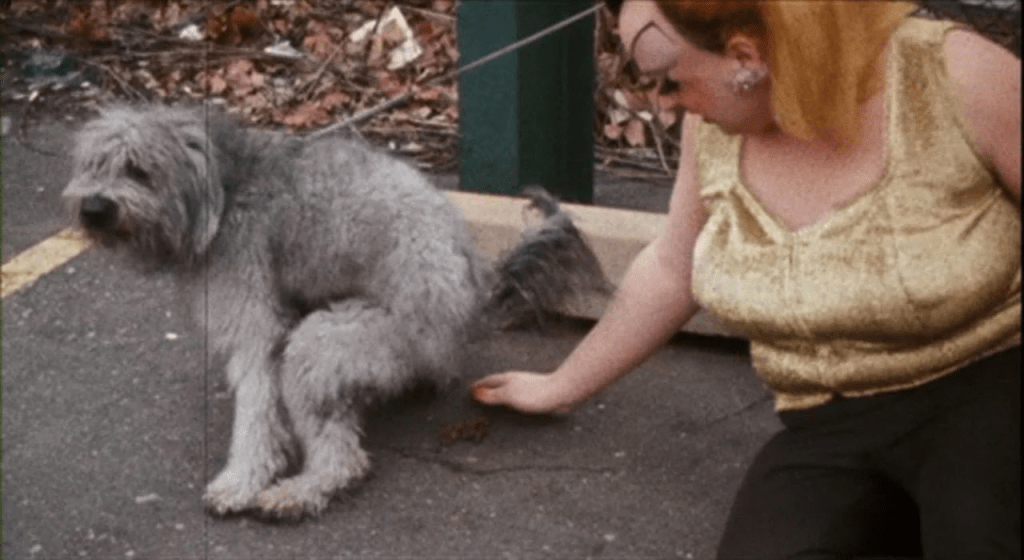
Let’s get back to the shit-eating scene, because I can’t write honestly about this movie without going back to it.
It’s not there to shock you, or I suppose, not just to shock you, shock is the door and not the room. What’s in the room is Divine looking at the camera, at the crew, at you, and does the one thing a respectable movie would never let its queer protagonist do. She doesn’t suffer beautifully, or die for your understanding. She performs the single most abject act available to the human body, and turns it into a coronation.
That’s the movie’s whole argument compressed into about thirty seconds. Filth isn’t something that happens to you, it’s something you grab, own, perform and win.
Waters didn’t make a movie asking to be tolerated, he made a movie that dares you to look away first, and most people did, for decades, and called that looking-away taste.
There’s a new freedom in that dare and it took the culture twenty years to catch up. But even now, the polite version of that history likes to file Pink Flamingos under midnight-movie novelty, camp as costume, and skip over the part where a man in Baltimore created a queer cinema of total and unashamed refusal long before anyone had agreed it was allowed.
The chicken died for this. The rivals died for it. Divine ate the shit and smiled at the camera. And somewhere in that smile is a door that New Queer Cinema would walk through twenty years later, although by then the door had a name, a festival slot, and a press kit.
In 1972, it was just a woman in a red dress refusing on camera, forever, to be sorry.
Adam Page is a freelance writer focusing mainly on film and literature with a special interest in all things horror related. He is in his final year studying for a BA in English Literature and Language and is somewhat obsessed with Bruce Springsteen. He plays terrible guitar and is definitely a cat person. His favourite film changes depending on what his mood is.


