
by Joseph Ratchford
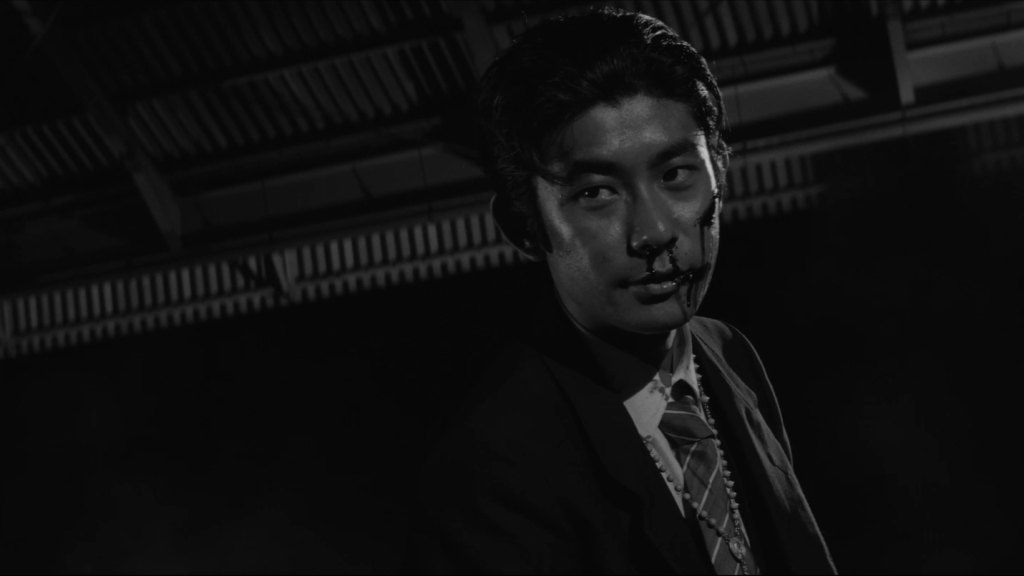
When we think of ‘noir’ as a concept, the images and tones that come to mind are almost inevitable. A weathered, handsome man. The film is in black and white and so is his suit. Cigarette smoke dissipates across the screen. He walks across a street draped in carefully constructed, moody shadows, perhaps he is holding a shot of bourbon between his index and his thumb as he considers the femme fatale that stands before him. Perhaps a voice narrates these images, maybe it’s Bogey, maybe Welles, regardless, it’s a scratched, lived, voice and it delivers the booze-marinated acerbic wit of Raymond Chandler, Dashell Hamnet, or perhaps, if you’re an enjoyer of Calvin and Hobbes, Bill Watterson. Regardless, the detective is cool. The detective is collected, and the detective is solitary, with just a glass of bourbon and untrustworthy dame by his side. The ultimate symbol of solitary, masculine, coolness.
Maiku Hama (played by Japanese genre cinema legend Masatoshi Nagase), the titular character of writer-director Kaizo Hayashi’s trilogy of Japanese detective pastiches, is none of these things.Hayashi is a ‘postmodern auteur’ (Slater-Williams, 2025) whose films have spanned from ruminations on Japanese silent cinema (To Sleep So as to Dream), circus shows (Circus Boys), and samurai cinema (Ziprang), and those postmodernisms and cine-literacy is essential to what makes Maiku Hama such a clear and clever subversion of the genre. The character is draped in colourful, playful suits, (ironically, his style of dress bears more resemblance to the yellow and green suits Sam Spade is described as wearing in the original Maltese Falcon novel than the monochromatic appearance immortalised by Bogey.) he is uncouth and loud and easily frustrated by how the mystery around him just will not solve itself, surrounded by friends, only drinks sake, and the only femme fatale around is his own mother. In short, he is a subversion of the American PI; more a loveable frustrated scumbag than anything we could archetypically describe as cool.
Noir subversion is not an inherently Japanese phenomenon. Robert Altman’s 1974 take on The Long Goodbye subverted the idea of the cool and collected detective twenty years before Hayashi, and did so with a similar irreverence. Whilst less sociable than Maiku Hama, Elliott Gould’s take on Philip Marlowe, the character whose previous depiction by Bogey in Howard Hawk’s The Big Sleep may well be the definitive symbol of the aesthetics of both the noir film and the noir protagonist, is similarly bumbling, sensitive, and deliberately ‘uncool’ (at least, in the traditional ways we ascribe coolness and masculinity within the genre). Altman’s film was not shot with the meticulous lighting and control that marked the iconic noirs of John Hudson, Fritz Lang, and Howard Hawks. It’s a more guerilla-style affair, shot mostly handheld, the camera glides with Marlowe, and there is barely a shadow in sight. Gould’s Marlowe is constantly muttering to himself, there is no femme fatale, he isn’t particularly suave. Least, not in the traditional sense. He’s marked by this feeling that he is out of time, that the world has past him by, and all he can do is chase ghosts, smoke, and hope that by solving the case he will uncover some sort of ideal that makes him the detective he wishes he was.
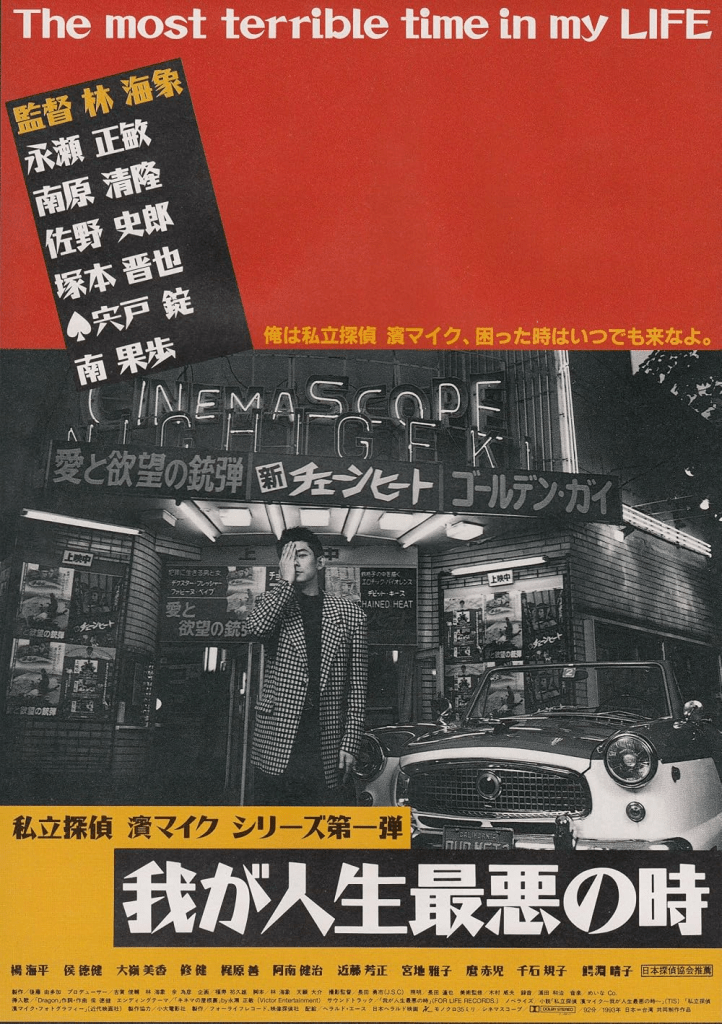
This too, I think, applies to Maiku Hama, most specifically in the trilogy’s first instalment, 1994’s The Most Terrible Time in My Life However, what makes the character and his debut film sing as pastiche of noir is how it reflects on how both the character and his wider cultural context reflects on the genre, and how his working-class slapstick detective persona .
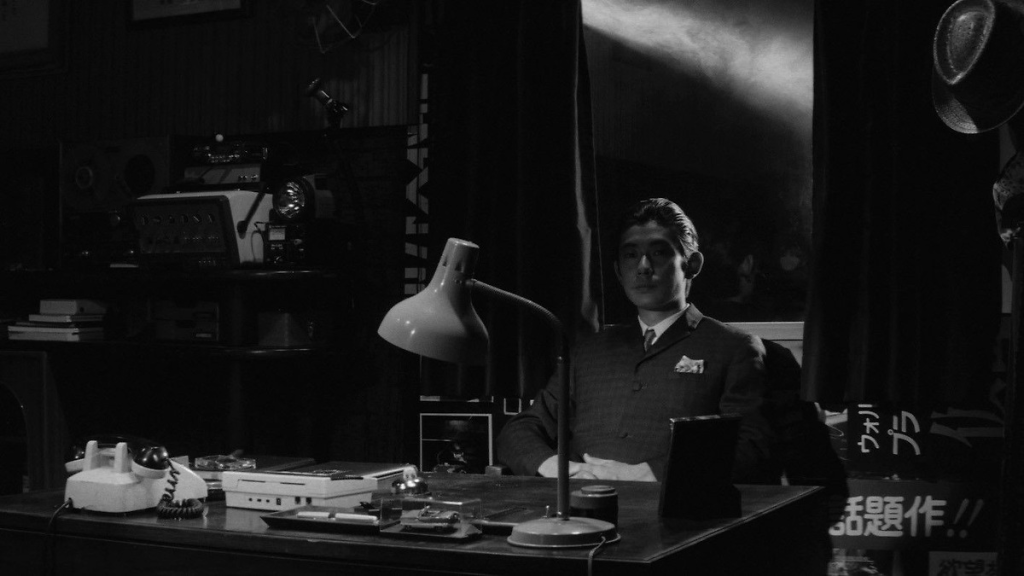
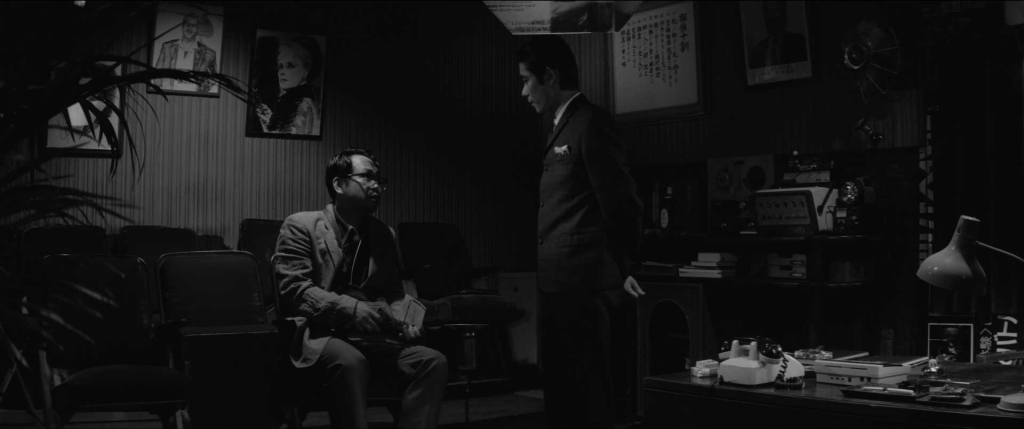
The Most Terrible Time in My Life opens with the hallmarks it aims to subvert. A client enters a detective’s office. The detective in dressed in a sharp monochrome suit. He’s smoking a cigarette. Everything is cast in shadows, and smoke from both the cigarette and the projector booth next to the office dissipates around the room. However, there’s a clear quirk: the office is based in a cinema. Maiku’s ‘Girl Friday’ is an elderly woman who thinks the client is there for the movie, more specifically the 40s melodrama The Best Years of Our Lives. The idea that anyone would choose to hire the detective upstairs is clearly one that doesn’t apply to her. This establishes that Maiku is low-status, in a way akin to Gould’s Marlowe. Whilst Maiku is introduced as the traditionally high-status ‘cool’ noir protagonist, he is still low-status.
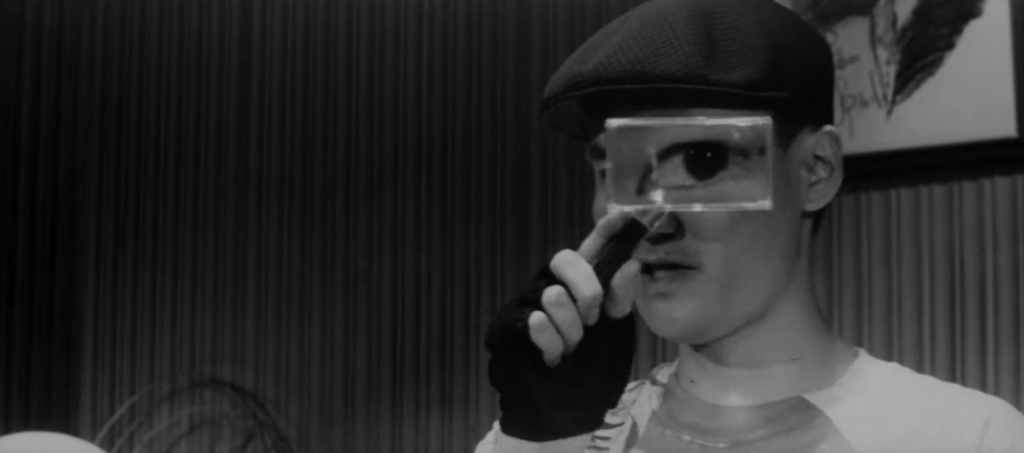
So, when Maiku leaves the setting of his office to the cinema, he is accompanied by a change of outfit. No clean monochrome suit (even though, as the film is in black and white, it all comes out monochrome), he wears a gaudy jacket covered in faces. ‘Maiku Hama. My real name.’, he says as he hops in his cool 60s convertible, drives away as the playful jazz soundtrack kicks in. The car drives into the front of the frame, the music builds, the camera follows him with a slick motion. Then the car breaks down, and the credits roll, not on the slick traditional detective he was introduced as, but on a blurry image of a man in a silly suit falling out of his car.
The name is a sneaky intertextual gag in of itself, a pun on Mike Hammer, the hard-boiled lead character of several old Hollywood noirs, most prominently Kiss Me Deadly, the name also translates to ‘Yokohama’, the setting of the three films. (Maybe as a deliberate display of Hama’s underdog nature, Mike Hammer, and the novels in which he originally appeared, is known, but not as ubiquitous in pop culture as a Sam Spade or a Philip Marlowe) With this single choice Hayashi displays the ways the series will pay homage to the classic American noirs, with irreverent references to irrelevant detectives, and wordplay that can only be understood in Japanese. The car stopping is essential to what makes the whole trilogy work.
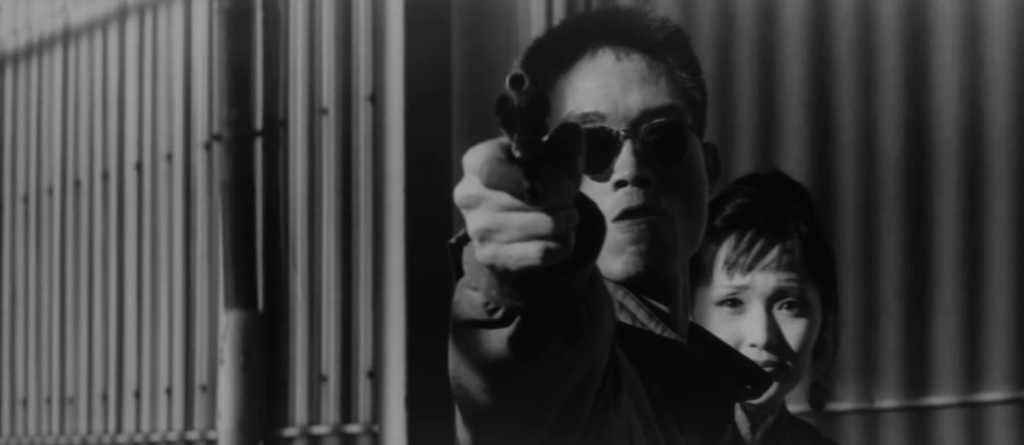
Unlike many noirs, The Most Terrible Time in My Life’s narrative is focused, not on the ubiquitous (and somewhat sexist idea) of an untrustworthy femme fatale manipulating the strong male lead, but on fraternity. The film’s plot focuses on Maiku befriending Yang (Yang Haitin), a Taiwanese immigrant waiter, who instructs him to find his brother, who illegally emigrated to Japan two years prior. However, in searching for Yang’s brother De Jian (Te-Chien Hou, in a rarity for Japanese film at the time, both brothers are played by Taiwanese actors) Maiku finds himself navigating a gang war between the Hong Kong Mafia, who Yang has been working for, and the ‘New Japs’, a gang of immigrants who have forged Japanese citizenship in order to live in the country, whom De Jian’s brother has defected through after years of service for the Hong Kong mafia.
The ‘New Japs’ speaks to the film’s cultural specificity through its exploration of anti-immigrant sentiment in Japan, more specifically, Japan as an ethnostate. The New Japs attempt to secure citizenship for their own by faking their members deaths speaks to the position of the immigrant within Japan. Japan does not allow citizenship for immigrants and their descendants, even if they are born and raised in Japan. Therefore, migrants, and those who are not ethnically Japanese tend to exist as second-class citizens, who are unable to vote and tend to struggle to find substantive work. This is commented on by De Jian’s motivation for defecting: he met and married his wife, played by Yu Wei-Yen, who, despite being born and raised in Japan, and only being able to speak the language, can only find work as a prostitute in a Chinese-themed brothel.
Whilst these themes, especially an early scene where Yang is harassed at work for his imperfect Japanese, are universal within our contemporary climate, the scheme of the New Japs, and the relationship the two brothers have with their homeland and heritage are specific to the nation. The framing of Maiku as mostly servicing immigrants also speaks to Maiku as the underdog within Japanese culture, it also displays him as morally standing with the immigrant lower-classes, in stark contrast to the frequently wealthy clients of Spade and Marlowe.
Whilst the difficult relationship with the law is common within detective fiction (in his wonderful academic discussion of the trilogy, Timothy Iiles expresses that the film’s depiction of the police as ‘corrupt, shoddy, violent, and exaggeratedly worthless’ (Iles, 2009) is another one of its noir-isms), Hama further subverts the genre by displaying the character’s lack of social power compared to the officers (More specifically Detective Nakayama, played by Akaji Maro) due to his background as a juvenile delinquent. Whilst Spade and Marlowe may be dismissive of the cops, both characters are noted as formerly working for the department. For all their posturing and angst, the idea often presented by these characters is that of a former idealistic officer of the law; beaten down by bureaucracy and corruption, which leads them elsewhere. Even his namesake is an ex-cop. Maiku, comparatively, gets no respect. Nakayama consistently belittles the man, whom he looms over within the frame, threatening with a bigger sentence, should he find Maiku guilty of wrongdoing, with a consistent undertone that, even if Maiku has not committed any wrongdoing, Nakayama will find it. He is harassed on the street, beaten, and has water thrown over him for no real reason outside Nakayama finds him suspicious. The point is clear, not only is Maiku not acquainted with the law, the law is actively antagonistic and dismissive to him as a man of low status. This helps inform his relationship with the immigrant characters: whilst these themes of solidarity between those on the fringes is not uniquely Japanese whatsoever, nor that of former delinquents and immigrants, within the more conservative space of mainstream Japanese media, presenting Maiku as such very much is.
The film also further subverts the genre and its cultural signifiers through its supporting cast, Maiku is supported by a large group of friends, most prominently crooked taxi driver Hoshino. The humour is very much in the realm of Asian cinema, the character bsing loud, big, personalities. However, they are not ‘friends in low places’, nor characters that Maiku is disconnected from. They are close friends, who discuss their long histories together and aren’t afraid to rib Maiku. They are also all working-class figures. This points to an enduring sociopolitical solidarity within the series that contrasts with the high-class world of the traditional noir (even in The Long Goodbye, Marlowe is navigating the world of LA’s upper-crust art scene). Not only is Maika Hama as a detective representative of the working-class, he is also of the working class, and popular within it There is no betrayal from Maiku’s pals, the way that all of Marlowe’s ‘old friends’ would end up being scumbags that play him like a fiddle. They are close, they are kind, and whilst rough around the edges, they are very much human in a way the genre tends to eschew.
This animated, easy-going charm is reflected within the film’s visual language. The Most Terrible Time In My Life is shot with a casual, almost-guerilla style. The film is shot mostly, not in the constructed sets and carefully considered locales of the noirs it is aping, but on location in Yokohama. This is interesting, as even in Japanese noir, and crime fiction in general, the setting tends to be some degree of Tokyo, so the choice to set the film in Yokohama, Japan’s second-largest city, but still somewhat underrepresented within the country’s media landscape, is a choice that displays a consciousness of the countries’ cinematic history consistent with Hayashi as an auteur. With the exceptions of the flashbacks of Wang’s childhood, which are shot with a surrealistic design sensibility that more akin to Hayashi’s debut feature, the postmodern silent film To Sleep so as is to Dream, creating a clear stylistic contrast between Maiku’s environment and that he has entered, putting the narrative defamiliarization common within neo-noirs like Chinatown, and translating them visually. The Most Terrible Time in My Life was made on a low budget, is mostly shot handheld, with a focus on quick, almost improvised-feeling camera moments, and casual blocking, where conversations are often shot in two-shots with little shot-reverse shot, with cuts being clean, and the film never looking anything less than beautiful, but there is a slapdash, run-and-gun sensibility to the visual language of The Most Terrible Time in My Life that feels more akin to Altman’s attempt at postmodern noir to the classics it would theoretically be aping by being shot in black and white. Whilst Hayashi and DP Yuichi Nagata are certainly not neglecting the harsh shadows and stark lighting of noir, by balancing it with a more postmodern, hangout, style, they are again bringing attention to the humanity and heart that makes Maiku Hama so compelling, and what makes the film such an engaging play with the genre.
Of course, even though the film eschews much of the genre’s archetypes regarding the class standing, personability of, and presentation of its lead character, it is not a complete subversion. One key element of the noir is that the detective is very rarely the emotional core of the film: their goal is to guide the viewer towards the active force who pushes the movie forward, and their character arc. One such example of such is The Big Heat, where the main character, hard-boiled cop David Bannion, is deliberately static in his uncovering of the central mystery, whereas the effect said mystery has on Debby March (Gloria Graham, in a career-defining performance), the trophy wife of the mobster Bannion is hunting, is the film’s central arc, a similar effect can be found with the unravelling of poor Faye Dunnaway’s attempts to free her sister until they are both trapped in the hands of the same man who abused her as a child in Chinatown. The detective is the conduit for the narrative’s active participant, but they themselves are often passive. Forget it Jake, it’s Chinatown.
This takes us back to Wang. Wang is introduced as working at a restaurant that Maiku and his friends are implied to frequent, his Japanese is imperfect, but he is a hard worker, who is unfairly threatened by a patron. There’s one thing that stands out, however. Wang carries a knife. After the patron takes Wang’s knife, leading to a comedic set-piece where Maiku’s finger gets sliced off, thrown out the window, and chewed up by a dog. (For all its serious themes and cultural subversion, this is, still, a very silly movie.) Throughout the film, the two develop a close friendship, and Maiku clearly sees Wang’s weapon as a sign of self-preservation. However, we, the viewer, know this is not true, as immediately afterwards Wang is revealed to be working with the Hong Kong mafia to kill his brother, and that by hiring Maiku, Wang is setting up the deaths of both his brother and Maiku. That the ‘betrayal’ is something we are aware of ahead of time and displayed through cutting away from the protagonist to a secondary character, is a clear subversion of the narrative tropes and filmmaking language of the genre, where the person hiring the protagonist, usually, but not always, the femme fatale, has been setting them up from the start. See The Maltese Falcon, The Lady From Shanghai, and Double Indemnity. In all three films, the way in which the plots unravel are staunchly focused on the protagonist’s point of view. No flashbacks, no cutting away. Therefore, by moving the reveal earlier in the film, Hayashi is able to reverse the usual structure of the central dynamics of a genre.
Whilst the mechanics of reversing the central dynamic of the genre are technical and structural, what makes the reversal of the dynamic, so key is that the film is able to make the friendship feel authentic. Whilst Wang’s primary focus in befriending Maiku is to later betray him, he decides against doing so. Not because of Maiku’s acerbic wit. Not because the stoic coolness that makes the noir detective admirable to his foes, not even the strange underdog charm of Elliott Gould’s Marlowe. No. Wang is won over because Maiku invites him out for a drink. Because Maiku wants to return to Wang’s apartment and keep going. Not out of suspicion, not to get information, not for any professional reason at all. He does it because he likes him. Maiku is a gregarious drunk, who takes an interest in engaging with Wang as a full person outside that of clientele. The two talk openly, or at least, as openly as they can, about their lives, concluding when Maiku enters Wang’s apartment, and the two men talk about Wang’s girlfriend over in Taiwan and what he left behind. It is interesting, both in how it ties to the solidarity Maiku feels with the immigrant mentioned earlier in this piece, but in that a noir film has such an uncool, unmeasured, freewheeling scheme, where the protagonist letting his guard down is not something to be exploited later in the film, but what ultimately saves their lives. The film is not just subtlety subverting the genre’s class focus and politics, it is also subverting its coldness and cynicism. The Most Terrible in My Life ends tragically for Wang and De Jian, sure, but it is a tragedy rooted in a warmth and care for the character of Wang that Hayashi wants to share with us as an audience and reflect on Maiku. Nagase and Haitin share such an easy chemistry, that the film’s tragic ending, which reveals that it has been Wang, not Maiku, who has been set up by the Japanese mafia, more specifically their cowardly leader, Yamaguchi, played by Tetsuo: The Iron Man director Shinya Tsukomoto, to forge a double of both brothers, each a representative of the ‘New Japs’ and the Hong Kong mafia, in order to organise a gang war that leaves their gang on top, completely sings. The undertones of national identity, especially the undertone that the ‘New Japs’ were never seen as equal to the Japanese mafia; just another immigrant force to be wiped out, are consistent with the film’s cultural specificity, but it speaks to the sincerity of the work that is uncommon in noir. The film is cynical about its character’s fate, but always sensitive to them as people. When Maiku discovers their bodies, there is no disconnect. No ‘forget it Jake, it’s Chinatown.’ Instead he tries to stop himself from crying. It speaks to the subversive nature of the film as a noir that the central dynamic can be such a sincere one, and that the commonly-reserved protagonist of the noirs can be both so animated and so emotionally sincere.
Joseph Ratchford is a freelance writer based in Manchester, and a recent graduate from Lancaster University. Whilst he has a particular interest in genre cinema, he strongly believes that all films are worthy of analysis, appreciation and interpretation.


