by Livvy Hubbard
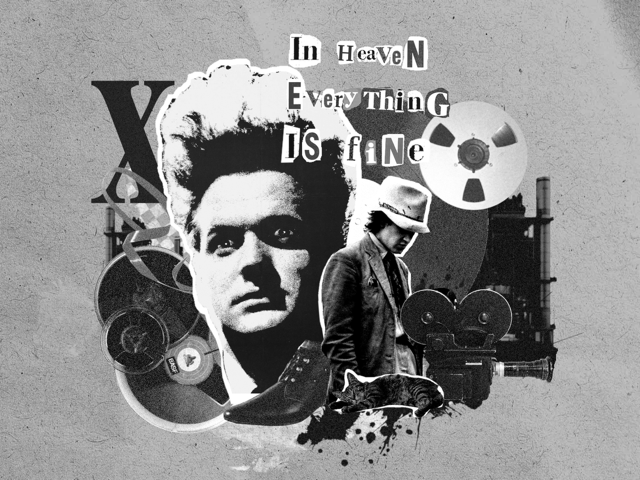
The progression of modern music has previously been attributed to developments in technology allowing for new genres and styles to emerge from the newly discovered methods and sounds these pieces of technology allow.
It could be argued that the invention and accessibility of magnetic tape stemming from the second world war, led to the commodification and commercial exchange of modern music. In Noise – The Political Economy of Music, Jaques Attali (1977) writes of the “repeating” phase of music history, where the physical entrapment of sound on tape led to “the gradual death of small bands” claiming that “public performance becomes a simulacrum of the record”. However, these technological breakthroughs of a post-war climate offer up the medium’s freedom for experimentation alongside the countercultural zeitgeist, which would shape the way that music was created, consumed and distributed for years to come.
Here, the new, widely affordable and malleable medium of tape provided the possibility not just for the documentation and playback of recorded noise, but the use of tape as raw material for new composition. The term “concrete music” was initially coined to distinguish it from “electronic music” in which, the source of the sounds comes from an oscillator (Dwyer, 1971). The genre focuses itself on the transmutation of “quasi-musical” sounds via magnetic tape manipulation to remodel the sounds of inanimate objects, machinery, and nature into the basis of a musical composition. The musique concrète movement has been noted as an extension of Dada (rejection of capitalist interest and intellectual conformity in modern art) with it’s somewhat random and psychedelic arrangements. (Gayou, 2025)
Despite the cultural concept of hauntology not being coined as a neologism until the 1990s, it has been retroactively applied to the Musique Concrete movement due its reliance on a lost future of analog mediums. This transmutation of found sounds, hints at “residual sounds being held in the concrete” (Tutti, 2021), rendering the musique concrete movement inherently nostalgic for a future promised by cultural and technological advancements of the 1960s.
The cultural context of Musique Concrète in conjunction with its technologically sophisticated medium, creates a sound commonly associated with the concept of a lost future for the people of the 1960s – a memory of a future for music that never arrived.
David Lynch’s Eraserhead (1977) is an exploration of surreal expressionist horror. The film pays great attention to textural soundscapes which work in tandem with the nightmarish noire visuals to elicit feelings of depression, confusion, and dreams brought on by industrial spaces.
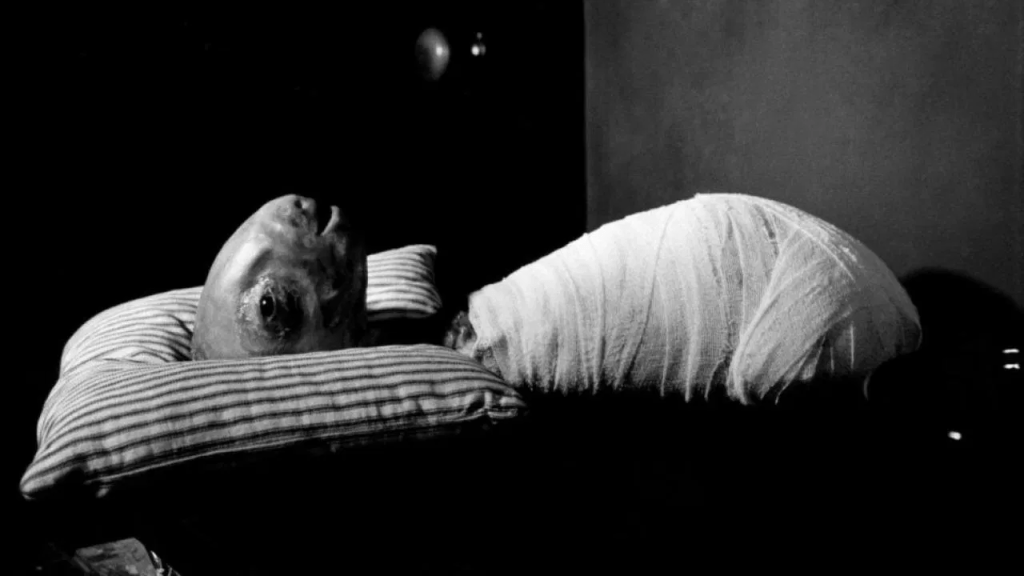
The soundtrack, alike the film itself, was made on a very tight budget with a limited crew over the course of 5 years, which led to an abundance of experimentation and creative freedom – particularly within in the realms of the soundtrack, which was made by Lynch and his musical collaborator, Alan R. Splet; recorded on reels of discarded tape found in skips.
Lynch and Splet complement the picture by evoking the misery and uncertainty of abandoned industrial spaces and isolation with a haunting soundtrack. Influenced by the city of Philadelphia and Musique Concréte production techniques, the two would experiment with what equipment they had to hand, including items such as pipes and bottles manipulated with “graphic equalizers, reverb, and a “little dipper” filter set for peaking, or cutting out certain frequencies.” (Lynch, 1978) The bed of noise created with these techniques blurs the lines between diegetic and non-diegetic sound, resulting in audibly polysemic foley accentuating the obfuscated spectromorphology.
The most traditionally musical elements of the film’s soundtrack are the samples of 1930s organ music which drift sporadically in and out of the noise. This organ music, however, is mostly heard when Henry (Jack Nance) is alone, further abstracting the acousmatic relationship between reality and dream. These samples are distorted, and “lo-fi”, utilising defects of a worn-out vinyl record such as crackle, and surface noise. The crackle of the gramophone “makes us aware that we are listening to a time that is out of joint; it won’t allow us to fall into the illusion of presence.” (Fisher, 2014) Such aesthetics would go on to be the hallmarks of sonic hauntology; The Caretaker, or Stanley Kubrick’s The Shining.
The implied metanarrative of the crackle leaves the viewer wondering if the sound exists in the world or is solely experienced by the protagonist: Whether the white noise embedded in the soundtrack is intended as wind, or electrical static, and whether it exists on a physical plane at all. These manipulated field recordings not only create a lush textural soundscape evocative of industrial spaces but connote a liminality and uncertainty.
“Lynch and Splet have constructed a foreboding, nihilistic sound-world haunted by vague, half-remembered snippets of music, hinting at a simplicity and innocence that will remain perpetually out of reach.” (May, 2012)
While not featured in the film itself, included on the film’s official soundtrack release is “Pete’s Boogie”. This track features the afore mentioned Fats Waller-Esque organ chords, whilst using oscillated impressions of wind and distant machinery. A rotating crackle of vinyl is heard throughout, emphasizing the palimpsestic nature of the analog medium, hinting at a materialised memory of the protagonist’s younger days. As the viewer, we have no indication as to Henry’s past, but we do know, whether good or bad, he is haunted by it with his constant surroundings (including his child).
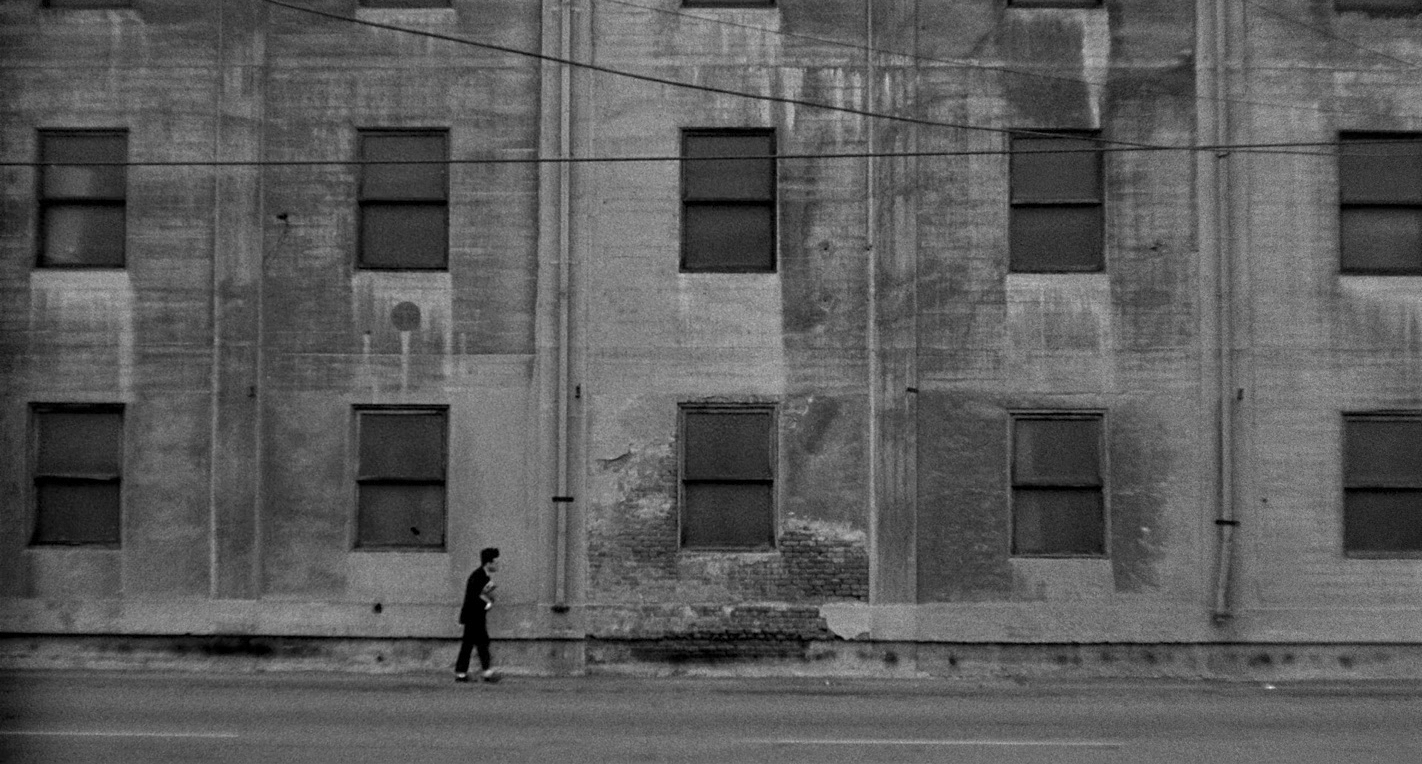
The elaborate opening sequence of the film leads into a plethora of shots in which Henry Spencer (Jack Nance), silently traverses industrial landscapes
Jack Nance walks slightly too fast, as if to imitate a Chaplin-Esque silent film, before comically standing in a large puddle, acting as a cultural recollection for the medium of film itself; its colours, movements, and hurried framerate accompanied by the jaunty organ music seems an intentional reference to the silent era. Despite this comedic moment however, the opening sequence establishes not just the setting, but also the tone of Eraserhead. A look of despair hangs on the face of Henry whilst pipes and concrete pass by, all the while the drone of machinery is present not just here, but throughout the entirety of the film – and is only interrupted by peaceful silence of Henry’s dream sequence.
The opening of Eraserhead bears resemblance to that of Barbara Loden’s Wanda, (1970) in which the protagonist, sick of her surroundings, trudges across the industrial wasteland of her hometown, driven away by the relentless cries of her baby. Although similar in themes to Eraserhead, Loden’s masterpiece can be differentiated by its 16mm technicolour palette of which Eraserhead does not have, and whilst it has less of a reliance on the idea of materialised memory – Wanda uses the idea of hauntology to illustrate the slow cancellation of the American dream by drawing on the despair and apathy of Barbara Loden’s self-insert as she navigates destitute liminal spaces in search of a future.
The spectral discrepancy present between diegetic and non-diegetic sound raises the question of the content of the soundtrack. In the official 2012 release of the Eraserhead soundtrack, portions of dialogue and foley are left in, obscuring what resides as part of the incidental score itself. Of course, this can be put down to artistic choice, or the inability to separate dialogue from music (the most likely reason), however with this 40-minute rendition of the Eraserhead soundtrack with dialogue and sound effects intact, a new viewing (listening) experience for the movie is created. The soundtrack release now no longer acts as just a record of incidental score, but as an audio drama. This is particularly fruitful when viewed through the lens of Marshall McLuhan’s (1967) “medium theory”, in which “the medium dictates the message”.
The story of Eraserhead takes a completely different form when experienced through an aural medium, the audio cues create a different sense of urgency when severed from their visual reference points. The imagery transcends the limitations of budget and restraints of a screen, broadening the oneiric plane of which Eraserhead takes place and how it impacts the experience of David Lynch’s masterpiece beyond the auteuristic intention. Of course, to take a David Lynch film outside of its intended viewing experience is sacrilege, but the director’s choice to release this version of the movie is a curious one that deserves its own attention separate from that of the film itself.
Also worth noting is the almost random splicing of the tape in order to fit the 20 minute restrictions on either side, which results in a Dada-esque presentation, as the audio jumps rapidly from the sounds of voices, electricity, and then to the crying baby – not too dissimilar to The Beatles’ Revolution 9, an infamous Dada sound collage.
The concept of transferring Eraserhead from one medium to another feeds back into the very idea the soundtrack was initially created with. The essence of musique concrète – severing the sounds from their context of space and linear time. By immortalising the movie onto a reel of tape, a new acousmatic listening experience has been created which only begs the question – is the best way to watch Eraserhead to not watch it?
Livvy Hubbard is a music production student at BIMM and aspiring amateur filmmaker with an interest in hauntological media and analog audiovisual production methods. She cites a pool of cultural reference points as her inspirations – from the movies of Gregg Araki, Chantal Akerman, & David Lynch to Shoegazer bands from the early 90s such as My Bloody Valentine.
References:
Backhouse, A. (2025). Field recording as hauntological practice | Andrew Backhouse. [online] Available at: https://backhouse.wtf/blog/artists-blog/field-recording-as-hauntological-practice/.
Barbiero, D. (2016). ONE HUNDRED YEARS OF DADA. Online Music Magazine. Jun.
Bulut, S. (2017). Revisiting Eraserhead’s haunting, industrial soundtrack. DAZED.
Film Crew Members and their Contribution to Cinema. (2014). In Heaven Everything is Fine: Sound Design and Worldbuilding in Eraserhead. [online] Available at: https://morganb0.wordpress.com/2014/04/26/in-heaven-everything-is-fine-sound-design-and-worldbuilding-in-eraserhead/.
Fisher, M. (2014). Ghosts of My Life: Writings on Depression, Hauntology and Lost Futures. Zero Books.
Fisher, M. (2016). The Weird and the Eerie. London: Repeater Books.
Fox, C. (2012). Multiple Nightmares: The Haunted Legacy Of Lynch’s Eraserhead Soundtrack. The Quietus. 17 Aug.
Henry, C. (2023). Eraserhead. British Film Institute.
May, T. (2012). Eraserhead Original Soundtrack, David Lynch & Alan Splet. [online] Articulate Silences. Available at: https://articulatesilences.wordpress.com/2012/11/08/eraserhead-original-soundtrack-david-lynch-alan-splet/.
Mcluhan, M. (1964). Understanding Media: The Extensions of Man. Berkeley, Calif.: Gingko Press.
Pintus, M. (2025). Page Restricted. [online] Gatamagazine.com. Available at: https://gatamagazine.com/articles/music/music-in-service-of-the-image-david-lynchs-role-as-sound-designer-for-eraserhead.
Schaeffer, P. (1966). Traité des objets musicaux : essai interdisciplines. Paris: Éditions Du Seuil.
Scovell, A. (2015). Analogue Ghosts of the 1970s And Hauntology. [online] Celluloid Wicker Man. Available at: https://celluloidwickerman.com/2015/07/20/analogue-ghosts-of-the-1970s-and-hauntology/.
The Paris Review (2014). David Lynch on Alan Splet. YouTube. Available at: https://www.youtube.com/watch?v=nSkyGRyUIEM.
Thoresen, L. (2007). Spectromorphological analysis of sound objects: an adaptation of Pierre Schaeffer’s typomorphology. [online] Available at: https://cccm.iem.at/wp-content/uploads/2019/11/thoresen2007.pdf.
TY – JOUR AU – Fisher, Mark PY – 2013/11/01 SP – 42 EP – 55 T1 – The Metaphysics of Crackle: Afrofuturism and Hauntology VL – 5 DO – 10.12801/1947-5403.2013.05.02.03 JO – Dancecult ER –
Vicente de Lima Palombini, C. (1993). Pierre Schaeffers typo-morphology of sonic objects..
Whitehead, G. (2022). Exploring Personal Spectres in Electronic Music. Dancecult, 4(1), 2-22. https://doi.org/10.12801/1947-5403.2022.14.01.01
Young, R. (2012). Pierre Schaeffer and the Birth of Musique Concrète. FRIEZE. [online] 1 Jan. Available at: https://www.frieze.com/article/music-22.


