
by Laura Barnes
“This whole city’s goin’ to hell!” the thick Brooklyn accent bursts from Cultplex’s speakers. “Ya can’t take a pee anywhere!”
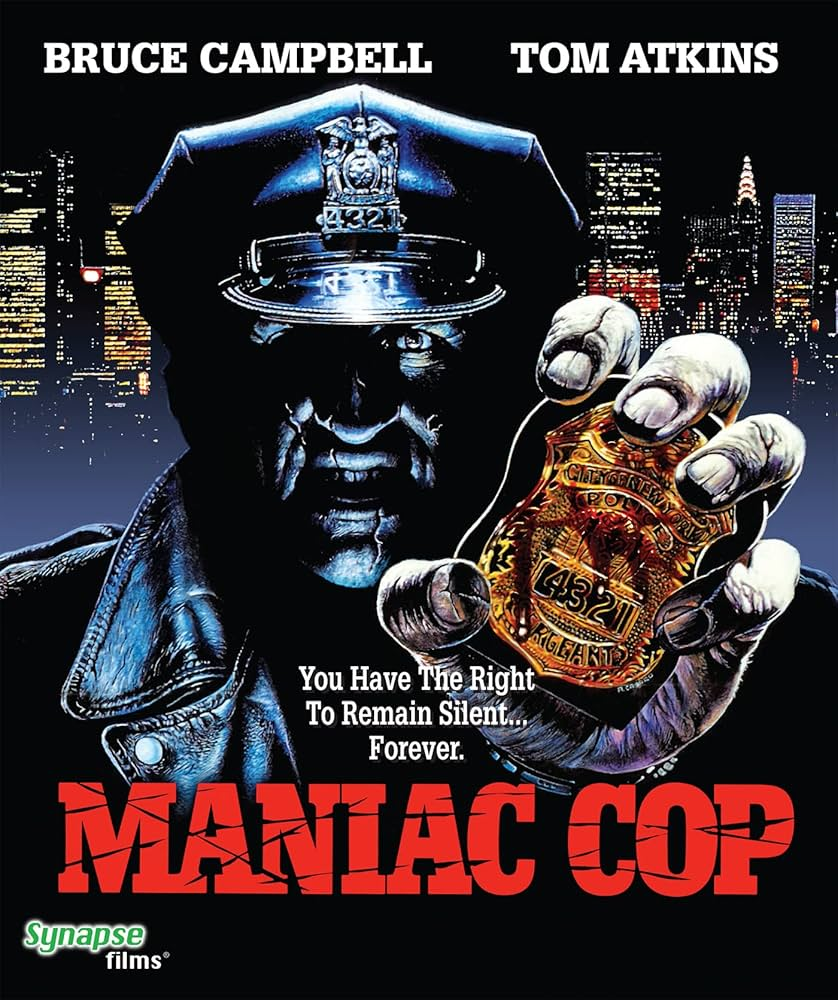
And the cinema erupts into laughter, unrestrained and infectious. Tonight, Cultplex has been taken over by the motley crew over at Interference Films, a Manchester-based collective dedicated to sourcing and screening lost Horror movies. Stroll through their small shop in Affleck’s Palace and you’ll find critically acclaimed classics such as Surf Nazi’s Must Die, Tokyo Gore Police, and Meatball Machine. What’s that? Do they have any Elevated Horror? Afraid the elevator’s broken, mate – you’ll have to take the stairs. Tonight’s schlockflick of choice is William Lustig’s 1998 Slasher Maniac Cop, a movie which boasts the tagline “You have the right to remain silent… Forever!” It doesn’t take a genius to see where this is going.
Maniac Cop is fifty percent slasher, fifty percent action flick, and one hundred percent stupid. The plot follows jowly detective Lieutenant McCrae (Tom Atkins) as he tries to figure out which one of his colleagues is the shadow-faced cop that has been slaughtering New York citizens en masse, and… Well, that’s pretty much it. Nobody in Cultplex is here for the plot. The folks populating the cinema tonight are people who appreciate Camp the way rich people appreciate wine. Whenever one of Lustig’s fast-talking cops drops a diabolical line (for example, “Ya always take a leak with a gun in ya hands? S’Good way to blow ya bawlls awff!, or “Gina, this isn’t about romance. It’s about murder.”) the entire audience dissolves into giggles, like we’re all part of the same stupid, private joke.
Despite its silliness, Maniac Cop’s politics are clear. Any cop could be the Maniac Cop, and for every cop that wants to expose the maniac on the force, there’s another three to cover up for him. When we first meet Lieutenant McCrae, he is being ordered by the Police Commissioner to keep the Maniac Cop killings a secret, out of fear that it will damage the NYPD’s reputation. When McCrae suggests that they look into officer’s that have shown any signs of emotional instability or psychological disturbance, the Commissioner quips, “sure, why don’t we test the whole damn force while we’re at it?!” Even when the Maniac Cop’s identity is discovered, he remains impossible to track down thanks to the allies he has dotted throughout New York’s judicial system – coroners and administrative officers enable every killing.
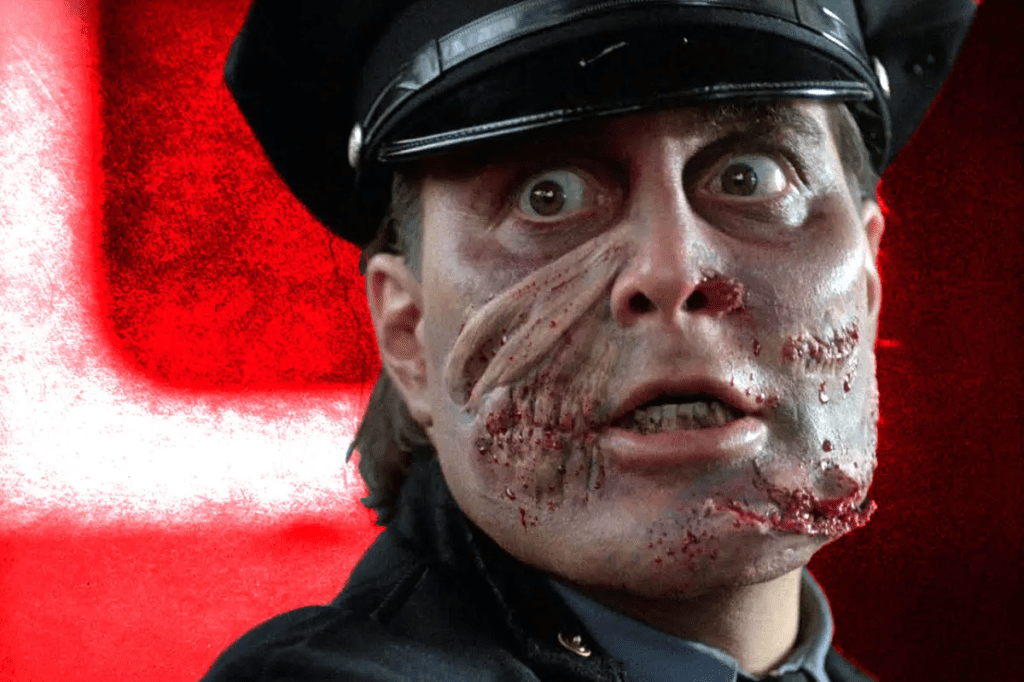
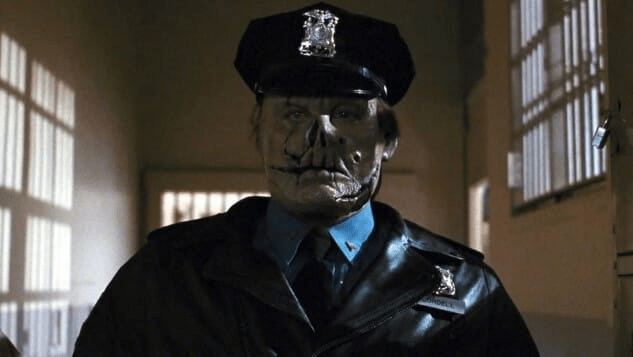
During the murder sequences themselves, Lustig does tap into a very real kind of tension. There are close-ups of the Maniac Cop’s gloved hands, brass buttons, and the hat that keeps his face in shadow. All of these shots work to emphasise the anonymity and authority that a uniform can grant to police offers, particularly in the US. Anyone who’s spent more than five minutes on the internet will have seen videos of misbehaving cops, faces hidden by pairs of dark, mirrored sunglasses. It’s just as McCrae says – “people will do anything a cop tells ‘em, even take a walk down a dark alley.” This sense of dread is elevated by the late Robert Z’Dar’s performance as the Maniac Cop himself. Z’Dar spent much of his career playing B-Movie Horror villains, a type-casting that likely emerged from his cherubism, a rare medical condition that results in an enlarged jawline. In Maniac Cop, however, the bulk of Z’Dar’s performance is rooted in his body, and for the most part, he remains faceless. He marches through the world like an android on a mission, completely free from the little hesitations that mark a person as human. If Lustig had spent just that little bit more time on kills, then Z’Dar’s performance might have earned the Maniac Cop a place among B-Tier Horror classics such as Tourist Trap and Prom Night. It perfectly encapsulates the phantom-cop that lurks in the public consciousness.
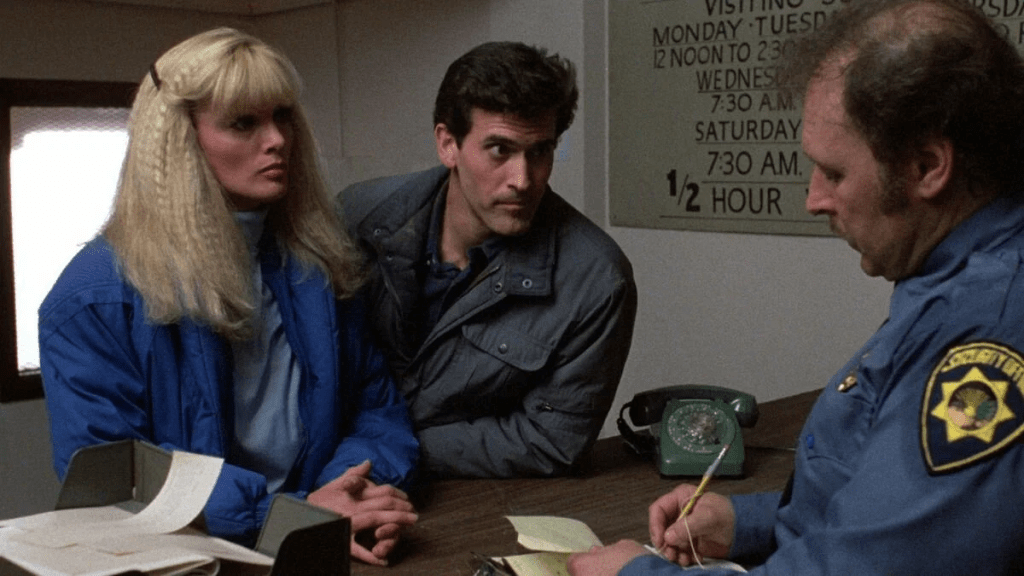
Maniac Cop’s political conscience is nothing, however, compared to the sheer ridiculousness that drives the rest of the movie. The third act takes place during the St. Patrick’s Day Parade, and boy, does Lustig not let you forget it. The police station – which only the day prior was the setting for Maniac Cop’s largest murder spree yet – is fully decked out with tricolour flags and leprechauns, and every cop has a four leafed clover pinned to his chest. Meanwhile, the Maniac Cop himself steals one of the on-call paddy wagons, and so ensues the kind of car chase choreographed by a seven year old with a Hot Wheels collection – the kind of car chase that no self-respecting B-movie would be without.
To make the screening extra-special, Interference also brought along Paul Downey, author of the recently released book, ‘This City Is Going To Hell: The Making of Maniac Cop’. When introducing the movie, Downey tells us that he first encountered the movie as a child rifling through the bargain bin at his local video store, and it had fascinated him ever since. Nothing quite captivates a person like the weird movie that they watched when they were six, whether it was found in a supermarket bargain bin or watched in thirty-six parts on Youtube. Maniac Cop feels like the archetypal childhood fever dream movie, the kind that really lodges itself in your brain for years afterwards. Was that even a real movie? your adult self would question. Did that guy really die by suffocating in cement?
That feeling of childlike fascination is one that unites movie-lovers, particularly those us that enjoy the slightly less-than-orthodox titles that fill Interferences’ shelves. Maniac Cop’s oddball nature is exactly what has granted it the kind of niche longevity that every indie filmmaker secretly longs for. Is Maniac Cop a great movie? Absolutely not. It’s terrible, really. But there really is something deeply joyful and defiant about its terribleness, a celebration of creativity without self-consciousness.
Everyone in that room was feeling that joy as we filtered out of the cinema and into the bar area. The folks at Interference Films have a real skill for creating community. They take the time to spark conversations with each person that has given up their sunny Thursday evening to sit in the dark with them, and their genuine passion for all the weird and wonderful movies of the underground shines through in every interaction. There’s no doubt in my mind that so long as Interference keeps putting on screenings, the Horror nerds of Greater Manchester will return to Cultplex again and again.
Speaking of returning, did you know there’s a Maniac Cop 2? And a Maniac Cop 3? And a rumoured Maniac Cop re-make? Well, now you do. Cinema is a beautiful thing, isn’t it?
Laura Barnes (Instagram: @maamowar / @absolutedestinyapocalypse) is a freelance writer obsessed with the horrors and joys of ordinary life. She has written for publications such as Cafe Lit, Stat Magazine, and Ever Metal, and spends entirely too much time thinking about Vampires.


