
by Laura Barnes
Cultplex is the perfect place to screen a movie like Exotica. This independent cinema exists on the outskirts of Manchester City Centre, so well-hidden that it is unlikely anyone could stumble upon it by accident. “Cinema?” the Uber driver asks, as the Satnav announces that we’ve arrived at our destination. “Where?”
Cultplex is a place that doesn’t care about being trendy. Though the cinema does have a core team of dedicated staff members, it is supported largely by a team of volunteers who will happily give up their evening to screen everything from cult genre classics to global award-winners. Brought to us tonight by Bigger Than Life Films, Exotica is a movie that exists somewhere in the centre of this spectrum. When the movie debuted in 1994, it scooped up awards at both Cannes Film Festival and the Genie Awards, yet Exotica still found itself marketed as the sort of Erotic Thriller movie that would’ve had Michael Douglas calling his agent.
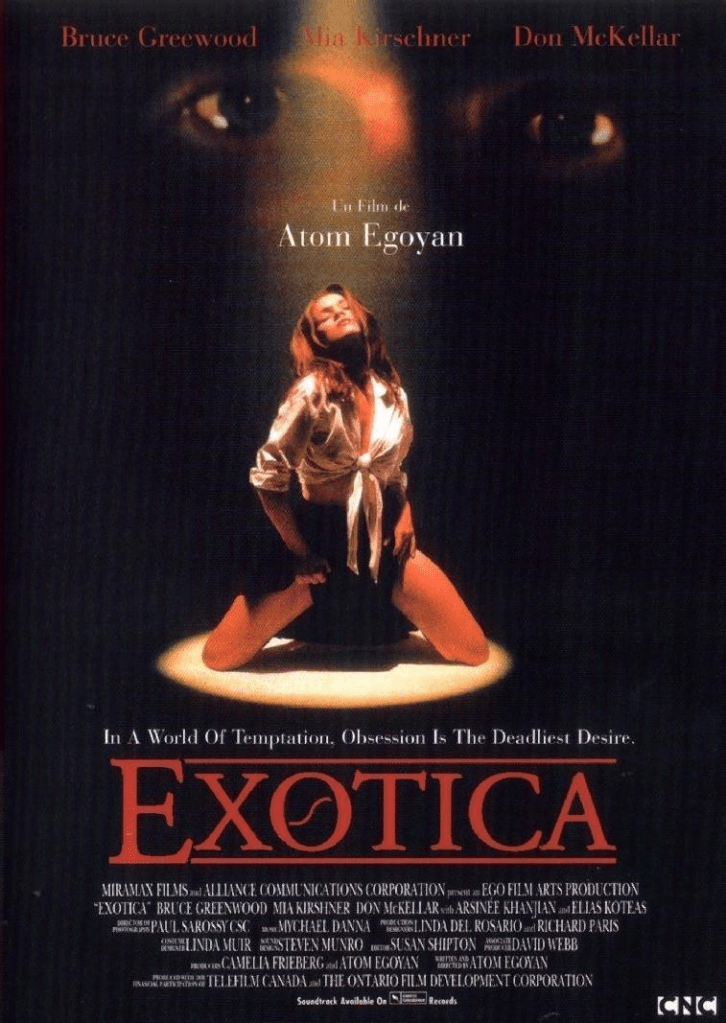
In some ways, Exotica does slot neatly into the category of the 90s Erotic Thriller. The men are sleazy, the streets are mean, and sex and love are world’s apart. But calling Exotica an Erotic Thriller doesn’t quite ring true. There are no crying women brandishing knives, for example, nor are there any bathtubs filled with blood. Egoyan’s take on the erotic thriller is a far more cerebral affair, more concerned with existential dread than frantic rooftop chases.
The movie revolves around ‘Exotica’, a downtown strip club that seems to pull in every lost soul that Toronto has to offer. There, we meet the sleazebag DJ Eric (Elias Koteas), who uses his position as the club’s MC to regularly humiliate his ex-girlfriend and club favourite, Christina (Mia Kirshner). Dressed in a short tartan skirt and school-issue blouse, Christina has been typecast as the quote-unquote ‘sexy schoolgirl’, a role which she appears to take less and less joy in everytime she takes off her tie. Christina’s most regular customer is the grim-faced Francis (Bruce Greenwood), a tax auditor who seems to be in a state of constant unease. Existing on the periphery of this unusual love triangle is Thomas (Don McKellar), a socially awkward gay man enaged in the smuggling of illegal hyacinth macaw eggs. We soon discover that these lives are more closely entwined than we thought, united by a brutal murder committed years ago.
As the plot unfolds, it occurs to me that Exotica is more of an exploration of what happens after the traditional Erotic Thriller takes place. How can you move on after your daughter’s murder? How can you plan your career after finding a dead body? And most pertinantly, how do you live in a world that has proven that it doesn’t care about you?
For many inhabitants of Egoyan’s world, the answer lies in playing pretend. By throwing on her mother’s wigs and speaking with the affect of the archetypal den mother, strip club owner Zoe (Arsinée Khanjian) can pretend to be someone powerful, someone with agency. By cruising for sex at a ballet, bird smuggler Thomas can pretend that he is part of the mainstream society that actively excludes him. The biggest pretender of them all, though, is Francis. With his slicked hair and cotton shirts, Francis wears respectability like a mask, and Bruce Greenwood does an unnerving job of portraying those brief moments where this mask slips. The moment he interrupts Christina’s striptease to ask her, “how could anyone hurt you?” is one of the most unforgettable moments in the movie, in large part thanks to Greenwood’s utter sincerity.
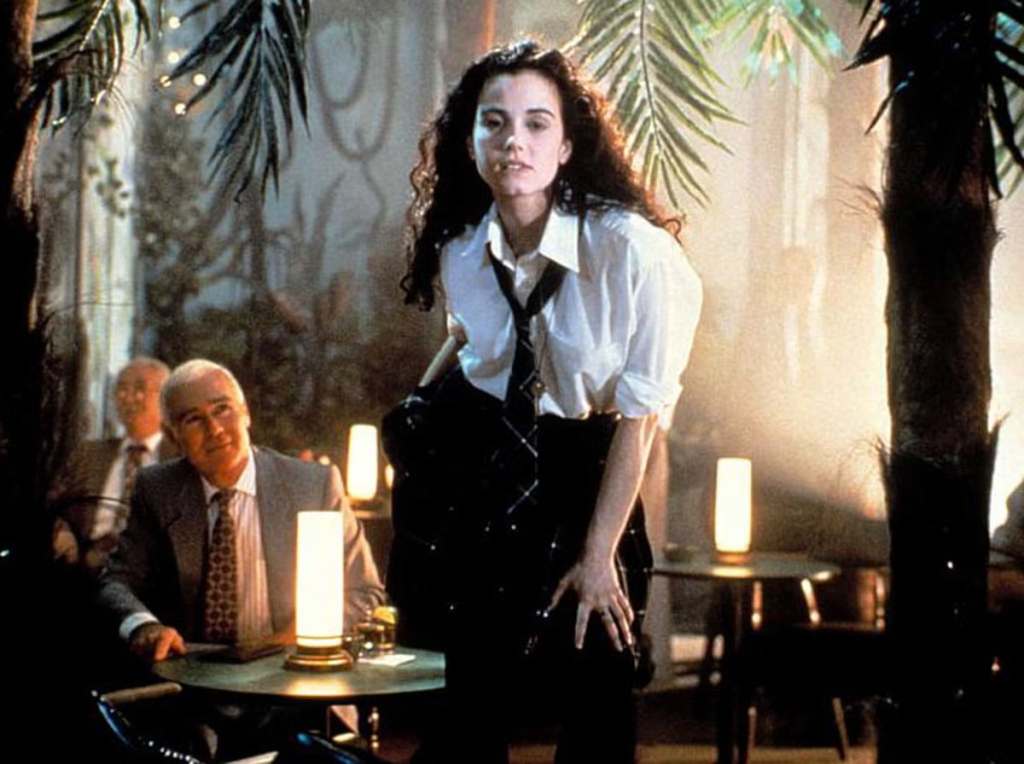
At other points in the movie, the characters deal with their powerlessness by digging their nails into whatever tiny portion of their lives that they can control. From his DJ’s podium in the centre of Exotica’s dancefloor, Eric rules over the strip club like his own personal panopticon. To watch someone is to have power over them, whether they can feel your gaze or not. Eric uses his position as club DJ to control both the dancers and the clients. He can tear away a dancer from a client by announcing her routine fifteen minutes early, and he can manipulate the men by whispering to them through the toilet stalls. Likewise, Thomas exists at the centre of his own panopticon. The rows upon rows of murky green tanks that surround his pet store are a perfect mirror to the strip club’s own gloomy world. Giving Thomas such a bizarre career feels like a deliberate choice on the part of Egoyan. Western culture’s obsession with owning and domesticating exotic animals is a display of domination over the natural world, and if there’s one thing that Egoyan is interested in, its domination. If we put a tiger in a cage and watch it curl up behind the bars, we can pretend that it will never eat us alive.
When introducing Exotica to the audience at Cultplex, film writer and BFI director Jason Wood sheds some light on Egoyan’s upbringing, and how his life experiences have shaped him as a filmaker. As a refugee to Canada from Cairo, Wood tells us, Egoyan grew up feeling that he was an outsider, doomed to a life of looking in. Egoyan replicates this feeling over and over again throughout Exotica with his use of odd camera anges and unsettling close-ups. There are down shots of Thomas’ hairy belly and extreme close-ups of Eric spying through a two-way mirror, all of which work to give the viewer a strange,creeping feeling: we’re not supposed to be here. While the ‘cinema-as-voyeurism’ philosophy has, in my opinion, run its course and then some, one can’t deny that in Exotica these shots pack a deliberate punch.
The dialogue throughout Exotica is minimalistic, and has a stilted, almost wooden feel. Questions are answered with long pauses or more questions (You think this is normal? What we do? // What do we do?) that elongate every scene. In the strange world of the strip club, this style of dialogue gives the scenes a dreamlike quality which draws you deeper into Egoyan’s world. But in moments where the characters are supposed to be at their most human – in the intimacy of their cars, their houses, their dressing rooms – this vague, back-and-forth manner of speaking only distances the viewer from the characters, serving as a reminder that you are, indeed, watching a capital-F Film.
Luckily, Mychael Danna’s score is strong enough to keep the scenes in a constant state of movement, even when Exotica is at its most naval-gazing. Danna skillfully combines the sleaze and mystery of classic film noir soundscapes with South Asian influences to create an atmosphere that is both gritty and surreal. ‘Dilko Tamay Huay’ is the standout song on the soundtrack, which sees Danna pair up a very 90s, very Industrial dancebeat with Pakistani singer Mehdi Hasan’s ‘Mein Hosh Mein Tha’ in a marriage that shouldn’t work, but does. Without a soundtrack so utterly original, it is doubtful that Exotica could have quite met the heights that it did.
A surface level look at Exotica reveals a thesis that is vaguely misanthropic. People will never change, and we are all doomed to repeat the same self-sabotaging cycles forever. Francis will always return to the strip club. Christina will always be a lost schoolgirl. Zoe will always perform a poor imitation of her mother. Yet there are glimpses of hope scattered all the way through Exotica, brief moments of catharsis for those who are willing to look. When Tracey (Sarah Polley), Francis’ niece, finally refuses to accept money from Francis in exchange for pretending his daughter is still alive, she bravely and compassionately frees herself from his control. Similarly, when Zoe takes back the DJ podium for herself, she is choosing to prioritise her dancers’ safety in a way that her mother never did. Salvation arrives, as it often does, in a quiet choice of defiance.
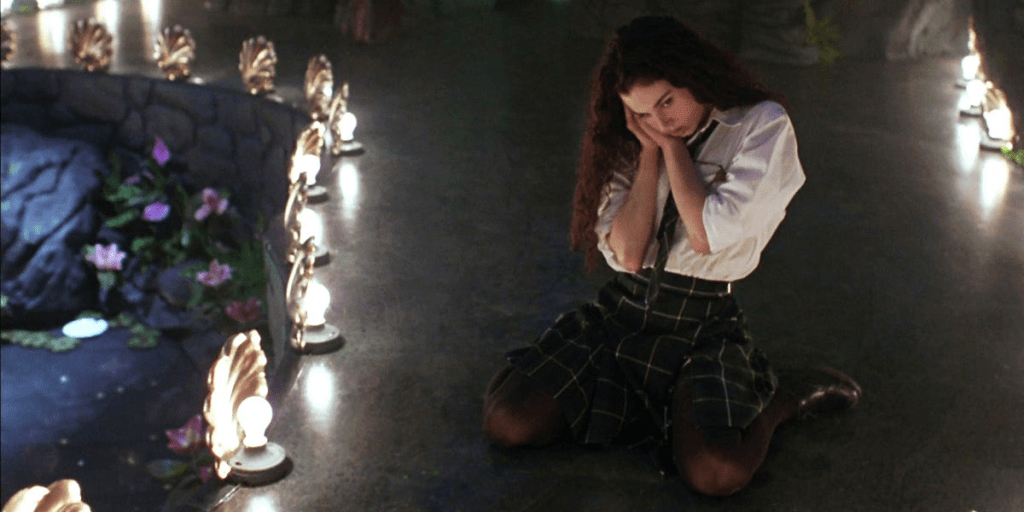
When Egoyan introduced the movie in a pre-recorded message, he didn’t tell us to ‘enjoy the movie’. He said “I hope you have a good projection”. It is entirely possible that I don’t know anything about this movie, and every pronouncement I’ve just made is a projection of my own. Exotica offers no easy answers, but if you’re the sort of person that likes to sit in a dark room and think, then this is no bad thing. Who doesn’t enjoy a mystery?
Laura Barnes (Instagram: @maamowar / @absolutedestinyapocalypse) is a freelance writer obsessed with the horrors and joys of ordinary life. She has written for publications such as Cafe Lit, Stat Magazine, and Ever Metal, and spends entirely too much time thinking about Vampires.


