
By Samuel Leary
THE EVENT
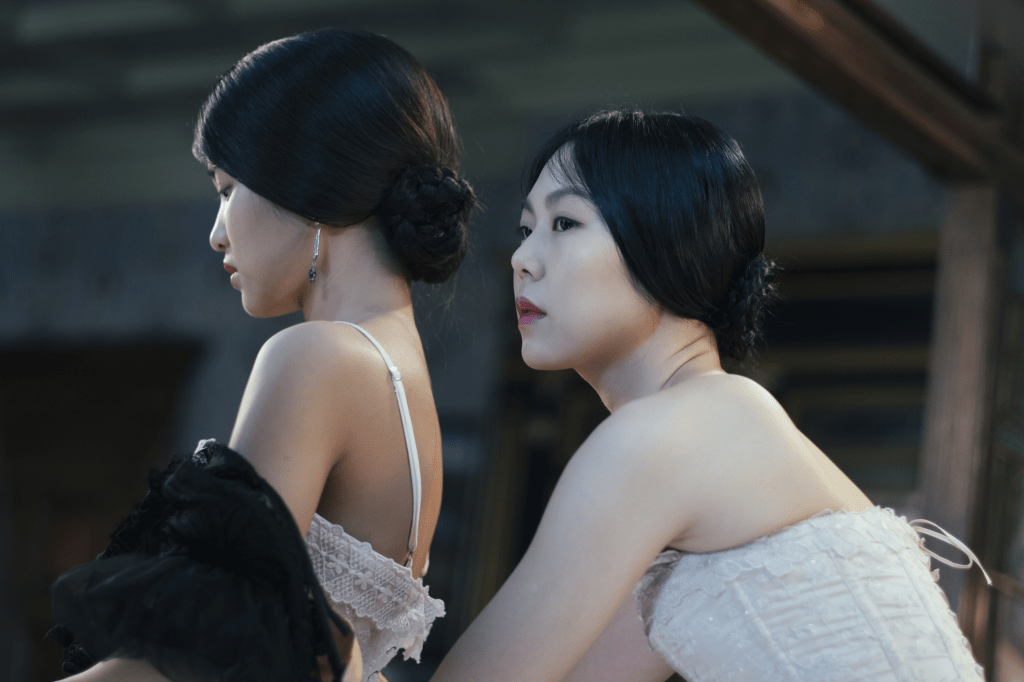
On January 27th, I was lucky enough to attend Dead Duck Film Club’s screening of Park Chan-Wook’s beloved modern classic, The Handmaiden (2016), at Savoy Cinema in Nottingham. Following their Dead Duck Cult Film Festival in November (for which I previously wrote an article ) and a screening of Let the Right One In (2008) in December (which I sadly missed), I was very excited to see what the good people at Dead Duck had in store for us this time.
I have previously praised Dead Duck’s advertising sensibilities, and their marketing rollout for this latest screening was no less impassioned and truly helped build anticipation in the weeks and months leading up to the film. Professional and cleanly designed posters, attention-grabbing Instagram posts, and a continued stream of interviews with local creators, experts and film enthusiasts are very much on brand for Dead Duck at this point. The whopping 211 people who attended their screening of The Handmaiden just goes to show how successful their marketing campaign has been, and that the club’s mix of careful curation and audience engagement goes a long way in bringing in audiences both old and new.
As for the screening itself, beyond the joy of re-experiencing one of the greats of the 2010s, it was just a delight to be in that atmosphere, surrounded by both long-time lovers of the film as well as those who had yet to experience what it has to offer. On a completely personal level, it also brought me immense joy running into so many people I knew at the screening. There was a real jump in the number of familiar faces I saw in only two months between the Dead Duck’s festival in November and their screening of The Handmaiden. This really emphasised to me how successfully Dead Duck has cultivated a core following that wonderfully represents Nottingham’s film buff population – a cornerstone of the city’s cultural scene.
Before the film started, Dead Duck’s Seb and Rue introduced the screening. Their vibrant personalities are infectious, and act as the perfect warm welcome needed for any good screening. Amidst their concise account of what was to follow in The Handmaiden, they gave a special shout-out to Nottingham-based filmmaker, Derry Shillitto, who was in attendance. Derry has recently directed a new film, The Correction Unit (2025), starring Bella Ramsey. This was especially heartwarming as Derry taught me for two years during my film and television production course at college. I had the privilege of attending the UK premiere of The Correction Unit back in September and I highly recommend that people seek it out. It was amazing to catch up with Derry briefly before the screening and personally gratifying to hear a round of applause for him. You can catch Lounge Trip’s special screening of The Correction Unit at Nottingham’s Broadway Cinema on March 3rd, which will be followed by a Q&A with Derry and other members of the cast and crew. Make sure you’re there, Nottingham!
Following Seb’s introduction was a poetry reading by local writer/poet, Jennifer Brough. Jennifer read out a series of poems she had written herself. The poems were inspired by three films that promote lesbian/queer relationships, the films in question being Lilly and Lana Wachowski’s Bound (1996), Peter Strikland’s The Duke of Burgundy (2014) and, of course, Park Chan-wook’s The Handmaiden. While I am ashamed to admit that I have not yet seen Bound and am almost entirely unfamiliar with The Duke of Burgundy, I found the poems written for those two films inspiring, and it made me even more eager to watch Bound and to learn more about The Duke of Burgundy. However, having already seen The Handmaiden, I found the parallels between Brough’s poem and the film’s unique aesthetic and thematic material very striking. Not only did these poems act as a fitting precursor to the film we were about to see, but it served as a push to watch the other two films her poems were based on.
Before moving on to talking about the film, I want to quickly talk about what is next for Dead Duck Film Club. Having now attended two of their events, and written about both, it is safe to say that I will be following everything the club does with great anticipation. They made a few exciting announcements before the screening begun. Firstly, they announced a brand-new podcast, the first episode of which (discussing The Handmaiden) premiered the following day on all podcast-supporting streaming platforms. Dead Duck are also hosting their first social on February 4th at the Arc Space in Hockley between 6 and 8:30pm. Finally, it was at the screening that they announced their next event: Gareth Evans’ high-octane Indonesian action film, The Raid (2011). Once again, the venue is Savoy Cinema, and it will be shown on March 30th at 8:30pm.
THE FILM – THE HANDMAIDEN (2016)
Dir. Park Chan-wook
★★★★
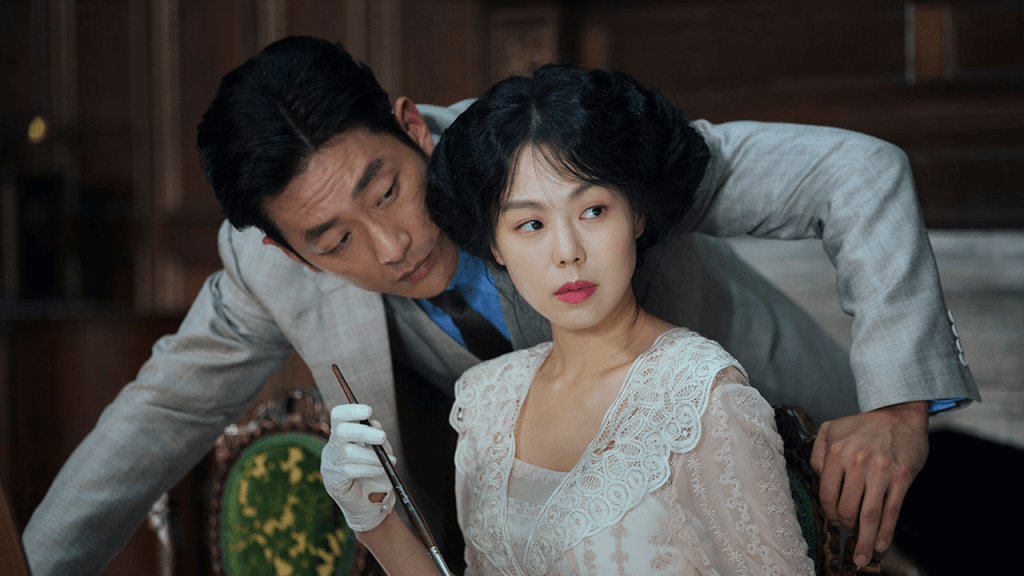
Coming hot off the UK release of Park Chan-Wook’s latest film, No Other Choice (2025), the week before, Dead Duck couldn’t have picked a more appropriate time to screen The Handmaiden. Having myself watched (and loved) No Other Choice only four days prior, I was more than ready to look back on one of Park’s most celebrated works. Although I had watched The Handmaiden once before, it had been almost five years, and my memory of it had faded. I remembered the broad strokes – the feeling, the structure, and some of its more notable moments, but the specifics had escaped me. It was an exciting position to be put in, as it made it as though I was watching the film through fresh eyes. Paired with the cinema experience inherently being a more intimate environment to view a film, the knowledge that I was going to be writing about it made me more attentive to what the film was saying.
One surprising element of my experience was that I quickly gave up trying to guess ahead and piece together the plot based on my fragmented memories of it. I instead allowed the film to sweep me away once again, taking in information as it came, as opposed to pre-empting it. Park Chan-Wook is known for many things, with one of the most significant being his attention to detail, and his implementation of symbolism into his stories. The film is so laser-focused on detail and recurring imagery that it is hard to be anywhere besides the scene you are witnessing in any given moment. Rarely can a filmmaker force the audience to second guess the meaning behind a shoe, a glove, a rope, a snake, a shared or even unreciprocated glance… but Park Chan-Wook’s mastery of visual storytelling practically attacks the audience, forcing them to confront ideas that transcend literal or spoken meaning.
The Handmaiden is a very subjective experience due to its barrage of concepts, symbolic imagery, and historical/cultural contexts. As a result, if you were to ask somebody what the film’s core hypothesis is, the answer would likely vary depending on the viewer. For me, I found that one of the most prominent aspects of the film is its subversion of the male gaze. For those unfamiliar, the male gaze is a highly influential and regularly cited aspect of film theory originally proposed by Laura Mulvey in her 1975 essay, Visual Pleasure and Narrative Cinema. The theory suggests that women in cinema are primarily posed as an object of heterosexual male desire to appease the so-called ‘male gaze’. She hypothesised that the male gaze exists on three dimensions: the gaze of the camera, of the characters on-screen, and of the audience. The portrayal of the female body in visual media is often one of objectification and oversexualisation, reinforcing conservative views of women as merely an extension of their male counterparts.
Although many filmmakers, such as Agnès Varda and Céline Sciamma have defined their careers by crafting stories around female characters with agency, the fact remains that the male gaze continues to plague the modern media landscape, setting back much of the progress made by these female-led and driven films. Even in a generally more aware time, many male directors still find themselves guilty of the male gaze. This makes it even more impressive how well Park Chan-Wook’s The Handmaiden has aged a full decade later. Even under the scrutiny of 2026 eyes, Park’s commentary on male control over the female body remains as urgent as it did in the year of its release. And despite having a male director at the helm, the examination of female perspective and the reclamation of urgency is thorough and thought-provoking. I would even go as far as to claim that the idea of perspective, and regaining control of that perspective is pivotal to understanding the film, with the deconstruction of the male gaze being the lens through which it enacts these themes.
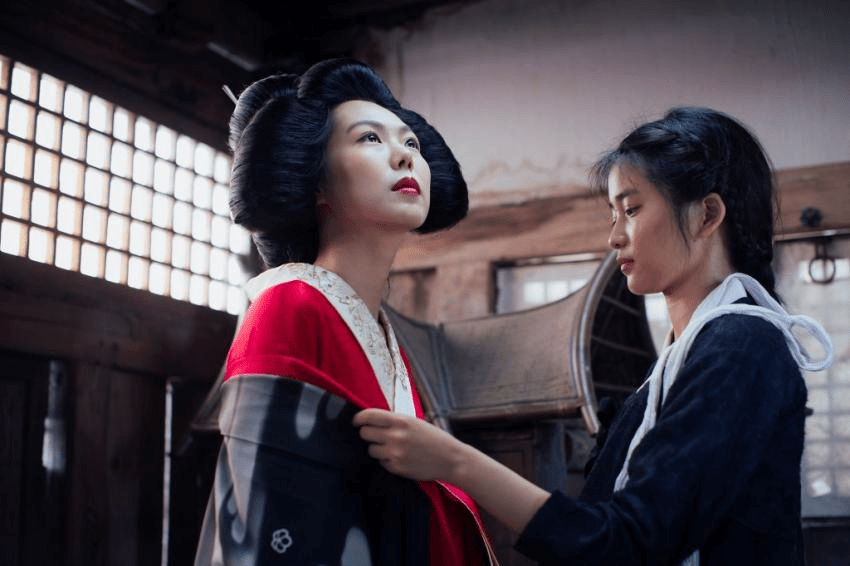
The film implements an interesting three-part narrative structure, with the division between each segment going beyond simply showing different portions of the story. Instead, Park completely challenges with each subsequent chapter what the audience has already witnessed in those prior. This is truly where the film’s manipulation of the entire idea of perspective comes in. It fully embraces the triad relationship between the camera, the characters, and the audience. One of those three core elements is always more in the know than the others, and it is usually the characters. For over a century now, since cinema’s inception in the late 1800s, audiences have been conditioned to trust the camera. What is shown through the camera’s lens is often the objective basis of most narratives. Films such as Akira Kurosawa’s Rashomon (1950) have famously challenged this notion, hence the coining of the term ‘the Rashomon effect.’ However, I would argue that The Handmaiden does not precisely fall under this category, as the differing perspectives shown in the film do not contradict one another – a staple of films that use the Rashomon effect. In The Handmaiden, everything we see is, for lack of a better term, objective. It more comes down to the fact that the camera simply does not show everything, making the narrative more of a puzzle that requires piecing together, rather than a mosaic of contrasting accounts of the same event. What is so interesting about The Handmaiden is how the camera itself feels like it is catching up as much as the viewer, and when more is revealed, it feels more in line with the intimate perspective of the protagonists, rather than the invasive allure of a camera.
The plot, in the simplest terms possible, centres around a young Korean thief who becomes the handmaiden to a secluded Japanese heiress, with the aim of coercing her to marry a conman (masquerading as ‘Lord Fujiwara’), who will then have her committed to an asylum and claim her inheritance. The film quickly establishes a hierarchy of power, with Sook-hee, the pickpocket who is hired as Hideko’s handmaiden, being used as the pawn at the very bottom of the ladder. She is the tool through which somebody else (Lord Fujiwara in this case) can get richer, cultivate more power, and achieve a higher status. He is thus posed as the central figure of power in this plot. He is the one pulling the strings of the scheme who will, as he believes, financially benefit once it is seen through. On the opposite end, Sook-hee and Hideko, the heiress, are simply means to his greedy end, who ultimately will not prosper should his plans come to fruition.
The film’s first act mostly follows the view of Sook-hee. Although she initially arrives as an agent of this elaborate plot, an interesting threat to Fujiwara’s plan materialises when Sook-hee begins to develop feelings for Hideko, and a romance blossoms between the two. From the beginning, Hideko is objectified by Fujiwara – dehumanised and seen as little more than a piece of meat from which Fujiwara can extract a great many assets once he has tossed her aside. This very much aligns with the male gaze theory, as it is projected onto Hideko by characters within the narrative. Although, the camera is not concerned with shooting Hideko as she is seen by Fujiwara. She is instead shown from the perspective (frequently in actual point-of-view angles) of Sook-hee, the titular ‘Handmaiden.’ Fujiwara’s clinical view of Hideko, (which is fleshed out as being more fetishistic in the film’s following acts) is portrayed as completely dissonant from how Sook-hee views her. In a literal way, she actually ‘sees’ her, and doesn’t just look at her for mere visual pleasure.
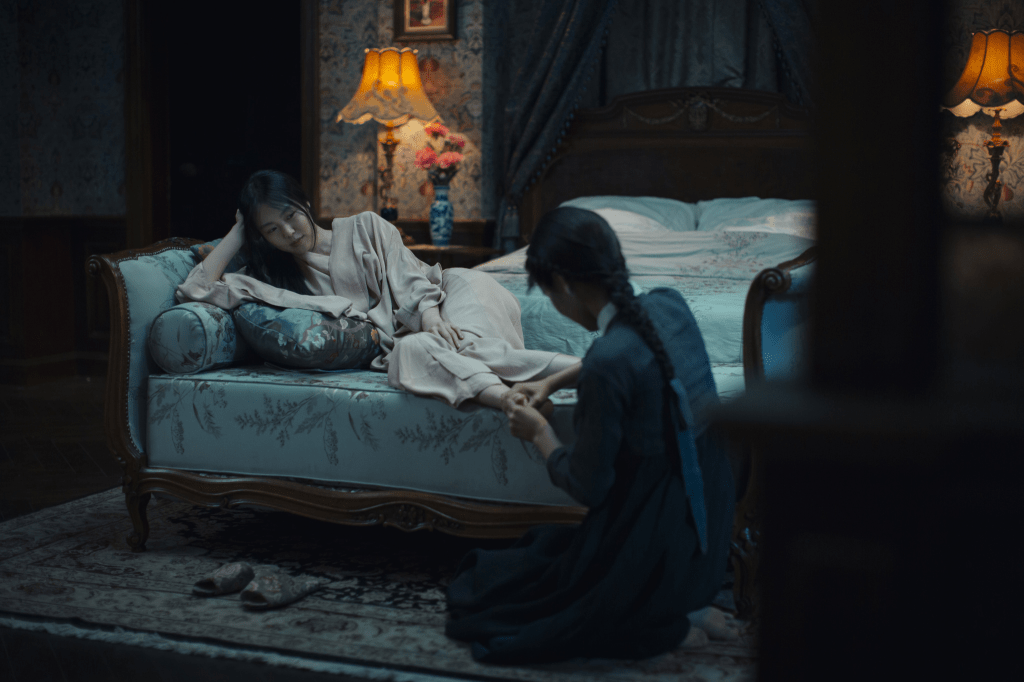
Much of the discussion surrounding The Handmaiden involves the film’s explicit sexual content. Intimate and/or sexually charged moments are frequently exploitative, especially in mainstream media. However, the sequences of overt sexuality in The Handmaiden are always framed solely through the empathetic eyes of the female leads… thus accomplishing the ‘female gaze.’ Referring back to what I said about Sook-hee genuinely seeing Hideko for who she is, the way in which the camera lingers on shots of the body is approached with a level of sensitivity seldom seen from male directors. The desire remains mutual between the two women, and these moments take place away from the prying eyes of the men within the story. In these moments, control is entirely their own, and they are free to express themselves without the looming expectations placed upon women in the 1930s backdrop that the film is situated in. Beyond that, there is a clear contrast between the two lovers’ passion and the shallow, fetishistic sexual demonstrations we see Hideko being forced to perform for a room of wealthy men before Sook-hee’s arrival.
Sook-hee and Hideko’s romantic partnership is, in itself, an act of rebellion against the patriarchal societal structures that the film establishes in the second chapter. The more we learn about Hideko during this portion of the film clearly fleshes out the torment and repression put upon women of the time. Seeing the borderline cult-like practices that Hideko was expected to perform is barbaric and immensely restrictive on a basic human level. The sexual acts she is made to do in front of an audience create a cold distance for the character’s sexual liberation, as she is actively objectified by an onlooking audience – the males who literally gaze upon her. It makes it all the more satisfying to slowly witness the two girls attempt to seize back power over their own narrative, which ties yet again into this notion of the relationship between camera, character and audience.
For much of the film, the audience remains in the dark about the ulterior motives and backgrounds of the characters due to what is not shown. It is as though, in these earlier moments, much of what the audience sees reflects the banal obliviousness of the men at the centre of the story, and the camera is actualised as ‘the man.’ Ultimate plans are hidden in plain sight from the very beginning, completely limiting the power of the camera as a storytelling device. Information is revealed slowly, and by the time the men of the story, the camera, and the audience are finally caught up, it is too late. The final inversion of the male gaze is in how it comments on the arrogance of patriarchy and its ignorance to female agency. Sook-hee and Hideko free themselves right under their noses by exploiting this core misunderstanding and underestimation.
What is so satisfying about The Handmaiden is how it totally flips what is understood to be the base power dynamic of cinema on its head. The camera and audience, which usually act as the omniscient, omnipresent observers of a story, are always multiple steps behind the central characters. The film constantly plays tricks on the audience to keep them on their toes, but to a greater purpose than simply providing moments of shock or superficial revelation. The lovers’ freedom is from more than just the patriarchy. It is freedom from an entire system, a way of living, and from the ever-watching gaze of the camera and the audience. Park Chan-Wook himself keeps distance from the characters as well. As the man behind the camera, he always ensures that Sook-hee and Hideko are in control of their own agency, completely outwitting their oppressors and the audience alike.
Samuel Leary (@themovieguysam on Instagram) is a Nottingham-based film enthusiast and lead programmer for film collective, Club Jok. He is dedicated to sharing his passion for all things cinema and aspires to highlight the power of film through both his writing and curation.


Leave a comment