
by ‘K’
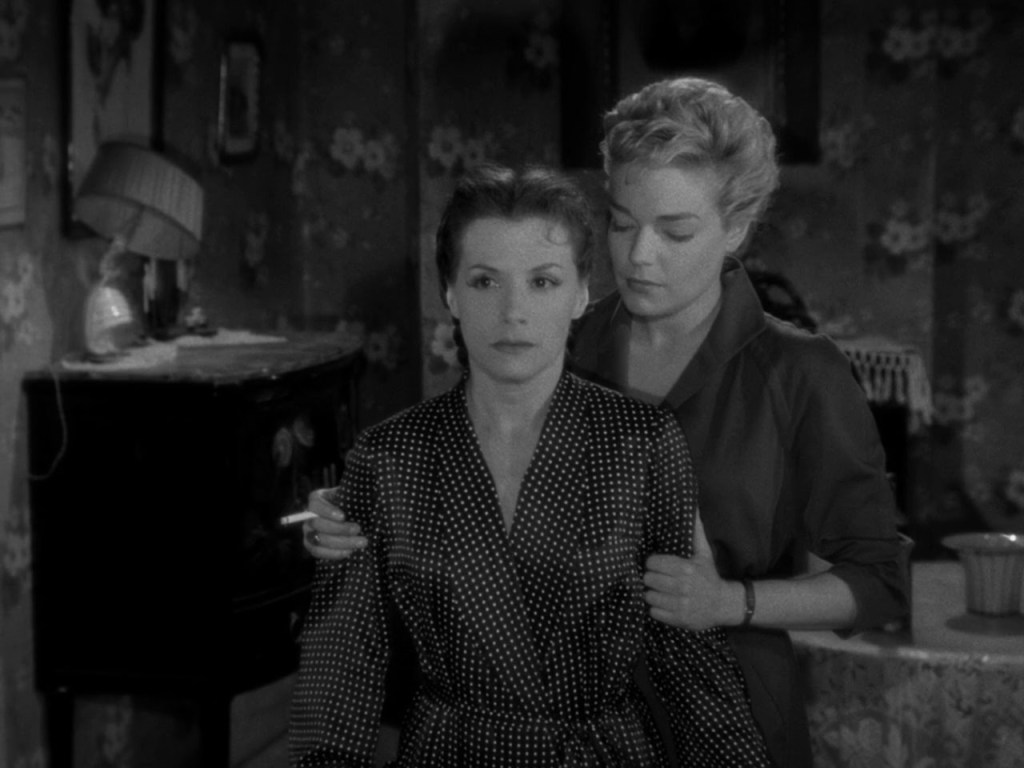
In 1955, a queer-coded thriller pierced the French cinema landscape, appearing in the horizon as a tower of layered anxieties and deceit. Tensions of different kinds vertically stack up like bricks: conspiratorial, romantic, psychosexual. Some anxieties boil over a dead body that can’t be found, and others burn between living bodies that never leave each other or the screen. Through many of its layers of paranoia, the film misleads the audience, and the truth can be either shocking, or shockingly disappointing. Discussion surrounding this French classic can be equally tense, as 70 years later, audiences still disagree on whether the film is merely a result of historical sexual repression or a legitimate portrayal of it.
Henri-Georges Clouzot’s horror masterpiece follows Christina and Nicole, two women who teach at a boys boarding school. Both are romantically involved with the same barbaric man, Michel. Christina is his feeble wife, the primary victim of his violence, and Nicole is his mistress, who has decided that the time has come to end his abuse for good. Despite their odd relationship, the duo is introduced as inseparable, and the story appears fixated on stress-testing the resilience of their bond, which is strongly suggested to be mutual queer affection. Together, they decide to murder Michel by drowning him in a bathtub. The aforementioned stress-test begins when the corpse disappears.
Three forms of anxiety are thrust into the audience’s lap. The first, and most obvious, is the conspiratorial-criminal tension, as both women are at risk of being arrested depending on how the dead body is found. The second is psychosexual in nature, since throughout the story, Michel’s living body acts as an obstacle between the two could-be-lovers and their repressed desire. The third is the audience’s anxiety for romantic fulfilment, and is the most difficult to decode, as in spite of incredibly strong clues, there is no explicit acknowledgement that the two women are gay and/or romantically interested in each other. Addressing the conspiratorial-criminal anxieties is a requirement to alleviate the psychosexual and romantic ones.
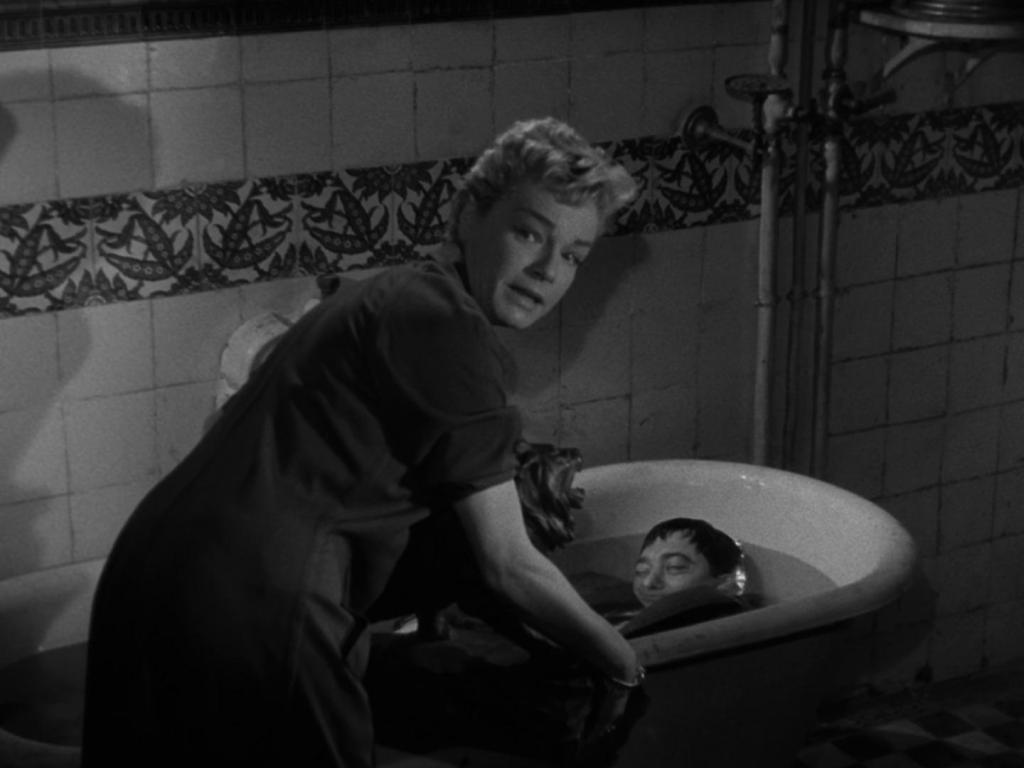
Fiction has all too often tragically severed queer bonds through phony dramatics, usually the death of one of the partners. If not for Christina’s weak heart, perhaps a conclusion in which both are incarcerated could offer some hope that their long restrained love could find a bittersweet opportunity to flourish in prison. But due to her medical condition, the pressure of going to jail would most likely result in her death. Thus, all three anxieties remain ignited, and their interplay becomes clearer. The two women must navigate the stressful Hitchcockian-murder-plan-gone-wrong to come out the other side free of male aggression, where the audience can finally discover if the two women are canonically gay, and if so, where the two can pursue their sapphic love. For the sake of catharsis, it becomes imperative that not only both women get away with the murder, but that they do so together.
For much of the narrative, Nicole and Christina’s actions are inspected by the gaze of confused men. In her book “Framed: Lesbians, Feminists, and Media Culture.”, critic Judith Mayne argues that, while the film is about the murder plot, everything else is about the women’s perceived affair. When the two arrive at Nicole’s home, where the assassination will take place, they’re concerned about making too much noise and what the neighbours will think – humorous sensual undertones behind the overt criminal activity. While the two women battle the conspiratorial tension resulting from their crime, the male characters exclusively speculate on the nature of their relationship. Ironically, this allows both women to plot the murder rather freely by the swimming pool while Nicole knits. The boarding school, with its many windows and glass panels, presents the ideal environment for male surveillance, yet the men fail to accurately perceive the two women’s murderous intent. At most, the men see the threat of a ‘deviant’ affair which threatens their sexual relevance and gender dominance. It seems beyond the men to comprehend that, in reality, the two women are a threat to their physical existence altogether.
Mayne contends that Christina and Nicole fall on opposite ends of the Freudian Madonna-mistress complex, in which women are either categorised as Madonnas, innocent and free of impurities, or mistresses, degraded and promiscuous figures. The frail Christina is petite, softspoken, and has her hair braided in dual ponytails. She’s the one that is most vocal about her fears and quite literally suffers from a weak heart. Christina is coded as a femme lesbian, and according to Freud’s theory, a Madonna. Meanwhile, Mayne claims that Nicole “sports the ‘masculine’ swagger, the short hair, and the deep husky voice so typical of the female invert”. She’s assertive, inspires action, and is the one that gets things done. For the 1950s standards, Nicole is coded as a butch lesbian and a Freudian mistress.
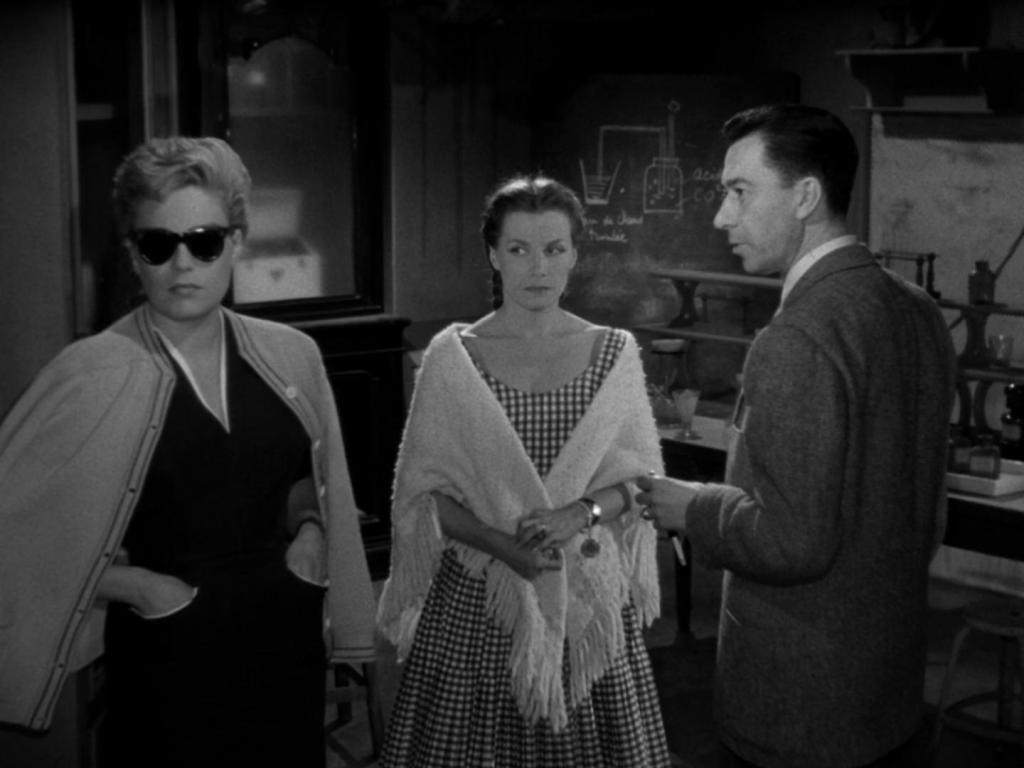
In addition to wider heteronormative societal conventions, the abusive Michel seems to play a direct role in Nicole’s and Christina’s sexual repression. After the murder, tension rises exponentially, as the two women struggle not only to find the corpse, but to make sense of ghostly signals of Michel’s presence – from a hotel room being rented in his name to his face making paranormal appearances in photographs. The patriarchal spectre looms over the protagonists, and even in his physical absence, the two women are incapable of enjoying a life together. The flames of multiple anxieties go on smoldering.
However, the resolution of this nightmarish ordeal isn’t so linearly satiating. Rather, it reveals even greater fears that were thus far unknown to the audience. In what is perhaps one of cinema’s greatest twists, the male corpse arises from the bathtub, literally scaring Christina to death, and revealing that Michel, the abusive husband, and Nicole, the protective mistress, conspired together to kill the frail Christina for her inheritance money. The anxieties built are abruptly amputated, as the viewer finds that they misread both the murder plot and the lesbian subtext. The shock isn’t only that Michel is alive, or that Nicole’s a traitor – both perfectly Hitchcockian and adequate twists. What adds bitterness to the betrayal is that Nicole is straight, and that her newly-found heterosexuality provokes her bold independence to fade into submission for a male abuser.
In She Who Was No More, the 1952 novel that inspired the film, the genders of the three main characters are reversed. Instead of a duo of women attempting to kill an abusive man, the book follows a married man, Fernand, and his mistress, Lucienne, in their plot to kill his wife, Mireille, and collect her life insurance. In the end, Fernand dies of guilt over his spouse’s murder, and the climatic reveal is that not only is Mireille alive, but that she and Lucienne are lovers. To achieve an impactful twist and make the women canonically gay, the book must contradictorily dedicate most of its pages depicting a heteronormative couple. Since Christina is played by Véra Clouzot, the director’s wife, giving the female characters more screen time evidently motivated the creative decision in the adaptation. But ironically, reversing the characters’ genders and arguably repressing the lesbian relationship makes for a story much more centered on the two women than the original material. Though Clouzot’s spin might have been indeed homophobic or nepotistic in reasoning, the final product is a 1950s classic that puts women at its forefront. Attempting to unravel the politics of Diabolique only makes the threads increasingly more entangled.

Authors Stephanie Bastek, Isabel Lockhart Smith, and Kerstin Rosero, in their essay “Queer Horror: Unearthing Sexual Difference in Les Diaboliques”, make the case that in Diabolique, it is not lesbianism that is demonised on a narrative level, but Michel’s patriarchal violence, and observe that this contrasts with the horror genre’s common typification of monsters as stand-ins for repressed queerness. Although Christina’s and Nicole’s relationship isn’t explicitly gay, Bastek et al argue that its undefined nature outside social norm mirrors queerness itself, in that it “destroys rigid territoriality and undermines binary oppositions”. The authors defend that Diabolique proposes a repression of patriarchal conventions, both through Michel’s absence and the women’s relationship. The male abuser’s return to life doesn’t equate to a victory of patriarchal customs, since Nicole and Michel are immediately incarcerated, and Christina’s spirit doesn’t leave them behind. The article’s conclusion is that repression itself is the real monster in the story.
The film’s conflicting queerness reaches its zenith during the parting of ways between the two women. Christina encourages Nicole to leave, as their terrible destiny seems near, and they say goodbye in the bedroom. Mayne points out that this is where the film diverges from usual homophobic stories, in which it is the butch that dispels the femme so that she can live a ‘normal’ life. When Nicole moves into the hallway, something quite odd occurs – as she walks down the frame, the character dissolves into thin air, in a cinematic device previously unseen. A fantastic element of cinematic manipulation is introduced to a film that so far has stood grounded in film noir conventions. To banish the lesbian plot, Mayne observes that the butch-coded female character must fade away before the audience’s eyes, in order to later return as a heterossexual traitor. Diabolique metaphorically buries its gays to make the plot twist possible, but the phantom of queerness throughout the film is so powerful that it has two apparitions. For Mayne, the vanishing of the butch-coded Nicole isn’t enough to erase the queerness that her presence projects onto the entire film, while Bastek et al highlight that the late Christina’s ghost inhabits the screen on a narrative level seeking justice. The lesbian plot might be killed, but it leaves enough questions unresolved to haunt the film.
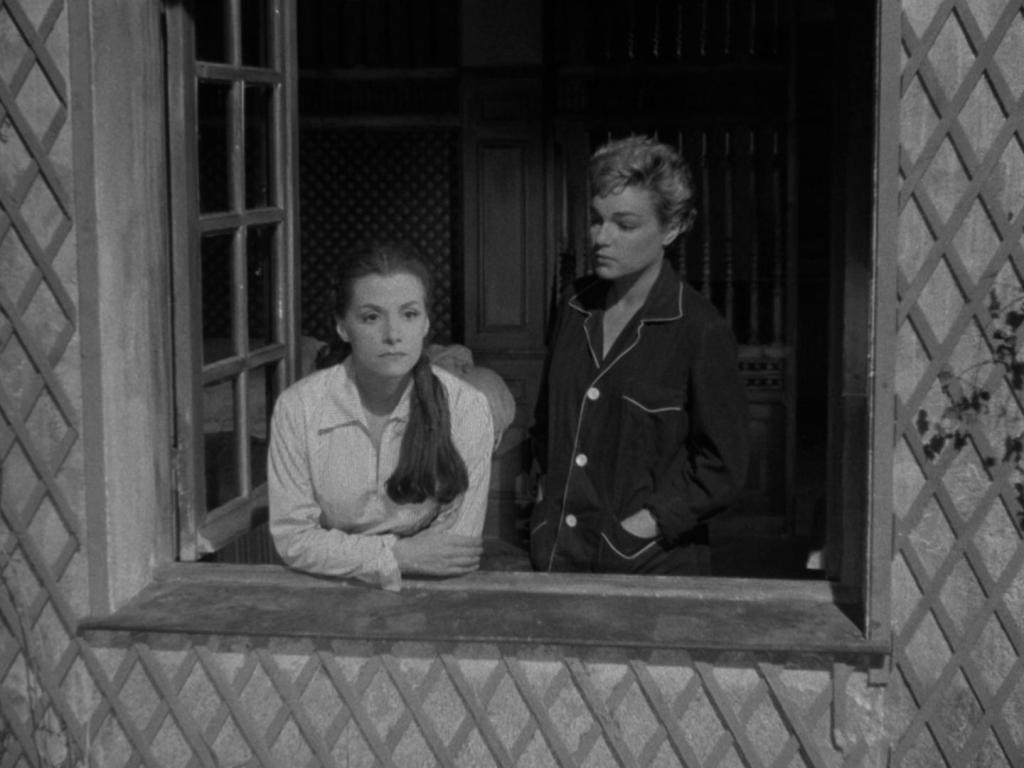
Certain viewers categorise the film as a piece of queerbaiting. In the scene which most strongly suggests their secret love, the two women stand by the window waiting for Michel’s corpse to float in the pool. In the background, the bed they share is unmade, and they wear matching pyjamas. During Christina’s last conversation with Michel, she refers to a single bed not as hers or Nicole’s, but as theirs, seemingly disclosing their physical intimacy to her husband. Judith Mayne brilliantly points out that, while the women share beds throughout the film, Christina spends much of her final moments alone in hers. Arguably, the most tragic victim of queer-baiting isn’t the audience, but Christina herself, and there’s good reason to believe that her affection was genuine.
On the other hand, the butch-coded Nicole, which symbolised female strength thus far is not only complicit in Christina’s recurring physical abuse, but financially invested into it. This singular kind of discomfort can, in itself, evoke slightly paternalistic responses which are counter-productive to a feminist examination of the film. The expectation that all butch-coded women inherently stand for structural rebellion reduces them to idealised moral confines that echo Freud’s Madonna-mistress complex, and that mistake the rising number of female CEOs in the capitalist savannah as progress, for example. Nicole’s participation in the longform violence against Christina demonstrates a departure from her fictitious nurturing personality, and serves as a sour attack against the assumption that solidarity and support between women is the universal construct that it should be.
The pill is even tougher to swallow since, to achieve such a plausible performance, Nicole necessarily must have a certain degree of understanding and self-imposed empathy for Christina’s abuse. After all, earlier in the film, she conceals a black eye, which the audience then believes was a result of Michel’s abuse. Although direct patriarchal violence is revealed not to be a threat to her personally, it is an anxiety she understood closely enough to simulate. In the days of anti-feminist tradwives and Latinos for Trump, it’s important to underline that individual values unfortunately do not always correspond to the material needs of any given social group. Nicole represents no woman besides her own flawed self, and Christina’s abuse is a cost she’s more than willing to pay for a satisfactory return on investment. Diabolique fools its viewers similarly to how the female criminal pair fools the men – the film repeatedly shows what the two women are capable of together, and the audience forgets to ask instead what they are capable of individually.
Some argue that this final twist betrays the film’s premise, and this dissatisfaction is mostly caused by its reputation. Diabolique has been reclaimed as a be gay, do crime movie, and that pre-conception can be bitterly sabotaged with the reveal. The contrast can be established with Alfred Hitchcock’s 1948 masterpiece Rope, which similarly portrays queer-coded criminal activity, as two men commit a murder quite comparable to that of Diabolique (both corpses are stored in wooden boxes). Although the narrative doesn’t canonically acknowledge their homosexual relationship, Hitchcock never deprives the audience of its interpretative license to remember the film as the story of two gay murderers, and what is left unsaid continues to guide the film’s reputation. The same is not true for Diabolique, and the answer it provides seems to leave many contemporary viewers wishing they had seen the film they believed they were watching. However, perhaps an analysis centered on expectations of what the film should be prevents viewers from building a meaningful relationship with what the film is, and the audience’s imagination should aim to interpret the artist’s work as it stands, not to fix their finished art.
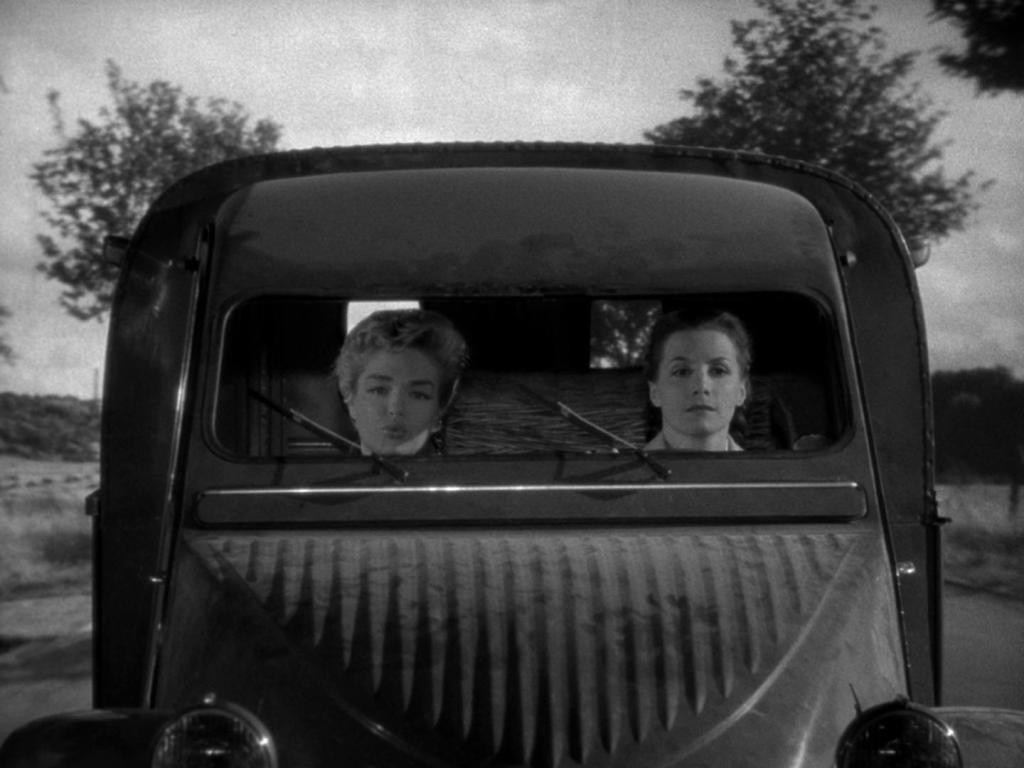
After tormenting the audience with fears surrounding criminal conspiracy, forbidden romance, sexual repression, patriarchal dominance, domestic abuse and many more, Diabolique unveils how undiluted greed and self-interest triumphs over them all. Much like in the real political stage, shared social anxieties aren’t enough to bridge categorically opposing material interests. Clouzot’s film raises interesting questions around the ‘traitors’ in groups still fighting for their voices today, and summons to imagination the unpleasant faces of nefarious figures like Hannah Pearl Davis.
It seems only appropriate then, that this text has no irrevocable sense of closure to offer regarding Diabolique and its sexual politics. The film may well be a product of homophobic queer-baiting, 1950s censorship, or simply Clouzot’s nepotistic desire to give his wife more screentime. However, even if unintentionally, the thriller poses as a valuable object of discussion regarding audience expectations, idealised visions of minorities, sexual repression and even the extent to which patriarchal violence can be perpetrated by non-male aggressors.
Diabolique’s anxieties are bricks that assemble a layered tower of appearances which, although deceiving, is still worth climbing, as 70 years later audiences are still discussing whether the view from above pays off or not.
Bibliography
Mayne, Judith (2000). Framed: Lesbians, Feminists, and Media Culture. Minneapolis: University of Minnesota Press, pp. 41-62.
Bastek, Stephanie, et al (2011). Queer Horror: Unearthing Sexual Difference in Les Diaboliques. Film Matters, vol. 2, no. 4, pp. 13-17.
K is a Brazilian self-described annoying cinephile, chaotically eclectic music curator and sell-out iconoclast. He is the author of Punished for Sincerity, a Substack in which he shares class-conscious reflections on art.


Leave a comment