
by Ros Tibbs
New French Extremity: French New Wave’s Edgier and Violent Cousin
One period of filmmaking that unlocked a whole new level of the medium’s artistic properties and cultural significance is the French New Wave, an art movement that rejected the traditional modes of cinema in favour of something experimental and thematic, with notable contributions being released from 1958 to the late 1960’s. This era of French cinema was kickstarted and carried by some of cinema’s most influential critics-turned-filmmakers, including Alexandre Astruc, Jean-Luc Godard, Éric Rohmer, François Truffaut, Claude Chabrol, Jacques Rivette and Agnès Varda. Distinguished by film academics visually by its emphasis on the iconography of French culture and long tracking shots, as well as narrative-wise through existential themes and showcasing the absurdity of human existence through tones of irony and sarcasm. French New Wave cinema operated as a love letter to cinema as an emotive and social outlet. As Truffaut explained in a 1961 interview, “the ‘New Wave’ is neither a movement, nor a school, nor a group, it’s a quality,”a mindset to filmmaking that achieves new boundaries. Since its debut, this cinematic ‘quality’ has captured the hearts of every beanie-wearing, goatee-donning, chain-smoking guy I’ve spoken to on a dating app or at an underground bar who cannot refrain from making sure I know French New Wave is the only acceptable form of filmmaking.
This era of cinema is treasured by cinephiles as one that demonstrated sophistication and the importance of culture and the individual. Ask the average self-acclaimed film buff for a favourite feature, and there is a high chance they will respond with a radical and artistically attentive French New Wave classic. One that demonstrates black-and-white images of intellectual French men and women smoking cigarettes and sipping black coffee in a cafe as they discuss philosophical matters through occasional artistic references, as a sign value for their esteemed passion and understanding of “true” cinema. However, one subsequent and unsung approach to French, and additional overall European, film presents a world that is just as intimate but borders on the brutal side. New French Extremity, also known as New Extremity when considering non-French releases, is the term used to encompass 21st-century movies that are transgressive, explicit and unhinged, generating controversy and scandal through their obscure prioritisation of subject matter.

New French Extremity bears similarities to the French New Wave concerning experimentation, reliance on expressive visuals and thematic tapestries oriented around the individual. However, with those similarities come vast differences that can be perceived as two realms of filmmaking as a whole, and each side can have its tenets situated into two distinct artistic manifestos. As much as the French New Wave showcases a documentary-style presentation of French landscapes to explore realism, New French Extremity occupies its camerawork with graphic violence utilised to probe ideas of savagery. A French New Wave feature’s script is threaded by thematic values of the individual’s place in the world compared to civilisation and art. A New French Extremity screenwriter examines unconventional modes of spectatorship by challenging their audience to witness extreme depictions of sexual violence and social corruption, incorporating concepts of voyeurism and its ethics. French New Wave filmmaking dissects the individual’s psyche. New French Extremity violates the individual’s body and, subsequently, a unified morality. Any French New Wave-obsessed film buff who seeks to see all that French cinema has to offer would have to make thorough preparations before partaking in a New French Extremity marathon. Such a turnover in film taste would require the utmost mental and emotional conditioning. Any Godard lover dipping into new French cinema territory would find the culturally relevant debates and countless shots of coffee cups and cigarettes thrown out to make room for ethically challenged events compressed in merciless shots of brutality and social deformity.
One writer and director who has contributed to the New French Extremity in a similar vein to how Godard and Varda elevated French New Wave is Gaspar Noé, the Argentine-born and French-based filmmaker who is most notable for his sexually graphic and ethically questionable art films. In 2002, Noé shocked film buffs when he released his most prominent and recognised work, Irréversible, a challenging milestone in extreme cinema that later came to define it. The director’s second feature film stars the breathtaking Italian icon Monica Bellucci, as a woman who is brutally beaten and sexually assaulted in a Paris tunnel one night, with Vincent Cassel and Albert Dupontel featuring as two men besotted by the alluring charm of Bellucci’s character and so attempt to track down her rapist. Noé follows in the footsteps of the French New Wave filmmakers in their search for unconventional storytelling. While French New Wave artists disrupted cinematic conventions through jolted jump cuts and self-referential material, the Algerian-born director assessed a visual story’s structure by separating Irréversible’s narrative into 13 segments orchestrated to appear as long takes, carried out either through one individual and continuous shot or a collection of shots digitally altered to resemble a continuous shot. Furthermore, each scene takes place chronologically before the one that precedes it, communicating an experiment with cinema’s properties and audience cognition towards understanding such an unsettling narrative.
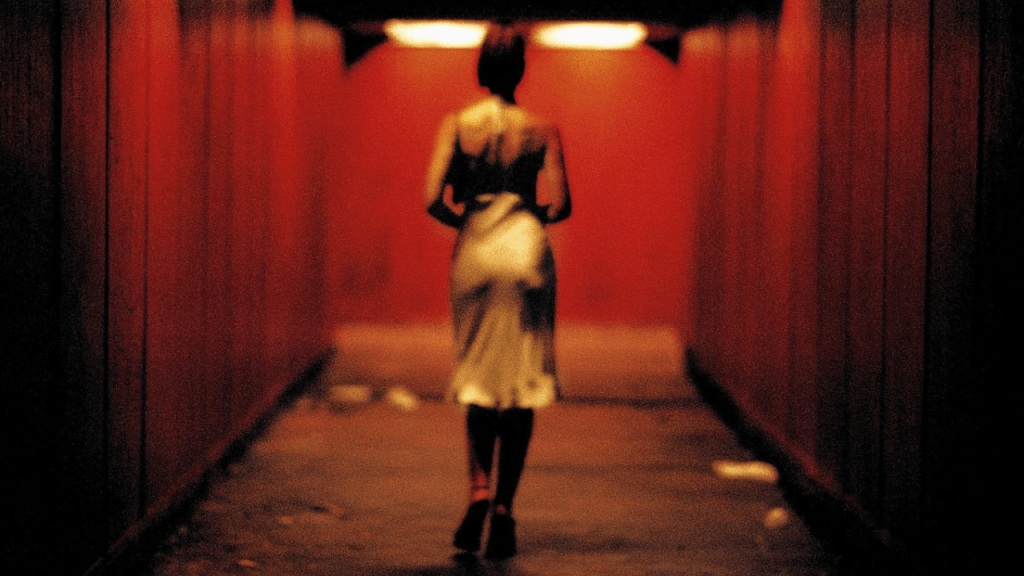
However, this experimentation with the visual components is the only way this work can find itself in the same vein as the French New Wave. In its quest to explore something more brutal compared to the 1960s artistic movement, Irréversible upholds all the visual and critical components of New French Extremity, such as extreme violation of the (usually female) body in a 10-minute sequence where the camera seemingly cannot get enough of the imagery of a body being assaulted in drawn out shots where there is nowhere else to look. This is connected to an exploration of social and moral depravity, with the former presenting graphic visuals to harmonise with the latter’s thematic reflection of societal ills. It’s a film that cares little for comfort and sensitivity, instead pushing viewers to face a world deprived of warmth where seedy and sick antics infiltrate every corner to infect it with threats to the civilised. Irréversible communicates every stark difference New French Extremity embodies compared to the period that came before it, attracting a different audience niche to the self-proclaimed culture activists of the French New Wave 60 years after its beginnings. The debates a film such as Irréversible creates, many of which I’ve been active in myself, concern themselves little with proof of what makes civilisation flourish, such as artistic passion, and more with what stifles civilisation, such as tainted perversion and to what extent should the latter be documented in visual storytelling. The film premiered at the 2002 Cannes Film Festival in a bid to win the Palme d’Or, and while Noé earned acclaim for his inventive direction and the cast was praised for their brilliant performances, the project’s subject matter generated negative reviews and ratings of one of cinema’s most visually and ethically cruel contributions.
Horror filmmaker Alexandre Aja’s 2003 slasher High Tension, also known as Switch Blade Romance, sees Cécile de France and Maïwenn play two best friends whose trip to a secluded farmhouse is interrupted by a vicious and ruthless serial killer played by the late Philippe Nahon. Aja directs a script co-written with Grégory Levasseur that exhibits brutality, bloodshed and the utmost barbarity, with Italian horror make-up artist Giannetto De Rossi helping bring the gory images of demolished skulls and chainsaws going through torsos with ease to life. This effortlessly accentuates the New French Extremity’s criteria with graphic violence threading every alleged plot point together, providing a striking difference compared to the French New Wave, which occupies its plots with philosophical discussions against Parisian backgrounds. High Tension relies on shock value-based carnage and twisted, unexpected turns of events where morality is utterly absent, unnerving viewers with a narrative and visual composition that refuses to relinquish the threat.
The two leads are thrown full throttle into an intense nightmare as Nahon’s villainous character forces their limits through his sinister antics and thirst for blood, with the director’s attention to every grizzly detail being blown up on the screen, constructing a full exploration of the macabre. High Tension employs its overuse of carnage to showcase a tension like no other. Aja ensures that the plot’s pedal is forced down from the moment Nahon’s role appears, kickstarting all the violence and suspense into a ruthless race before crashing head-on into the climax, the most shocking segment of the film. The plot twist conclusion brings a new, alarming layer to the narrative in the form of disrupted psychology, one that introduced criticism concerning a questionable social representation of sexualities, in addition to the buckets of gore. As a subsequent result of its disturbing nature, which sees tonal suspense and visual savagery attempt to balance each other out, Aja’s contribution to New French Extremity was met with controversy and censorship. Certain death scenes were shortened in run time with close-up shots of the fatalities cut entirely, and the film appeared on TIME Magazine’s 2010 list of 10 most ridiculously violent movies at number 10.
The 2021 Cannes Film Festival saw New French Extremity meet with eventual mainstream acclaim when the Palme d’Or went to Julia Ducournau’s unorthodox body horror psychological drama Titane, which translates to Titanium. The film stars Agathe Rousselle in her feature film debut as a car accident survivor who has received a titanium plate fitted into her head and works at a motor show as a dancing showgirl. Rousselle’s character, Alexia, conceals an erotic interest in objectophilia, meaning she is sexually aroused by the same cars she utilises as props in her work. One late-night sexual encounter leads to Alexia’s life changing forever when she falls pregnant with a human-vehicle hybrid, tossing the feature into a unique take on the body horror genre and so differs from the average ‘need for speed’ car flick. The character’s body succumbs to a shocking physical alteration, resulting from her sexual desires. Titane takes a step back from the graphic and relentless gore of other additions to New French Extremity and instead focuses its fascination with the extreme in unconventional displays of sexuality and body modification, exploring social aspects of gender rather than low-brow attempts to shock audiences.

Alexia’s disguise as a missing boy, which physically ‘passes’ but still exerts occasional yet extreme bursts of femininity, infiltrates the audience’s understanding of gender binaries and classification of sexual orientation in how biological men respond to this crossover of presentational tropes. This is evident during a sequence where Alexia, in male drag, shows her sensual dancing skills in front of male firefighters who display confusion stemming from possible sexual attraction, making for some dark humour to shake the film’s tone up. Furthermore, the film’s overall visual structure lacks surface-level sexual brutality, yet displays something just as startling in close-ups of flesh-tearing to reveal metal to explore further concepts of category confusion, which bleeds into horror tropes. Titane is a film that embeds itself permanently in the spectator’s psyche through this criterion, with Ducournau’s direction immersing itself entirely in a nonconformist story told through a vibrant visual palette, earning criticism that interpreted it as crude in its direction and unsympathetic in its subject matter handling. Despite the controversy, Ducournau’s fifth feature not only earned her the accolade of being the second female director to win Cannes’s highest award (the first to do so on her own) but her artistry led to a work that is experimental in its provocativeness and boundary-breaking in its visual exploration with flesh and material.
Overall, New French Extremity is a mode of visual storytelling and concept presentation that thrives on the explicit and the obscure. Its manifesto calls for directors to showcase narratives that negotiate morals, artistically and socially speaking, blended with savage visual composition to conjure works that dissect just how far a film can go when reflecting the worst of society. When elaborating on the latter aspect further, one can draw parallels between how the French New Wave, as an antecedent to New French Extremity, employed long continuous shots of Parisians debating the meaning of life to maintain philosophical properties with how its successor does the same – with close-ups of bodies being violated, to examine moral bankruptcy and its origins. As a result of such visual and thematic comparisons, both cinematic movements present an exploration of the medium’s DNA and the following influence on artists and audiences. They depict their own worlds through specific perceptible criteria, with one highlighting intellect and culture, while the other focuses on a societal fascination with violence and the overt sexualisation of bodies.
Ros Tibbs (Instagram: smellsliketeenros) is a freelance film critic/writer based in Essex and East London, specialising in theory, history and the horror genre. She mixes in feminist, political and/or queer frameworks within her passionately written prose and curation work.


Leave a comment