
by Pranamika Subhalaxmi
In my childhood bedroom in Singapore for much of 2017, I had my first taste of film curating for other people in the form of movie nights. Friends would crowd in my room, sat atop my single bed and pull-out and some pillows and blankets strewn across the ground, to drink, snack and chatter as we watched an assortment of films that I chose and they mostly agreed to on my not-very-large computer monitor. I don’t think this is a unique story; many of us have had a similar, human entry point into curatorship even if we do not always think of it as valid or significant.
In her chapter of Expanded Cinema: Art, Performance, Film, Catherine Elwes writes about the intrinsic ties of the domestic to video and expanded cinema. “All film is fundamentally spatial,” she says, “whether it’s weaving out-of-body magic in a high-definition movie or ‘emancipating’ a mobile viewer in a gallery constellation of projections” (202). The television’s first habitation, after all, was the home.
Home Cinema, a curated season of experimental films dedicated to the people, the artefacts and the memories that magic a space into a home, is an attempt to return to the first habitation. The experimental video artists knew this, with the constraints of the movie theatre when it came to watching the unconventional and the avant-garde. Different animals require different ecosystems, and this is a season keen on exploring where the animal bodies of different films can exist alongside our own. How do we reconceptualise the home, in a time where we are remembering that the nuclear family isn’t the way we are meant to live? How do we turn the solitary back into community, while making space for the quirks and complexities of what a home is? How do we recognise the home as a space we can experience cinematically, without letting it fall to the restriction of formality?
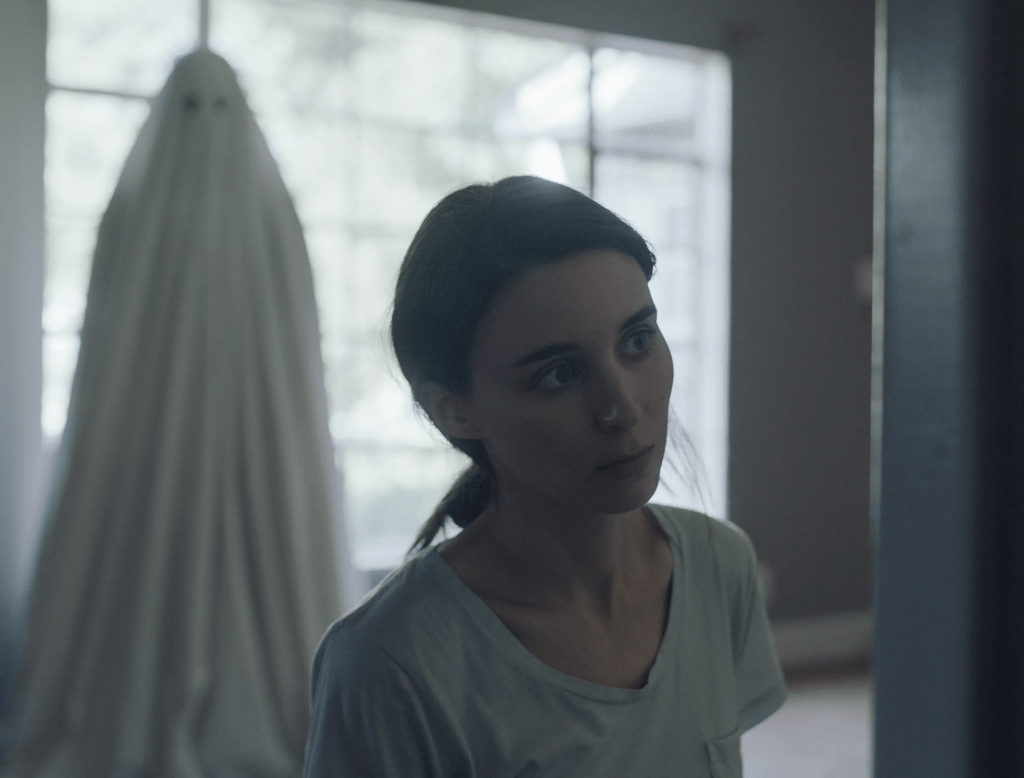
The films in the season are themselves explorations of what a home is, and how we form our relationships to it and the things and people who live inside it. ‘Home’ is looked at through three lenses. Carl Elsaesser’s Home When You Return (accompanied by a pre-recorded introduction) and David Lowery’s A Ghost Story open the season to look at Home as Memory. Although Elsaesser’s film is an experimental documentary, both it and Lowery’s film (which stars Casey Affleck and Rooney Mara) are tender attempts to understand the shadows we leave on our homes, how they stretch across space and time, how our memories and the tangible space feed and collapse into each other. They’re hushed revelations, but revelations nonetheless.
The second day, Home as Routine, pulls from video artists to create a selection of shorts—Living Inside dir. Sadie Benning, Underscan dir. Nancy Holt and Window Work dir. Lynne Sachs—followed by a poetry reading by the wonderful Bidhya Limbu and ending off with The Lacey Rituals. The experimental shorts programme is almost a journey through one person’s life, and how the meaning of Being Inside changes and shifts, particularly with relevance to queerness and womanhood. I’m so excited for Bidhya’s warm, gentle words to help guide us into the often odd Lacey Rituals. This was a part of Bruce Lacey’s “Human Behaviour” series—attempts to explain humanity to incoming Martian visitors. Whether the Martians would be able to piece together a cohesive picture of our species from this film is for you to decide.

Finally, Joyce Wieland’s fantastic short Water Sark opens the third evening on Home as Uncertainty, before we settle in to watch Like a Dog or a Boat, you tether it by Myles Wheeler, with whom I’ll be conducting a Q&A session to finish off the season. Both films here engage with how our relationship with the home is a shifting, moving thing; how there is always a new way to look at it, and how that reflects into our conceptions of ourselves. Wieland’s work is beautiful and almost mischievous in its use of lenses and glasses of water and mirror to distort the world through her eyes. I’m thrilled to be following it with Myles’s film, which I watch nearly every year since it came out and is so funny, warm and sincere.
For the season, we’ll be dressing The Horse Hospital up as a living room—a process of domesticating a venue already repurposed. Space is a living, breathing organism, just as film is. Audience members can bring their own tokens, swap them for those on the shelves in the room, explore and build and shape this living room as we take ownership of it for three evenings in celebration of the domestic and cinema. Elwes astutely notes how our own homes, once the template for the cinematic home, have become moulded in the image instead—”Aided by stylistic fragment, television doesn’t so much infiltrate domestic space as become fused with it” (204). Rather than resisting this fusion, I want to consider how we can swim with its tides, find a sense of control and community in the water.
If you’d like to join me in this endeavour, I’d love to invite you to our shared living room for the 18th, 19th and 20th of November at The Horse Hospital, for which tickets are available here now. You can keep up with the season and my other work on Instagram @kind.ofcuration.
References: Elwes, Catherine. “The Domestic Spaces of Video.” Expanded Cinema: Art, Performance, Film, edited by David Curtis, Duncan White, Steven Ball, Tate Publ., 2011, pp. 202-211.
Pranamika Subhalaxmi is a film curator and writer. Her work has been published in the Singapore International Film Festival Film Academy journal, as well as by Asian Film Archive. A graduate of the National Film & Television School’s Film Studies, Programming & Curation MFA, her curatorial interests lie in experimental cinema and exhibition, documentary, and work that is kind. She is in love with peopleness and commas.


Leave a comment