
by Billy Butler
“The cowboy is the archetypal American hero: in real life he conquered the West; in his celluloid form he conquered the world.” (Sandford, 1980, P.103)
The American western genre perhaps encapsulates all that Hollywood has become synonymous for; epic stories where men are ultra-masculine and women ultra-feminine and where good and evil exist on clearly defined planes with little to no room for grey area. Whilst this genre of Hollywood film traces a very specific history of America, it is notable how its influence is felt the world over in films that portray different cultures and histories. It is the intention of this essay to analyse the influence of ‘The western’ on renowned New German Cinema director Wim Wenders. By using his 1974 film Alice in the Cities as a primary text, with 1976 film Kings of the Road and 1984’s Paris, Texas as secondary texts, this essay will focus on masculinity in Wenders’s road movies whilst also examining how American pop culture is socially adopted into a post-Nazi Germany.
The western and the road movie relate to one another as if cousins; the influence of the western is found not just in the geographic aesthetics but in a road movies characterisation. In this sense, as Robert Phillip Kolker and Peter Beicken write in The Films of Wim Wenders: Cinema as Vision and Desire, “John Ford looms like a spectre.” (1993, P.28) The influence of John Ford’s filmmaking on Wim Wenders is not to be understated. Ford’s film The Searchers (1956) tells the story of Ethan Edwards as he hunts for his kidnapped niece in a post-civil war America. Most memorably the closing scene plays as Edwards decides to, as Kolker and Beicken state, “leave again for the desert, forsaking the dark, comforting warmth” (1993, P.28) of the family home. This idea of the self-tormented, self-exiled, male vagabond, that is so potent in the western – can be found in the work of Wim Wenders. It is as Kolker and Beicken go on further to say that Wenders’s films show “the modern male hero as lone migrant and wanderer, always displaced and only temporarily able to enter the realm of domesticity.” (1993, P.28) This is most evident in his 1984 film Paris, Texas in which the character of Travis, whom after being missing for four years, is reunited with his brother, sister-in-law and son and travels across country to reconcile with the mother of his child. Despite this reunion and the opportunity for familial bliss – he walks away and once again abandoning his family.
Although it is evident that Wenders is influenced by the illusive nature of the cowboys in westerns it is notable how a European road movie differs from the American and what is offered instead. As David Laderman writes in Driving Visions: Exploring the Road Movie, “Generally speaking, European road movies seem less interested than their American counterparts in following the desperately rambling criminal exploits of an outlaw couple; or, in romanticising the freedom of the road as a political alternative expressing youth rebellion. Rather, the exploration of psychological, emotional and spiritual states becomes more important to the Continental drive.” (2002, P.247)
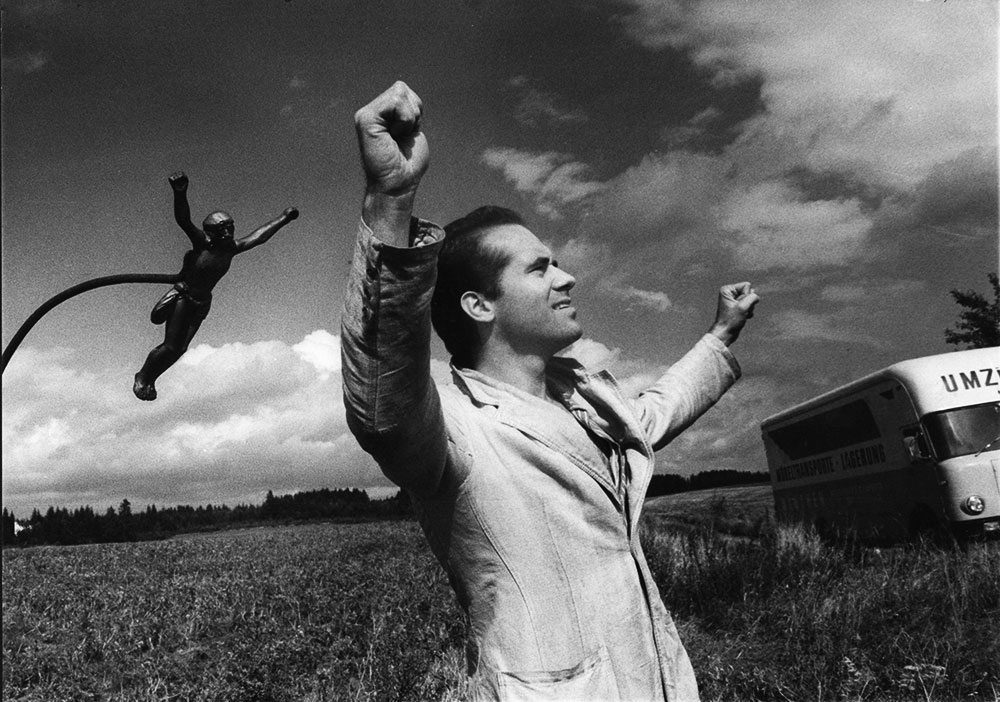
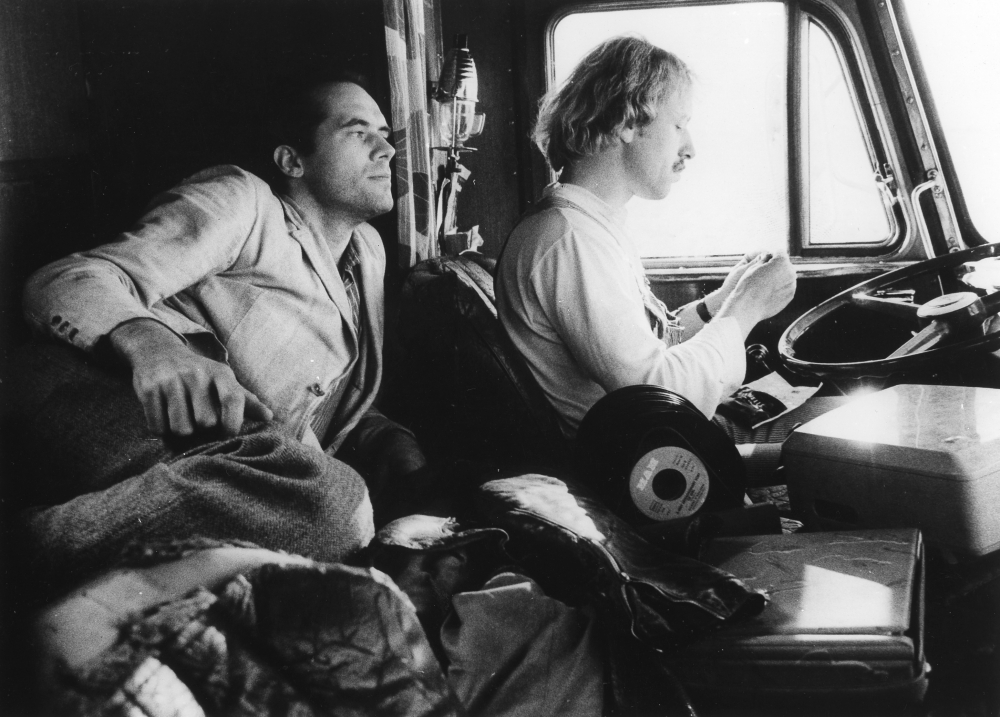
Wenders’ 1976 film Kings of the Road offers a far more subtle take on the road movie when compared with American road movies. There is no threat, no villain, no danger. Instead, the film follows two men become friends as they travel across Germany fixing cinema projectors. With the low stakes drama having a nearly three-hour runtime the film is drenched in scenes with little to no dialogue but instead the men bond as they listen to American rock and roll music in their van. In the absence of American tropes Wenders places American pop culture. As Inga Scharf writes in Nation and Identity in the German Cinema: Homeless at Home “due to the Nazis’ (mis)use of the [cinematic] medium, film and its spectators became estranged from one another.” (2008, P.33) This means to say that Germany, post Nazi rule, had a deep distrust of cinema due to the Nazi regime using it as a means to push their own propaganda. According to Beicken and Kolker, “Wenders comes from a generation who wilfully, perhaps inescapably, were born into a state of historical amnesia” with them stating that “the Germans had no body of images and narratives to struggle against.” (1993, P.29) This means to say that not only was their mistrust of German cinema but a willingness from the population to forget about the horrors of Nazi Germany. Wenders, who was born after the war had ended, grew up in a void of national identity and as such his films demonstrate a hybrid: European existentialism and contemplation mixed with American pop culture. As John Sandford writes in The New German Cinema “Wim Wenders is acutely aware, perhaps more so than any other German director, of American ‘cultural imperialism’ as an inescapable and fundamental fact of life in post-war West Germany.” (1980, P.104)
Wenders’ 1974 film Alice in the Cities perhaps best encapsulates this cross section of American cultural imperialism whilst also maintaining its strong European origins. It follows a German journalist who has been travelling around America trying to write a story but after suffering writers block and being sent back to Germany he finds himself the custodian of a little girl named Alice. They hop city to city around Holland and Germany desperately trying to find the little girl’s family and the two start to bond after initial tension. There is certainly more plot to this film as opposed to Kings of the Road, but the two share a lot in common (not least Rüdiger Vogler as the male lead). Silence and rock and roll are never far around the corner. The journalist, Philip, is another wanderer – never wanting to stay anywhere for too long and never truly impressed with where he is. Echoes of Ford’s Ethan Edwards ring out not just in this wanderer’s sensibility but also in how he takes on the responsibility of caring for somebody else’s child. Constantly flickering between indifferent, irritated, and caring for the young girl, Phillip for the first time has a sense of direction to his life – even if it is aimless. One could recognise this in Ethan Edwards who spends years of his life searching for his niece and when once found aimlessly walks out into desert. Beicken and Kolker write of Wender’s male protagonists that they are “mostly lower-middle-class men in a state of self-exile without secure emotional footing.” (1993, P.34)
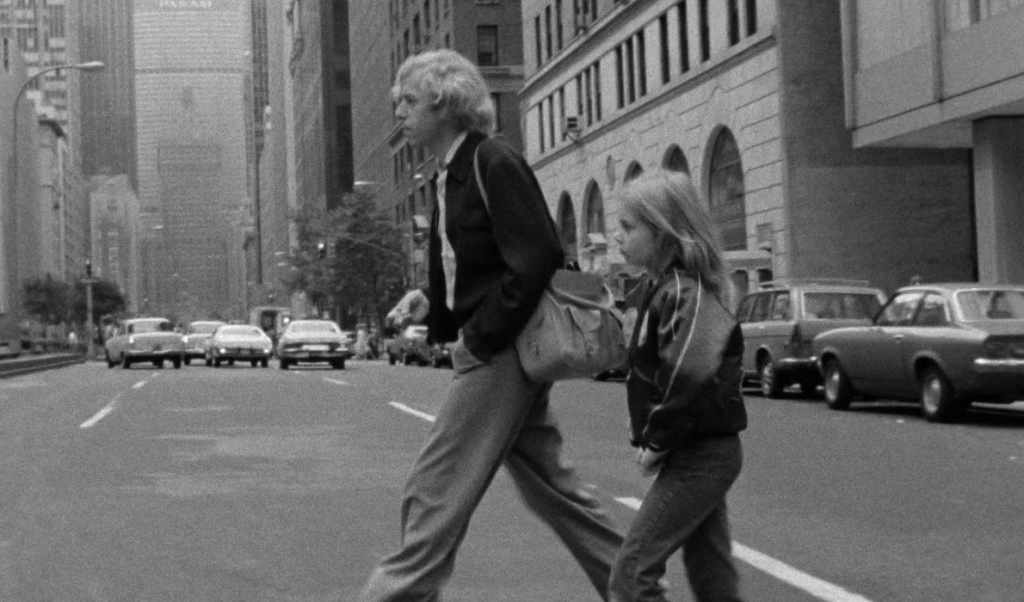
Alice has a scathing contempt for New York, where she first meets Philip, and longs to go back to Amsterdam. Having lived in numerous cities throughout her short life she seemingly would be something of a kindred spirit to Philip, who is also somewhat estranged from his family, but instead the opposite is true. Alice craves stability. It is the longing for home and family that speaks to a generation growing up in an amnesic West Germany as Beicken and Kolker write that Wenders “depicting his characters as uprooted and searching, Wenders addresses the loss they have suffered, a loss of home and identity that, for the most part remains hidden from the figures who have suffered it.” (1993, P.35) It becomes clear how Wenders shifting the focus to the interior thoughts and feelings of characters as opposed to a lawless adventure but still retaining the homesick self-exiled protagonist speaks to a whole society who feel adrift with no national identity.
Paris, Texas, on the other hand, is set in America with American actors; there is no mention of West Germany or national identity. This does not mean, however, that these principles are not still applicable – the character Travis is quite literally lost in the wilderness for four years and when he returns, he’s a quiet man who can’t fully remember what has transpired. It seems entirely likely that Wenders’ approach to storytelling remains unchanged even when the film is set in a different country and characters of a different nationality. As Laderman writes, “Paris, Texas inflects the American genre of rebellion and alienation with a foreign accent.” (2002, P.142) Whilst this statement goes towards the notion of Wenders influencing Hollywood genre filmmaking it is clear that an almost symbiotic relationship has occurred; Wenders is influenced by Hollywood and simultaneously Hollywood is influenced by Wenders. That being said, Wenders is not necessarily praising Hollywood as Alexander Graf points out in The Cinema of Wim Wenders: The Celluloid Highway, “Travis Henderson, representing as he does the average middle-class American male, is sent forth from a desert – an iconic, now dead and empty landscape that has come to symbolise the myth of Hollywood’s entertainment industry and, for Wenders, the death of the myth of Hollywood.” (2002, P.103) This would mean to say that Wenders, despite his Hollywood influences, remains critical and sceptical of the Hollywood machine; perhaps no wonder when considering the distrust of cinema in West Germany as Scharf spoke about.

The idea of cinema being something of a healing tool for the people of West Germany is something explored in Kings of the Road. In the opening scene, as the main character is fixing a cinema owner’s projector, it is revealed that the owner is a former Nazi. As Laderman writes “this sequence-shot prefaces the film’s journey with the horrific shadow of the Nazi-past, but also the reflexive theme of “fixing cinema.” (2002, P.260) Kings of the Road attempts to address Germany’s traumatic past – something West Germany had avoided. Kolker and Beicken write “[Wenders] is concerned as well with the cultural corruption that occurs when the past is ignored or dealt with uncritically.” (1993, P.35) We see then how the western’s cowboy, so often depicted as decisive and steadfast, would be something of an influence in cinema for a people that feel lost to themselves. As Sandford writes, Kings of the Road has “three interlinked concerns woven into it: the psychology of the two men, the fate of the German cinema, and the Americanization of German life.” (1980, P.110)
The Americanization of West German life can be felt across Wenders films in a multitude of ways – of course the rock and roll soundtracks but also in the fashion and even diet of the characters. For example, in Alice in the Cities, Alice wears an oversized bomber jacket, eating a large ice cream in a café, whilst rock and roll music play on a jukebox. It paints a picture of a failure of national identity as Alice, as previously mentioned, does not like living in America and yet so much of her identity is informed by America. This is where the notion of, as Scharf states, being “homeless at home.” (2008, P.202) Alice is somebody who longs for home without truly understanding what it is about home she craves. This is in opposition to her chaperone, Philip, who seemingly has given up on having a home – he has, like Ethan Edwards, untethered himself and is now wandering. His relationships with women are fleeting and unsubstantial; almost as if a hurdle to his day he must pass. Philip is someone who wants to rule his own life and the presence of Alice as a child who needs him to take care of her is something he most certainly wants to get away from; as Kolker and Beicken say “the narrative continues presenting Philip as a potentially depressive figure, alone in a foreign, empty landscape.” (1993, P.51) This perhaps best sums up the role of masculinity across these films – they are sullen men in transit.
The relationships these sullen men have with children however offers very different outcomes to the men in Alice in the Cities and Paris, Texas. It is firstly important to note that any notion of paedophilia is mute in these depictions; instead, children offer the salvation of these men. For instance, Philip having to care for Alice allows him to come out of his shell and gives him a purpose. Kolker and Beicken write “Given a story, Philip has direction; given a new role, Philip has purpose; with direction and purpose, Philip is relieved of his obsessive introspection. He is, in effect, put into a state of grace by the child, who offers him redemption.” (1993, P.52) Alice allows Philip to be a better person. It is also important to note how the film ends with the pair travelling back together on a train to meet her mother after Philip is given the opportunity to leave. We do not see the reunion and we do not see the farewell between Alice and Philip, instead – as Graf states the “second half of the film simply renews the trajectory of the protagonists’ movement from the first half of the film.” (2002, P.87) Their journey remains incomplete. Interestingly, Philip is reading a newspaper announcing the death of John Ford; again, “John Ford looms like a spectre.” (1993, P.28) In relation to the Ford’s character Ethan Edwards and Philip, Edwards abandons the child he spent so long looking for, leaving her with family as he turns to isolation.
Paris, Texas echoes this conclusion. Travis, after reuniting his son with the boy’s mother, leaves after only just returning from another self-imposed exile. Kolker and Beicken write of Travis’ initial introduction that he “is seen first as a child, inarticulate and withdrawn into an almost autistic state. He is a character ruined by the terrors of uncontrolled domestic violence, a modern-day Ethan Edwards.” (1993, P.56) This is an important point, Travis was an abusive partner which ultimately caused his family to fracture. On his return, his infantile behaviours make him unreachable to his young son who does not and cannot understand who he is and why he behaves the way he does. This is to the point that his son is almost parenting him as they hunt down the boy’s mother in their car. Travis is ignorant to consequence. Kolker and Beicken write that the son is “the idealized and idolized figure of the child redeemer […] enabling the father to become a healer of patriarchal wounds.” (1993, P.56) It is this that encapsulates the difference between the relationships with the children in the films. Alice offers Philip transformation whereas Travis must redeem himself. Once he reunites his son with his mother, he has done just that and like Ethan Edwards, he exiles himself to the jagged wilderness of America.
Of course, the children offer the vision of the New German Cinema movement; a Germany that acknowledges and has moved on from its horrific past. The children are something of aspirational figures to the adults who, according to Kolker and Beicken, “represent the self-possession and security [Wenders’] adult characters must work toward repossessing or keep from losing as they make their way in the symbolic realm of the inchoate world around them.” (1993, P.57) This means to say that the children in these films represent a certain idealism that Wenders wishes to see go forward into the next generation.
In conclusion, the western has influenced Wim Wenders in profound ways. Not only in its stylisation and the wandering nature of the genres protagonists, but he has also adopted it in order to articulate his political and social values. We see through Wenders’ films his vision for a Germany that confronts its own past. The archetypal masculine cowboy character, although distorted into more sullen men, articulates the idea of a generation that feel they have no identity, no direction, and no purpose. A film such as Kings of the Road actively encourages citizens of West Germany to confront their past and engage with the necessary healing; this is made clear in the attempts to ‘fix cinema.’ We also see how in Alice in the Cities America has dominated German culture through fashion, food, and music on a subconscious level. Despite this however we see how the “homeless at home” in West Germany can find purpose and direction, not only by connecting and engaging with younger people who offer a self-security that is lost on this generation but also, like in Paris, Texas by making the necessary steps to engage with one’s own past and make amends even if to the extent that you do not profit from it.
Bibliography
- Graf, Alexander. The Cinema of Wim Wenders : the Celluloid Highway. London: Wallflower Press, 2002. Print.
- Kolker, Robert Phillip., and Peter U. Beicken. The Films of Wim Wenders : Cinema as Vision and Desire. Cambridge [England] ;: Cambridge University Press, 1993. Print.
- Laderman, David. Driving Visions Exploring the Road Movie. 1st ed. Austin, TX: University of Texas Press, 2002. Print.
- Sandford, John. The New German Cinema. London: Wolff, 1980. Print.
- Scharf, Inga. Nation and Identity in the New German Cinema : Homeless at Home. New York: Routledge, 2008. Print.
Billy Butler (Instagram: bill.y.butler) is a freelance writer and film theorist based in Devon. Graduating from the University of South Wales in 2024, he is passionate about community-based film screenings as well taking interest in queer and gender based studies – especially representations of so called “toxic masculinity.”


Leave a comment