by Jesse Williams
Although every effort has been made to avoid triggers and spoilers, this article may contain light plot spoilers & tasteful references to self-harm/transphobia/sexual assault.

All images credit: Dark Star Pictures
Every year, as the end of summer looms, a swarm of horror fans descend upon Leicester Square for Frightfest, five days of supernatural cinema. This year, Culture Film Publication were lucky enough to catch the UK premiere of queer horror icon Alice Maio Mackay’s latest picture The Serpent’s Skin, a gothic, witchy lesbian love story.
To those unfamiliar with Alice Maio Mackay’s astounding career so far, the indie horror darling gained admiration from both queer and horror communities for crafting an incredibly coherent cinematic voice beginning at just age seventeen with her debut So Vam (Mackay, 2021). But to reduce Mackay to her age (like many publications have) would understate just how wise her filmography has been – these pictures are not impressive due to her age, they have been pivotal to defining the blooming trans cinema scene, with now frequent collaborator Vera Drew even titling her ‘my favourite living filmmaker’. Her most beloved work so far, T-Blockers (Mackay, 2023), a punky, genderqueer Bodysnatchers tale delved into transcoded cinema, practically laying the foundations for the much celebrated, and completely astounding, I Saw The TV Glow (Schoenbrun 2024). Two years later it is more relevant than ever, and to this day it stands as a powerful rally cry for artists to find strength against a violent wave of transmisogyny in the community & the history of trans cinema.
So entering her most recent film, it is fair to say expectations were high. This time shooting in the gothic style of 90s YA television, Mackay focuses on the tender lesbian romance that blossoms when Anna (Alexandra McVicker) meets Gen (Avalon Fast), two women bonded in supernatural abilities. The premise alone feels conjured in the same wheelhouse as The Craft (1996, Fleming), although this time supernatural ability is less a symbol for the coven-like high-school culture of late 20th century femininity, and more so symbolic for the inherent connection that binds queer identities together.
Like her prior works, queer friendship & community is in the foreground, yet there’s a notable tone shift present in Mackay’s most recent venture. As the narrative moves into genre territory, with Anna’s ex developing into a soul-sucking demon, it becomes increasingly clear that B-Movie shocks and thrills are somewhat backseated here, with tender heart taking centre stage. Without losing the Araki-esque, grungy edge synonymous with her filmography, she’s adopted a softer tone, and her stylistic direction has never felt so natural, even effortless.
‘Especially when you’re showcasing bigotry, you want to show the juxtaposition of love’ – Mackay speaking to CFP, 2025

Perhaps the film’s tonal control is best summarised by its most impressive sequence – we crosscut between straight and lesbian intimacy. The former violent, hedonistic, animalistic, as a demonic man literally feeds on the soul of a woman. Meanwhile the latter is tactile, ethereal, almost spiritual, the girls barely touch each other, using their supernatural queerness as a device for intimacy. The contrast is comical, tightly scored and very well cut by Vera Drew, but also speaks to a near masterful blending of contrasting tones: the sultry atmosphere of The L-Word (Showtime, 2004-2009) seamlessly melding into punky gothic haze.
There’s a tenderness to it all. The gentle sincerity of queer connection isn’t an easy one to capture onscreen, but McVicker & Fast’s chemistry is utterly irresistible. Anna is particularly compelling, playing a three-dimensional bisexual trans woman whose newfound confidence shocks her sister, a dynamic brought to life by McVicker’s soft-spoken performance hinting at an introverted past. Meanwhile Fast’s screen presence is intoxicating, the director-turned-actor bringing warmth and mystery in equal measures to the role of Gen.
‘I aimed to do something different from my previous work, and I wanted to make a film reminiscent of my early self watching Charmed, watching those Early 90s shows as a queer child’ – Mackay, 2025

Having dedicated such praise to The Serpent’s Skin as a lesbian love story, I do not want to turn off horror fans seeking grunge and gore. Mackay is still astutely cineliterate in horror, paying homage to everything from Hitchcock to Raimi. Scroungy practical effects and Buffy brow-bone prosthetics lend a gory texture, and rare moments of CGI lean into their own artifice, recalling an era of television in which fabricated graphics were a magic trick to be celebrated, not a device designed to be concealed & hidden. Likewise, the soundtrack compiles tracks from gothic favourite H3LLB6ND6R, while a genre-fluid score ranges from shoegazing punkyness to Hermann-esque strings, confirming Alice Maio Mackay operates at her finest when she is filtering queer expression, raw and urgent, through the cinema she loves.

But just like its gentle tone, Mackay’s thematic exploration feels more intimate than ever. That’s not to say there’s not a political voice, naturally any film loudly declaring itself in its opening credits as ‘A Transgender Film by Alice Maio Mackay’ is inherently political. But external politics are not a narrative hinge, they merely appear in playful moments, Aaron Schuppan’s camera lingers on Danny’s ‘Fuck Trump’ tattoo, and at one point Anna even uses her telekinesis to set a TERF rally poster ablaze. Violence towards trans people feels less like a narrative device and more like a subtle backdrop to the film’s true interest in the trans individuals themselves.
‘I wanted to make a film that centers a trans woman, but unlike T-Blockers this isn’t about her being trans, it’s about her falling in love’ – Mackay, 2025
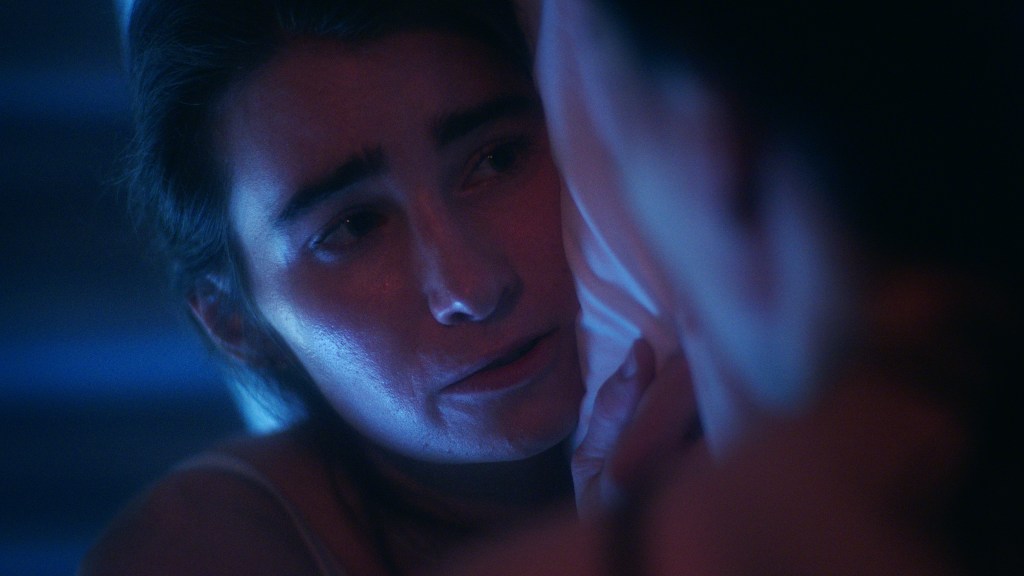
Like it’s YA horror references, a playful approach does not shy away from darker subject matter. Rather the contrary as we first meet Anna self-harming in her bedroom, immediately marking the film’s sociopolitical identity as an introspective one. Rather than focusing on violence directed towards trans and queer people from the outside world, The Serpent’s Skin turns inward, examining cycles of self-destruction within the queer community.
The demonic antagonist of the piece, whose destructive misogyny crescendos in increasingly distressing sex sequences, emerges from a dark part of Lex’s subconscious. While trans cinema exploring topics of self-destruction is nothing inherently new, it feels revelatory to see such delicate topics helmed by a trans director through the lens of spirited genre cinema, lighter than other trans works such as Castration Movie i (Weard, 2024) and I Saw The TV Glow (Schoenbrun, 2024) (intensely cathartic, empathetic masterpieces in their own right, but undeniably harsher experiences). As The Serpents Skin draws to a close, Mackay suggests that with queer love, in the face of violence, can bring self-destructive cycles to a close. As Lex asks, ‘What if something really terrible comes out of me next time?’, Ana replies, ‘Then we’ll deal with it’.
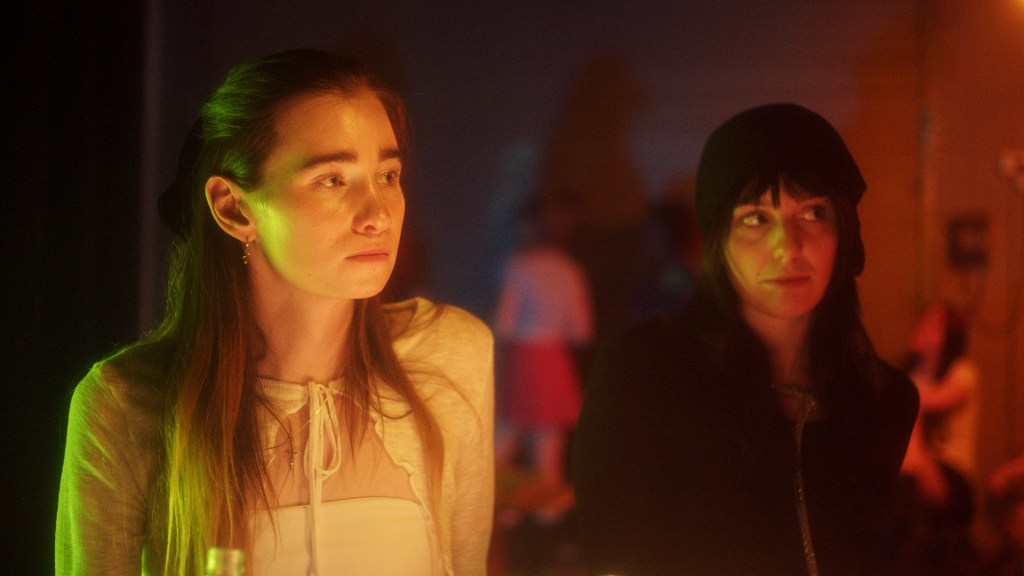
The end result is a sincerely mature work that I can see developing into a comfort for many isolated young queers seeking connection in cinema. Hearing a cishet male character say ‘That’s fine’ upon finding out a girl is trans will be a tonic for many trans women tricked into believing they are not worthy of love and intimacy by one hundred years of oppressive, transphobic cinema. But the real miracle here is that Mackay hasn’t lost a single ounce of the youthful genre playfulness that she cultivated in her early filmography. With this sense of creative evolution, I would not hesitate to call The Serpent’s Skin Mackay’s best yet, a worthy instalment into a modern wave of trans-helmed cinema, proving that the queers do (and always have done) it best.
Leaving the UK Premier at Frightfest 2025, I was left thinking ‘If Buffy and Charmed raised Mackay to make cinema this delightful, imagine the filmmaker that will evolve from a young trans girl watching The Serpents Skin?’. If this is the media that future queer generations will be raised on… then the kids are going to be alright.
Jesse Williams (instagram: @jessee_williams) is an author at Culture Film Publication. When she’s not delving deep into the depths of Queer cinema, she’s often found directing her own films!


Leave a comment