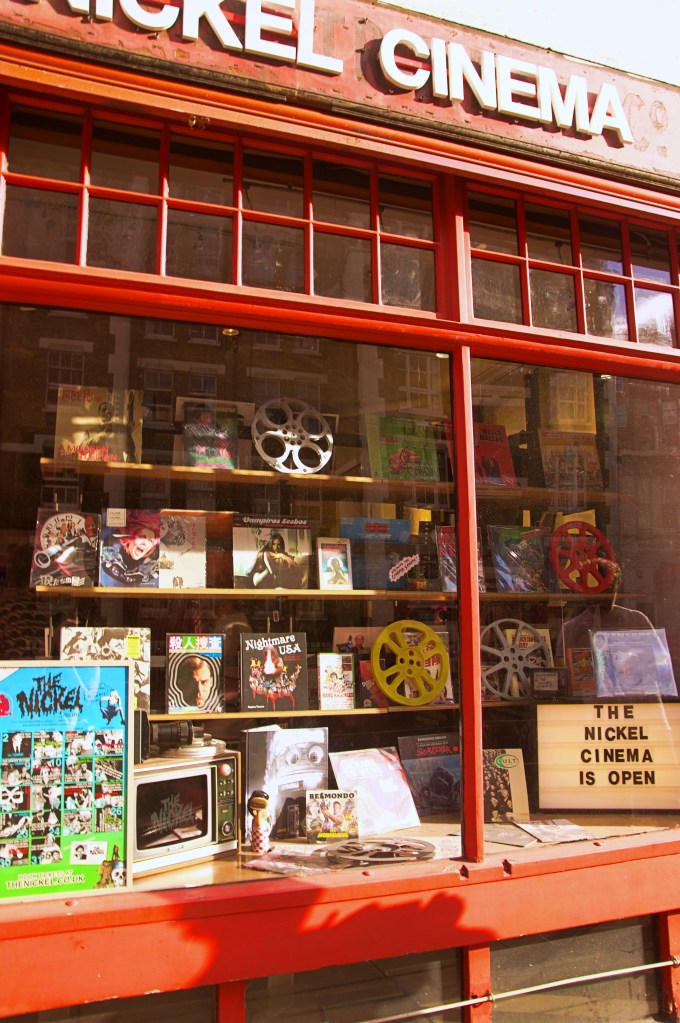
On a sunny day in late June, I went to visit The Nickel, a 37-seater micro cinema, media shop and basement bar in the heart of Farringdon. Run by filmmaker and cult film fanatic Dominic Hicks, The Nickel screens grimy underground oddities and essential cult classics alike on 16mm film, VHS and digital every week. We met to discuss all things The Nickel, physical media, shock value, streaming, David Lynch and more.
To start with the beginnings, what were your cult film awakenings? What kind of films and filmmakers gave that first exposure to you that you really wanted to pursue?
A rather mundane choice really, Quentin Tarantino. Watching RESERVOIR DOGS (1992) on video cassette at 13, which I think is the perfect age to watch Reservoir Dogs, blew me away. It was the first time I realised that there was an intertextuality at play, that a film could be about other films, and give you a spider map into other genres and artists. It got me into Godard because his narrative technique is stolen a little bit from that and THE KILLING (1956), the early Kubrick film, CITY ON FIRE (1987) which he copied the plot from and THE TAKING OF PELHAM 123 (1974) where he stole the names from. I wanted to pursue everything that came from that. Even more with KILL BILL (2003), a bible of genre cinema. That got me into everything from Lucio Fulci to spaghetti westerns. I watched things like GOKE, BODY SNATCHER FROM HELL (1968), the blood red sky behind her on the plane references that. It opened my eyes to a ton of esoteric weirdness. I’ll always be indebted because he opened the doors for me.
Can you walk our readers through the origin of The Nickel, its history with The Cinema Museum and different pop up screening locations?
I’ve worked as a filmmaker all my life, primarily in commercials, short films and music videos. But I wasn’t very fulfilled because it was taking something that I loved and turning it into a job.
I started to get the idea for this after going to theatres like Spectacle Theatre in Brooklyn, a micro cinema even smaller than ours. I went to their horror all day-er where they don’t announce the titles and you go at midday and thought ‘I wish we had something like that here’. It was from traveling to these theatres and feeling homesick about them when I had to come back to London. As much as we’ve got great cinemas here, I think there was a gap for something a bit more underground.
I cut together the trailer for The Nickel just because I just wanted to cut together moments from things I loved, almost a creative experiment. It just started to take shape. And then I started doing screenings at The Cinema Museum and The Bear Pub which sold out. I curated the pre-shows quite carefully with trailers and short films and I was quite nervous – you feel quite exposed when programming, like it’s telling everybody a lot about you. But I enjoyed it. Then put up a crowdfund, had a good response and we made about 15 grand – which created a situation where I couldn’t back down or out; I would have had to leave the nation in shame. It’s been a process of over a year looking for a space and now we’re here.
In your article with Celluloid Junkie, you said that you had advice from Jane Giles of The Scala. Can you tell us more about that?
Obviously I was aware of The Scala. I went to the premiere of their brilliant documentary at the BFI Southbank. I had settled on the idea, I was laser focused like never before in my life and was able to corner Ali and Jane at the end of the screening. I said I was trying to do this, and they were very kind. I’ll always be in the shadow of The Scala and what they did, I’m under no illusions. We’re just trying to capture a small bit of the magic of what that was.
Going back to The Cinema Museum, you put on a David Lynch memorial screening of ERASERHEAD (1977) with the free cigarette for a post-screening ceremonial smoke. Could you talk about the feeling of that screening?
Cinema is meant to be experienced together. I think that you’re only going to get a small percentage of the feeling from a film on your own on a laptop screen. The feeling of tension in the room when something like Eraserhead is playing, where one person might be laughing and someone else might be feeling sick, is really what it’s about. It’s something you could dispose of for the sake of convenience, but it’s key. Especially when somebody as magnificent and unique as David Lynch passes away, and everybody is indescribably affected by it because he’s been important to people. We showed a mixtape of Lynch moments and everybody laughed with him. There were some tears, and it was a moment to communally grieve about it, but also to celebrate it. There’s something about transgression that’s fun in cinema and doing something a bit naughty. Watch BLUE VELVET (1986) with an audience. You feel like you’re partied to a crime, everyone comes out feeling a little dirty. The idea of going behind the bike shed and lighting fags together is that feeling. A lot of new cinema chains are all about a sort of middle class experience with the comfiest seats imaginable or food available and it’s all very fucking boring really. I just don’t think that’s really what it’s about. It’s about getting in the muck together a little bit and sharing in the fun of it all.
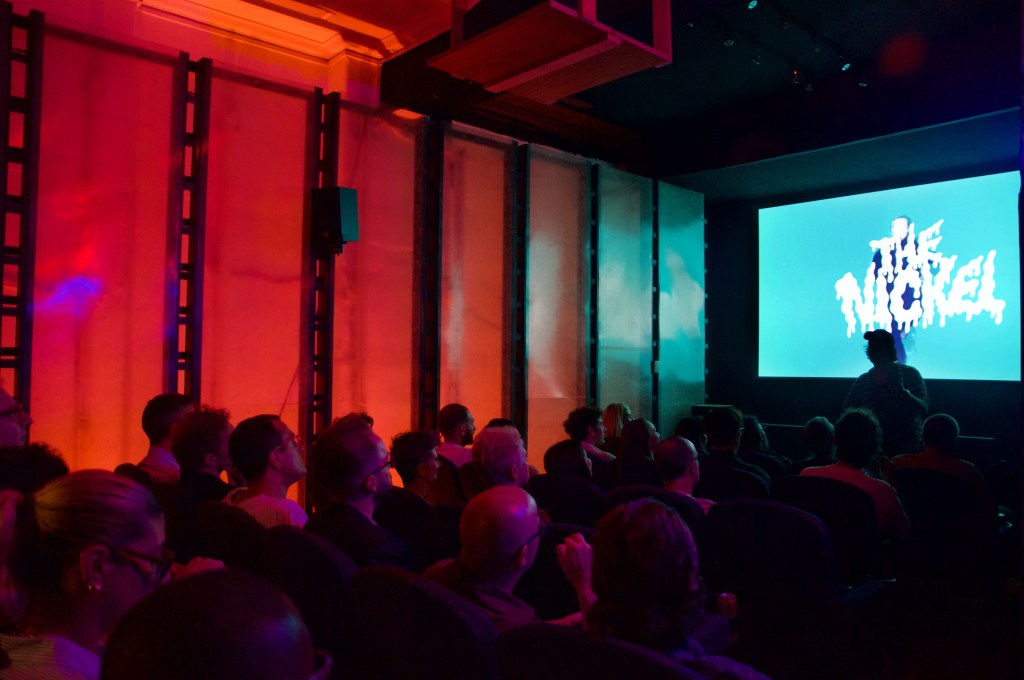
You announced the opening with the June inaugural program. Can you explain these picks? There’s quite a range, was that very intentional?
Yeah, I didn’t want it to feel like it was one thing or the other. It was important to mix the high brow and low brow, something that’s more critically esteemed rubbing shoulders with something that’s been critically panned. That juxtaposition makes it interesting. These early programs are like my wish lists that I’ve been building up for a long time, so what I wanted to show came easy to me.
CECIL B. DEMENTED (2002) was the first screening in the program. I want to ask why you chose this film to open with, and also, what’s the extent of the impact of John Waters career and legacy on you as The Nickel?
Well, he’s the Pope of Trash, isn’t he? He was the guy to show you that you could make films with your friends and non-professional actors, and it wasn’t about waiting for the right amount of money to come along or to make it perfect. It was just about getting it done. And that DIY approach you can also apply to the cinema. I work with my friends to build this place, and it’s not perfect or about having loads of finance. It’s just about getting it done. The same ethos of that kind of independent spirited filmmaking is in the bricks and mortar of this.
I think Cecil B. Demented is perhaps the most appropriate choice from his filmography given that it’s about rejecting ‘the man’ of movies, “Death to those who support mainstream cinema!”
I think when I was watching that, I sort of thought ‘shit, this has been me’. I don’t like the idea when you’re describing places like this, you say ‘community’ over and over again, it’s a bit of a dull word. It reminds me of a retirement home or milky tea. I quite like the idea of it being more of a cult. Cecil would approve. I think he’s definitely into cults. Yeah, a mad cult. And John Waters was very kind to do a little video blessing for us. He blessed the place as the Pope of Trash and called us the wildest grindhouse in London. It’s been amazing how many people I’ve been able to talk to because of this project. Like Buddy G, the director of COMBAT SHOCK (1986), and Jeff Lieberman, director of BLUE SUNSHINE (1977) and all these filmmakers and artists. When a filmmaker finds a place like this and we love them and their work and they love going to the movies, everybody’s a fan really when you take the money out of it all. Like John Waters is a movie fan, you know? We’re all just nerds really.
You also had the UK premiere of RATS (2023) on your inaugural June program. Is a mission of The Nickel to blend old and new by also supporting new cinema that is influenced by cult filmmaking and sensibilities?
I like to think so. There’s obviously good things being made. I love Rats, it has some John Waters to it, some REPO MAN (1984), a bit of Ren and Stimpy on PCP or something, all mixed up in a blender. We would love to have some involvement in people being creative and making new things too. We’d like to have workshops in our basement bar, people can learn how to shoot 16mm or join screenwriting groups and hopefully the community that we form here might end up making things as well.
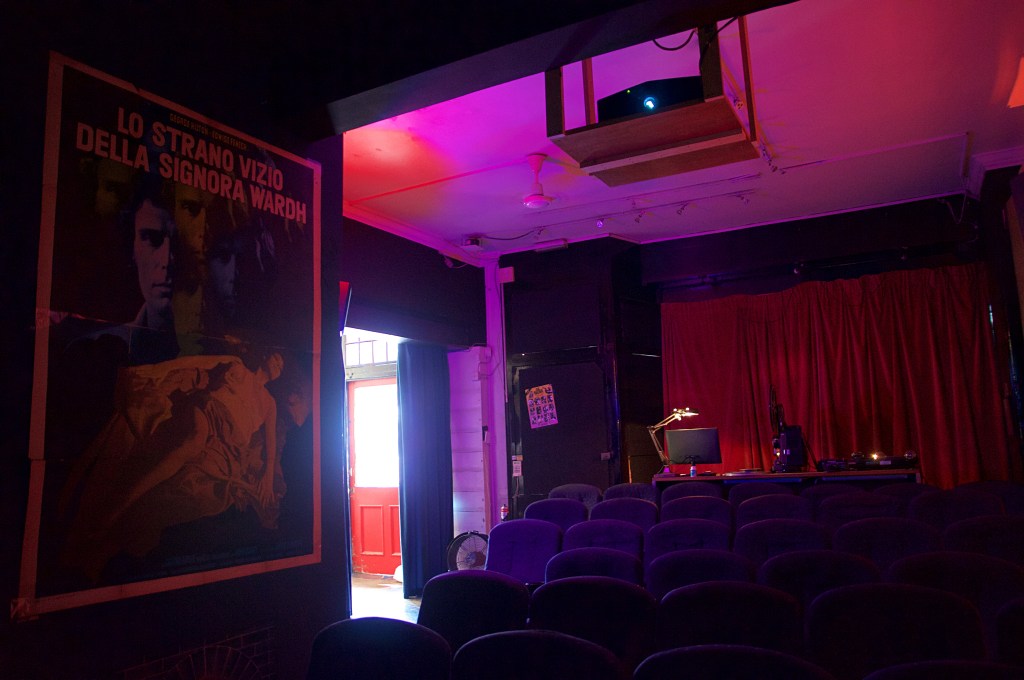
Some of these cult films have legacies where at some point they may have been dismissed as using ‘shock value’, and thus reduced to being sensationalist visions. Do you find that there is a more genuine value in shock that carries a purpose when it’s used ‘properly’?
That’s a good question. A lot of European films have shocking content in them. Bergman was the first filmmaker to have characters vomit on screen. Pasolini is extremely violent, sexual, perverse and excessive. But when European artists are making work like that, it’s considered arthouse. If Americans do it, it’s considered exploitation. There’s an interesting contradiction there. It’s a tough question. Hot take maybe, but I think that when you’re dealing with subject matter, for example, the Vietnam War and that era in American culture, it’s so violent and appalling that it demands to be expressed in a very forceful way. One of the best cinematic responses to Vietnam in a tangential way is THE TEXAS CHAINSAW MASSACRE (1974) because it’s about young Americans being plucked off one by one brutally, without any intelligence behind it in the same way that young people were drafted. It’s reciprocal with the violence that was on news footage coming in – that kind of violence did describe the time in American culture. Sometimes shock and excessiveness is an appropriate way to express something. COMBAT SHOCK (1984) is a great film about a returning Vietnam vet – you could do that film very subtly and it’s been done wonderfully with films like THE DEER HUNTER (1978). Combat Shock does it in an extreme way – and it was an extreme thing, Agent Orange, mass mental illness, trauma, the visceral nightmare that was the Vietnam War. And also without justifying it all in an intellectual way, it’s also just so much fun. Violence, sex and extremity in film is fun and no other art form can do violence like film can do. I don’t think we should be ashamed of sex or violence in film.
I personally feel with some films it would actually be disrespectful to the subject matter to not show the horrors of certain things.
Exactly. For example, with blaxploitation cinema, the vernacular being used, the violence, the racism in the South. BROTHERHOOD OF DEATH (1976) is about some black friends in a small southern town who get picked on by the KKK and then drafted to Vietnam. When they come back, they use the tricks that they learned from fighting the Viet Cong to take on the KKK. If you sanitise the story of racism in America, you’re playing the fiddle for the racists and for the oppressors. You’re cleaning up history and you’re making it more palatable, Oscar worthy and safe. The truth of it is it was disgusting and it was fucking hard to even read about, to see, to think about. I think you’re bang on. If you clean that up to make a tasteful film, you’re sort of hiding the truth of the matter.
You’re screening THE KILLING OF AMERICA (1981). Would you say the same thing applies to a film which uses real footage of violence?
That movie was made in Japan, financed by the Japanese government as a propaganda piece against America to deter people from travelling there. It wasn’t released in America for 25 years. No, I think America doesn’t deserve to be cleaned up. It is what it is. We’re allowed to watch death and destruction on the news or Tik Tok or X, but when watching it in a cinema as a film it’s suddenly subject to all these questions of taste. It’s a little bit like how people watch a sex scene in a movie like, “Well, that sex scene didn’t need to be in it. It didn’t further the story.” and then they go home and watch hardcore incest porn. It’s a bit of a hypocrisy. So I think let it all hang out. It might make us more healthy; repression is a cause of sickness. The more we push things away and compartmentalise it and just watch it on our phones in private, it’s a more sick thing than watching things in public and embracing the darkness of stuff with an audience, I think.
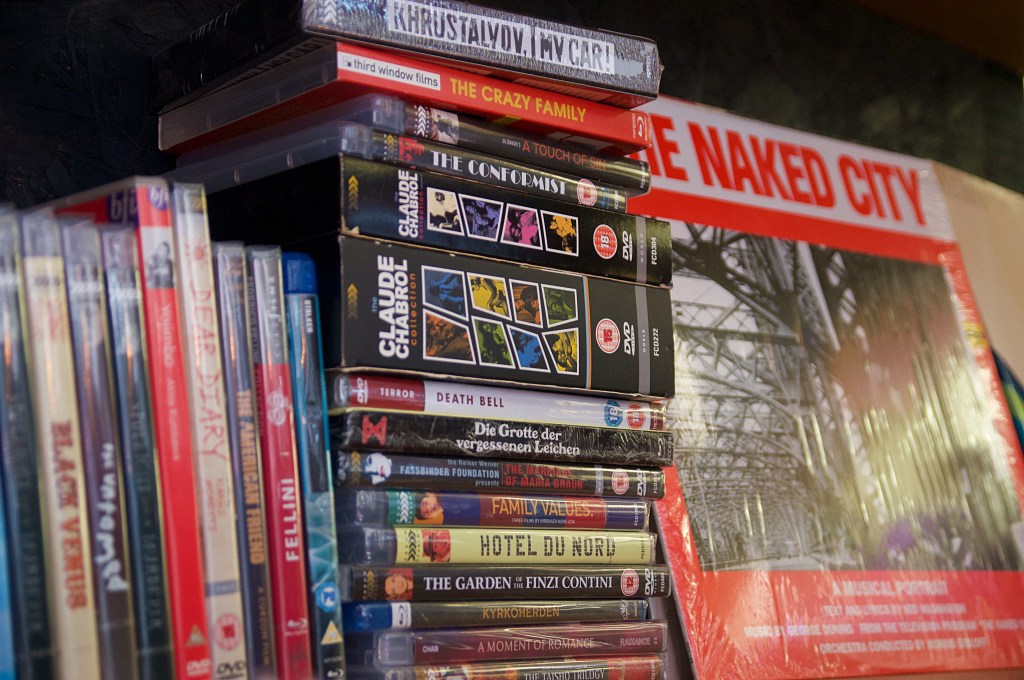
That’s very interesting. You sell lots of Blu-rays, VHS tapes and records. Why are you such a big advocate for the consumer owning physical media?
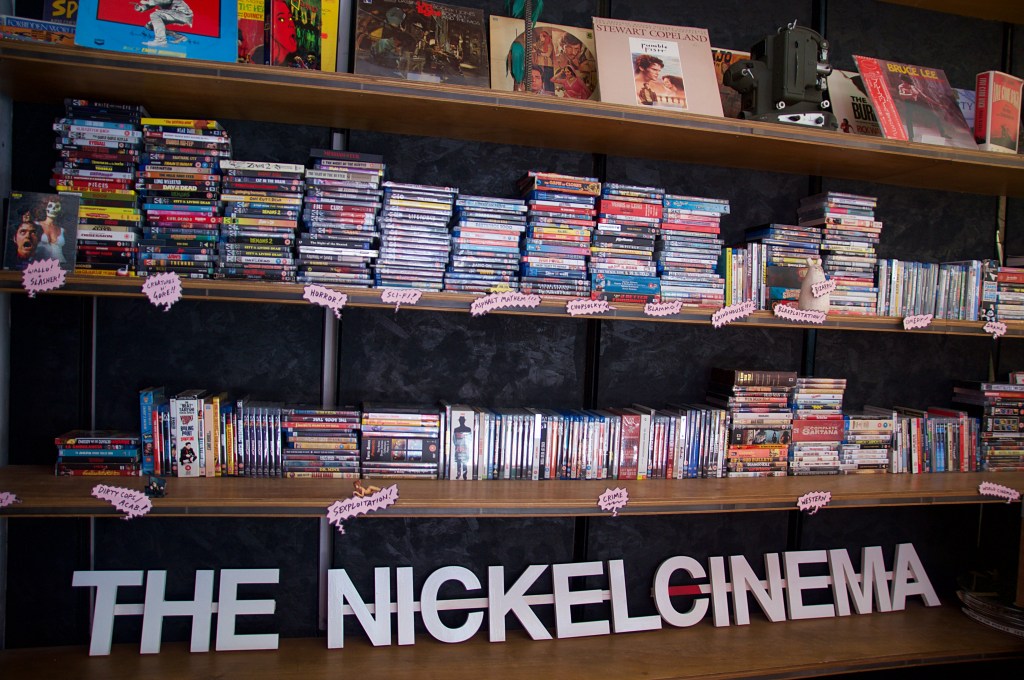
I’ve always been a collector, I love the tangible feeling of holding something in my hand. It sits on the shelf in the same way that people put art in frames, it’s a reminder of things that you love, and I can show you this book and you can leaf through it. It’s a way to share and experience things together that you can’t do digitally. And it’s a conversation starter. People come in here and someone will pick up Preston Sturges’ film and say, “Oh, I always thought Preston Sturges was overrated.” I’ll say, “No way.” And we have little debates. I was really lucky to visit Scarecrow Video in Seattle and go to the counter and say, “I’ve been waiting all my life to come here. Can you give me three recommendations?” And he really took it seriously. You come away with something to watch that you would never find through an algorithm, through ‘other customers also liked’, you get it right from a real person. You write it on your hand in a biro and go home and find it. It’s a lovely feeling of actual communication between people, of passing things along. Maybe I’m a romantic, but I think it’s much more powerful. I worked in a video shop when I was 20, ironically called Tomorrow’s World, and I got fired because I was loaning people my own DVDs for free.
You’ll be projecting 16mm film. What do you feel is so special about film in particular?
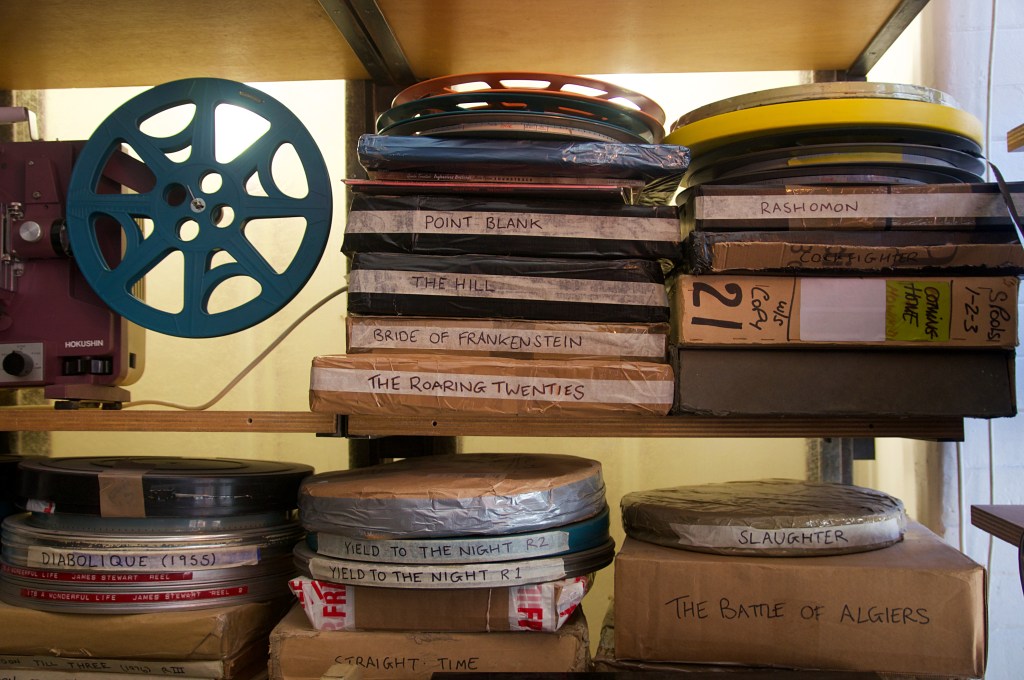
My take on shooting and projecting on film is that nobody can ever convince me that we’ve come anywhere close to the aesthetic quality of film. I know a lot of filmmakers who are not nostalgic because they appreciate the practicality, and I think digital is the correct medium to tell the story of this quite ugly time. I most admire the filmmakers who are using phones to tell the stories of today. But when it comes to the look and the feel, there’s nothing made on digital that stands up to the way TAXI DRIVER (1976), THE TEXAS CHAINSAW MASSACRE (1974), or George A. Romero’s MARTIN (1977) looks – the grain and colour, it’s poppy and bright. The colour that comes out of these prints that I have, you can’t really do it on digital. I don’t think anybody’s come close to making something that genuinely looks like film. For me it’s a preference. And new film processing plants are being built, just like vinyl factories – It’s never going to go away.
You repeatedly state on your graphics, “SAY NO TO THE NETFLIX DISNEY DEATHMACHINE”. Can you tell me a little bit about the reasoning for your firm stance on streaming?
I don’t have any. Netflix is just another tool, but the dangerous thing about it is that it gives people the illusion of choice, of having everything at their fingertips. Firstly, the selection is extremely limited. When I had Netflix, I typed Burt Reynolds and they had one film. He made over 100 films. Secondly, I think it disengages people’s natural curiosity. They get fed things rather than choosing. There’s a creativity and an art in how you curate your own experience, in following your own passages of interest. Streaming services take that away by feeding you things – you’re not making active decisions, creating a depressing conformity of experience. I also resent that there’s no real moment where a film comes out if it just leaks out on streaming. I remember when TRAINSPOTTING (1996) released, everybody went to see it, had the poster for a while, and had the soundtrack. It was a moment in time. To me, it takes the magic out of it. And they’re making films, which is very troubling. I don’t like the idea that Amazon, a fucking awful tax avoiding corporate structure, is going to own James Bond. We know enough about these tech giants now, don’t we, with Elon Musk, that they can’t be trusted with an important art form. Can we give those people film to look after and to preserve and to make? I don’t think so.
Big question. Why is this all so important to preserve? Sometimes when talking to people about these things I’m met with “But why? It’s just movies.” What would you say?
Everybody knows that we’re at a crisis point in human history. There’s a lot of very important things going on in the world that are very upsetting, worthy of attention, anger and fight. And you can’t always make an impression on things. There’s a line in ADAPTATION (2002) by Charlie Kaufman, about whittling the world down to a manageable size. When you choose your passion or your thing that you care about the most, you can whittle everything down to a manageable size and then you can fight that corner. There’s much more important things going on in the world than cinema or the future of cinema. But I choose that little battle. I think people should whittle their lives down to something they care about and can make an impression on because otherwise you’re just paralysed by the enormity of everything, aren’t you? The complexity of everything that’s wrong in the world. Even if it is trivial or small, try to make a difference there. And ultimately, you do it because you love it.
The Nickel is open now at 117-119 Clerkenwell Road, London EC1R 5BY. Check out the programme, opening times and more information here.


Leave a comment